 en
 中文简体
 русский
 Español
 Deutsch
 Polskie
 REQUEST A QUOTE

 Home / Author / Saskia Wen — Regional Sales Executive / Advanced Sports Equipment Molds for Consistent, Durable, and Efficient Production
Advanced Sports Equipment Molds for Consistent, Durable, and Efficient Production
Content
- 1 The Role of a Sports Equipment Mold in Product Quality
- 2 Why Aluminum Is Widely Used for Sports Equipment Tooling
- 3 Forged Aluminum Alloy for Higher-Performance Molds
- 4 Product Advantages Compared with Conventional Tooling Solutions
- 5 Advanced Manufacturing Process for Sports Equipment Molds
- 5.1 1. Product Review and Requirement Confirmation
- 5.2 2. Product Structure Optimization
- 5.3 3. Three-Dimensional Modeling and Mold Design
- 5.4 4. Casting or Forging Preparation
- 5.5 5. Precision Computer Numerical Control Machining
- 5.6 6. Surface Treatment and Finishing
- 5.7 7. Assembly, Inspection, and Mold Testing
- 5.8 8. Sample Validation
- 5.9 9. Final Quality Inspection and Delivery
- 6 Manufacturing Strengths and Integrated Technical Capabilities
- 7 Applications Beyond Dumbbell Plate Molds
- 8 Material Selection for Different Production Objectives
- 9 How to Improve Mold Service Life
- 10 Quality Control from Design to Delivery
- 11 Choosing a Reliable Sports Equipment Mold Manufacturer
- 12 Frequently Asked Questions
- 12.0.1 Q1: What material is generally suitable for a dumbbell plate mold?
- 12.0.2 Q2: Why is aluminum commonly used for rotational molding molds?
- 12.0.3 Q3: Is sand-cast aluminum suitable for high-volume production?
- 12.0.4 Q4: What information should a customer provide before mold design begins?
- 12.0.5 Q5: Can a sports equipment mold be customized for different sizes?
- 12.0.6 Q6: How does trial molding improve the final result?
- 12.0.7 Q7: What makes a durable playground equipment mold reliable?
- 12.0.8 Q8: Can the molds operate with electric-heated rotational molding machines?
- 12.0.9 Q9: Does mold surface finish affect the finished sports product?
- 12.0.10 Q10: What services are available during a complete mold project?
- 13 Conclusion
- 14 References
- 15 Product: Sports equipment mold
Sports equipment manufacturers face increasingly demanding requirements for product quality, dimensional consistency, appearance, production efficiency, and long-term durability. Fitness products must withstand repeated handling, outdoor exposure, mechanical stress, and constant market comparison. Whether the product is a dumbbell plate, a hollow fitness accessory, an outdoor exercise component, or a large recreational structure, the quality of the mold directly influences the quality of the finished product.
A sports equipment mold is not simply a cavity used to form plastic or metal. It is a precision-engineered production tool that controls product geometry, wall distribution, surface finish, parting lines, demolding, heating, cooling, and repeatability. A properly designed mold helps manufacturers achieve stable dimensions from one production batch to the next while reducing waste, rework, and downtime. It also allows sports equipment companies to develop customized shapes and sizes that differentiate their products from competing offerings.
For dumbbell plates and many other sports products, aluminum is an especially effective mold material. Sand-cast aluminum provides flexibility, manageable weight, useful thermal conductivity, and practical customization. Forged aluminum alloy can provide an additional level of strength, dimensional stability, and long-term service performance when production conditions are more demanding. The correct choice depends on product geometry, expected output, heating method, surface requirements, and mold operating conditions.
Jiangsu Zhroto Mould Co., Ltd. specializes in rotational molding mold design, manufacturing, product processing, and integrated technical support. Since its establishment in 2015, the company has developed a complete workflow covering product evaluation, structural optimization, three-dimensional modeling, mold design, precision computer numerical control machining, trial molding, sample validation, final inspection, delivery, and technical assistance. This integrated approach enables customers to receive a mold solution that is matched to the product and production process rather than an isolated tooling component.
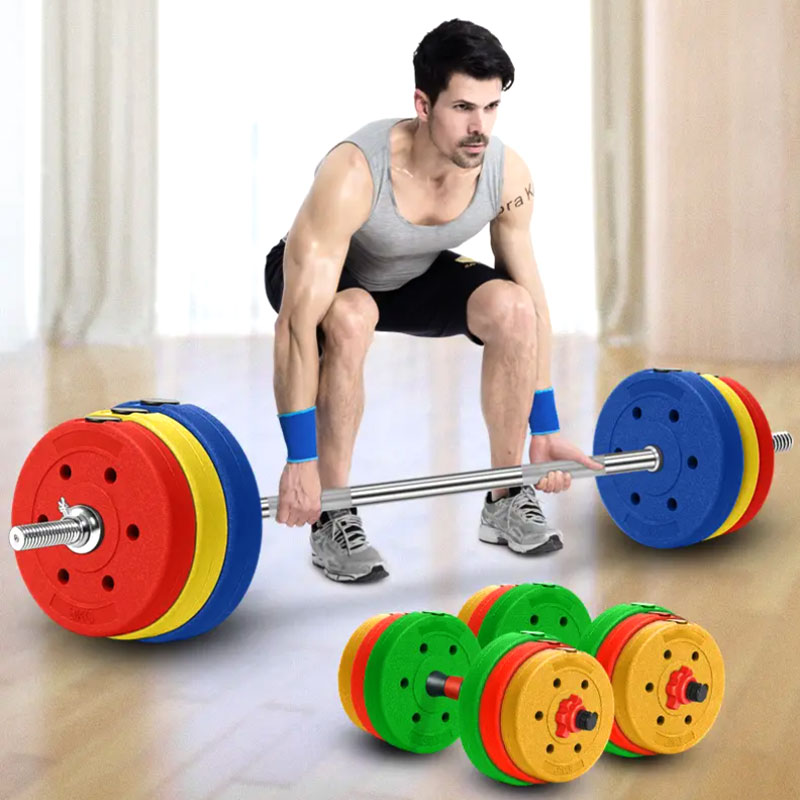
Sports equipment mold
The Role of a Sports Equipment Mold in Product Quality
The mold is one of the most important assets in sports equipment manufacturing because it determines the basic form and repeatability of every finished component. A minor error in a cavity, parting line, vent, or surface can be reproduced across hundreds or thousands of products. Conversely, an accurately designed and carefully manufactured mold can provide stable production performance over a long service life.
For dumbbell plates, the mold must maintain the intended outside diameter, thickness, central opening, edge profile, and overall balance. Variations in these features may affect the appearance of the plate, its compatibility with bars or storage systems, and the user’s perception of quality. In commercial gyms, rehabilitation facilities, home fitness environments, and sporting goods stores, consistent product dimensions are essential.
The mold also affects the surface condition of the finished product. A smooth, properly treated cavity can produce a cleaner and more attractive surface, while an unsuitable surface may cause defects, unwanted texture, difficult release, or excessive finishing work. When the product requires logos, raised markings, recessed lettering, grip features, or decorative patterns, these details must be incorporated into the mold design with appropriate machining accuracy.
Rotational molding introduces additional considerations. Plastic powder is placed inside the mold, and the mold is heated while rotating around multiple axes. The material melts and gradually coats the internal cavity. As the mold continues to rotate during cooling, the plastic forms a hollow product with the desired geometry. The mold must therefore support even material distribution, reliable heat transfer, effective venting, and controlled cooling.
A well-engineered sports equipment mold contributes to:
- Stable product dimensions and repeatable geometry.
- Consistent wall thickness and material distribution.
- Smooth and attractive surface finish.
- Reliable demolding without damaging the product.
- Efficient heating and cooling during rotational molding.
- Reduced waste, rework, and production interruptions.
- Flexible customization for different sports equipment models.
- Long-term mold durability under repeated production cycles.
These benefits give manufacturers an important advantage over competitors that rely on poorly matched materials, limited machining control, or incomplete tooling validation. In a competitive market, a mold that improves consistency and reduces production problems can influence product quality, delivery reliability, and overall manufacturing cost.
Why Aluminum Is Widely Used for Sports Equipment Tooling
Aluminum is widely selected for rotational molding applications because it offers an effective balance of weight, thermal performance, machinability, and adaptability. Large molds can be difficult to install, remove, inspect, and maintain when they are made from excessively heavy materials. Aluminum helps reduce handling demands while still providing the strength required for many sports equipment applications.
Thermal conductivity is another important advantage. During rotational molding, the mold must transfer heat efficiently to the plastic material inside the cavity. A material with suitable heat transfer characteristics can support more predictable melting and coating. This is particularly valuable for products with curved sections, varying wall requirements, deep recesses, or complex hollow structures.
Aluminum can also be machined and finished according to the product’s design requirements. Manufacturers may request different cavity textures, polished surfaces, functional ribs, logos, mounting features, or special parting-line arrangements. Aluminum tooling can be adapted to these requirements without making the mold unnecessarily difficult to handle.
Material selection should nevertheless be made through engineering evaluation rather than by choosing aluminum automatically. The mold designer must consider the final product, the expected production volume, the heating system, the required service life, the size of the mold, the desired appearance, and the anticipated handling conditions. Sand-cast aluminum may be ideal for many customized dumbbell plate molds, while forged aluminum alloy may be more appropriate for high-performance tooling or demanding production schedules.
Sand-Cast Aluminum for Customized Dumbbell Plate Molds
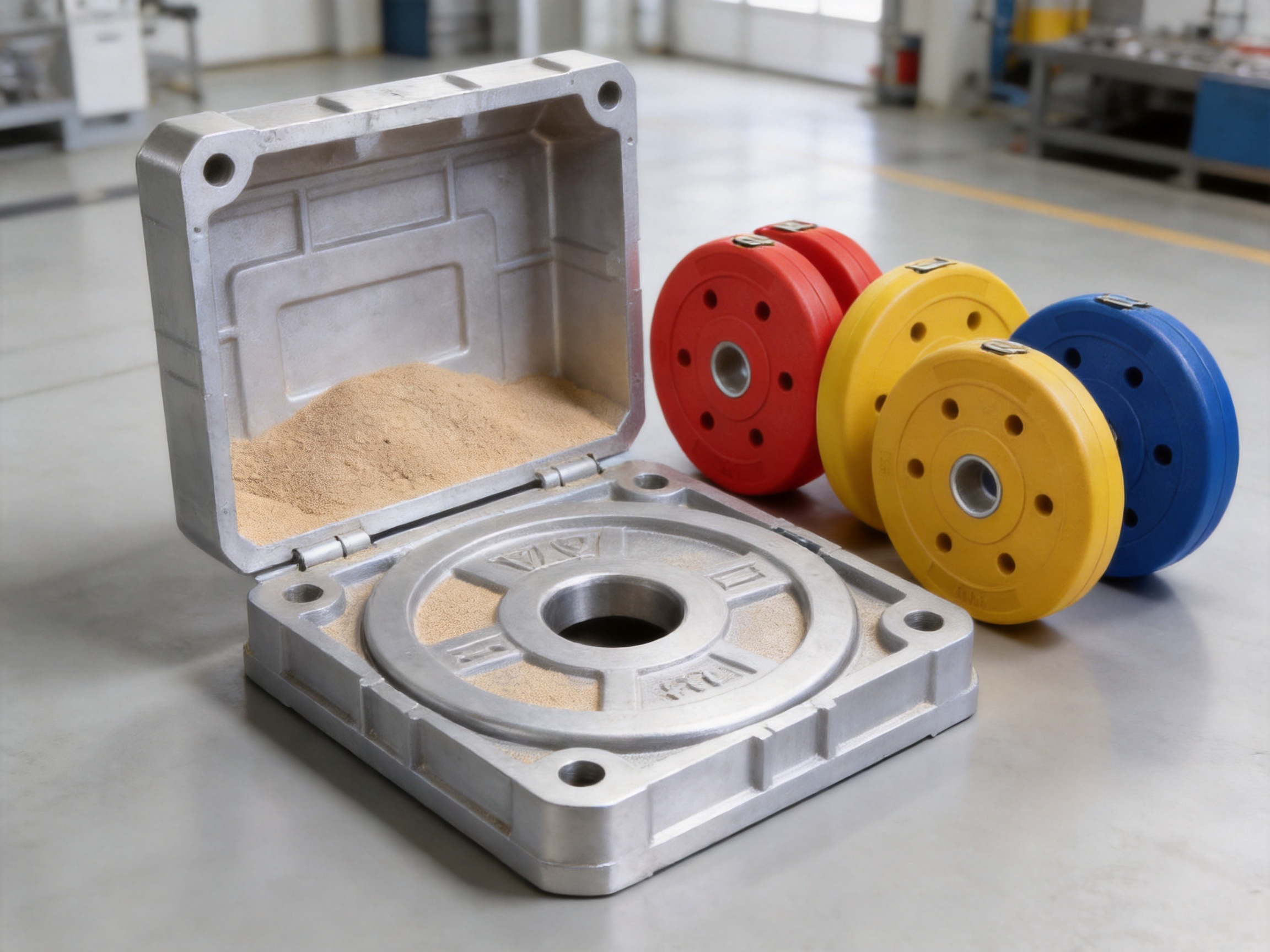
Sand-cast aluminum is a mature and practical material for producing dumbbell plate molds. The casting process allows the mold to be formed as an integrated structure, reducing the need for complex assembly in applications where a unified cavity is preferred. It is suitable for a range of plate sizes, thicknesses, edge profiles, and product configurations.
One of the most important advantages of sand-cast aluminum is its customization potential. Dumbbell plates may vary significantly in diameter, weight, thickness, central opening, handle design, edge geometry, and visual appearance. Manufacturers may also require a family of related products that share a design language but differ in size. A customized sand-cast mold can be developed according to product drawings, three-dimensional data, samples, or specific production requirements.
Sand-cast aluminum provides a useful combination of thermal performance and manageable weight. This can simplify mold installation and removal, particularly when production requires frequent changes between different product specifications. Operators can inspect and maintain the mold more efficiently, while production managers can reduce the physical burden associated with large or repeated tooling changes.
The casting process also supports integrated construction for certain product forms. This may reduce potential alignment problems between multiple mold sections and provide a stable foundation for subsequent machining. After casting, important functional areas can be processed using precision equipment to achieve the required cavity dimensions, parting surfaces, holes, inserts, and surface details.
However, the quality of a sand-cast aluminum mold depends heavily on the complete manufacturing process. Casting quality, allowance planning, machining accuracy, surface treatment, inspection, and trial molding must all be controlled. A capable manufacturer does not rely on casting alone. Instead, casting is combined with engineering review and precision finishing to create a production-ready mold.
Advantages of Sand-Cast Aluminum Tooling
- Suitable for customized product dimensions and shapes.
- Relatively low weight compared with many alternative mold materials.
- Useful heat transfer for rotational molding applications.
- Practical for integrated mold construction.
- Adaptable to different dumbbell plate designs and product families.
- Convenient for installation, inspection, and routine maintenance.
- Compatible with surface finishing and cavity detail requirements.
- Balanced tooling investment for many standard and customized products.
These characteristics make sand-cast aluminum a strong choice for manufacturers that need flexible tooling without sacrificing product quality. It is particularly useful when a company must produce multiple models, test a new product design, or respond quickly to changing market preferences.
Forged Aluminum Alloy for Higher-Performance Molds
Forged aluminum alloy is an alternative for customers seeking higher material performance, stronger structural characteristics, and greater dimensional stability. The forging process can produce a more robust material structure, making forged aluminum attractive for molds that will experience repeated heating and cooling, frequent handling, or demanding production schedules.
Compared with sand-cast aluminum, forged aluminum alloy is often selected when the customer places greater emphasis on long-term service performance and material strength. It may be suitable for high-quality fitness equipment, premium product lines, large production programs, or molds that must maintain stable geometry through repeated thermal cycling.
Forged aluminum can also support detailed machining and surface finishing. This is important when the final product requires precise dimensions, clear visual details, controlled surface texture, or a polished appearance. A stable and accurately machined cavity helps reduce product variation and improves the consistency of different production batches.
The decision between sand-cast and forged aluminum should not be based only on material price. It should consider the entire operating environment. Important questions include how many products the mold is expected to produce, how often it will be heated and cooled, how large and heavy the finished mold will be, how much handling it will receive, and what level of dimensional accuracy the product requires.
For example, a small or medium-sized dumbbell plate mold intended for moderate production may perform effectively with sand-cast aluminum. A premium fitness product manufactured continuously in multiple shifts may justify forged aluminum alloy because its long-term stability and strength can support more demanding conditions. Engineering evaluation helps prevent both under-specification and unnecessary overspending.
When Forged Aluminum May Be the Better Choice
- High production volume and repeated mold cycling.
- Strict dimensional stability requirements.
- Premium fitness equipment with demanding appearance standards.
- Frequent mold handling or mechanical loading.
- Complex cavity details requiring precise machining.
- Long service life expectations.
- Products requiring stable quality across many production batches.
Forged aluminum does not eliminate the need for careful design. The mold structure, heating conditions, cooling process, parting lines, venting, surface treatment, and inspection standards remain important. Material quality can support performance, but the final result depends on the complete tooling system.
Product Advantages Compared with Conventional Tooling Solutions
A professionally engineered sports equipment mold provides several advantages over basic, poorly customized, or insufficiently validated tooling. These advantages are especially clear in applications where product appearance, dimensional repeatability, and production efficiency influence purchasing decisions.
Improved Dimensional Consistency
Consistent dimensions are essential for dumbbell plates and other sports products. The mold cavity must be accurately produced and maintained so that each product remains within the required tolerance. Stable dimensions support product interchangeability, packaging, stacking, storage, and compatibility with other fitness accessories.
Dimensional consistency also improves customer confidence. A buyer who purchases several plates or accessories expects them to look and perform like a unified product set. Variation in diameter, thickness, edge shape, or central opening can create an impression of poor manufacturing quality. Precision mold design and inspection help reduce this risk.
Better Surface Finish
The surface of a sports product communicates quality before the product is used. A clean and uniform surface can improve visual appeal, support branding, and reduce the need for secondary finishing. Mold surface treatment, cavity machining, polishing, and texture control all influence the final result.
For products used in gyms and public facilities, surface quality may also affect cleaning and maintenance. A well-controlled finish can reduce unwanted irregularities where dirt or moisture might accumulate. For outdoor equipment, appropriate surface characteristics can support durability and appearance under exposure to changing environmental conditions.
Flexible Customization
Mass-market sports equipment is no longer limited to a small number of standard shapes. Manufacturers increasingly develop products for home fitness, professional training, rehabilitation, children’s recreation, outdoor exercise, and specialized sports programs. Each market may require a different shape, size, grip, marking, or structural feature.
A customized mold allows the product to be developed around the intended user and application. It can incorporate brand-neutral design details, functional recesses, reinforced sections, ergonomic features, mounting points, or product identification elements. This flexibility allows manufacturers to compete through product differentiation rather than price alone.
More Efficient Mold Handling
Weight is an important operational consideration. Molds that are easier to move can reduce installation time and simplify production changeovers. Aluminum molds are often more manageable than heavier alternatives, particularly when operators must inspect, clean, adjust, or store multiple tools.
Improved handling may also contribute to workplace safety. When mold movement requires less lifting force and fewer complex handling procedures, the risk of accidental damage and operator strain can be reduced. The final handling method must still be determined according to mold dimensions and workplace equipment.
Reduced Production Risk
Production risk can arise from inaccurate dimensions, poor venting, ineffective demolding, weak mold structures, inconsistent heating, or inadequate trial validation. A complete engineering workflow addresses these issues before mass production begins.
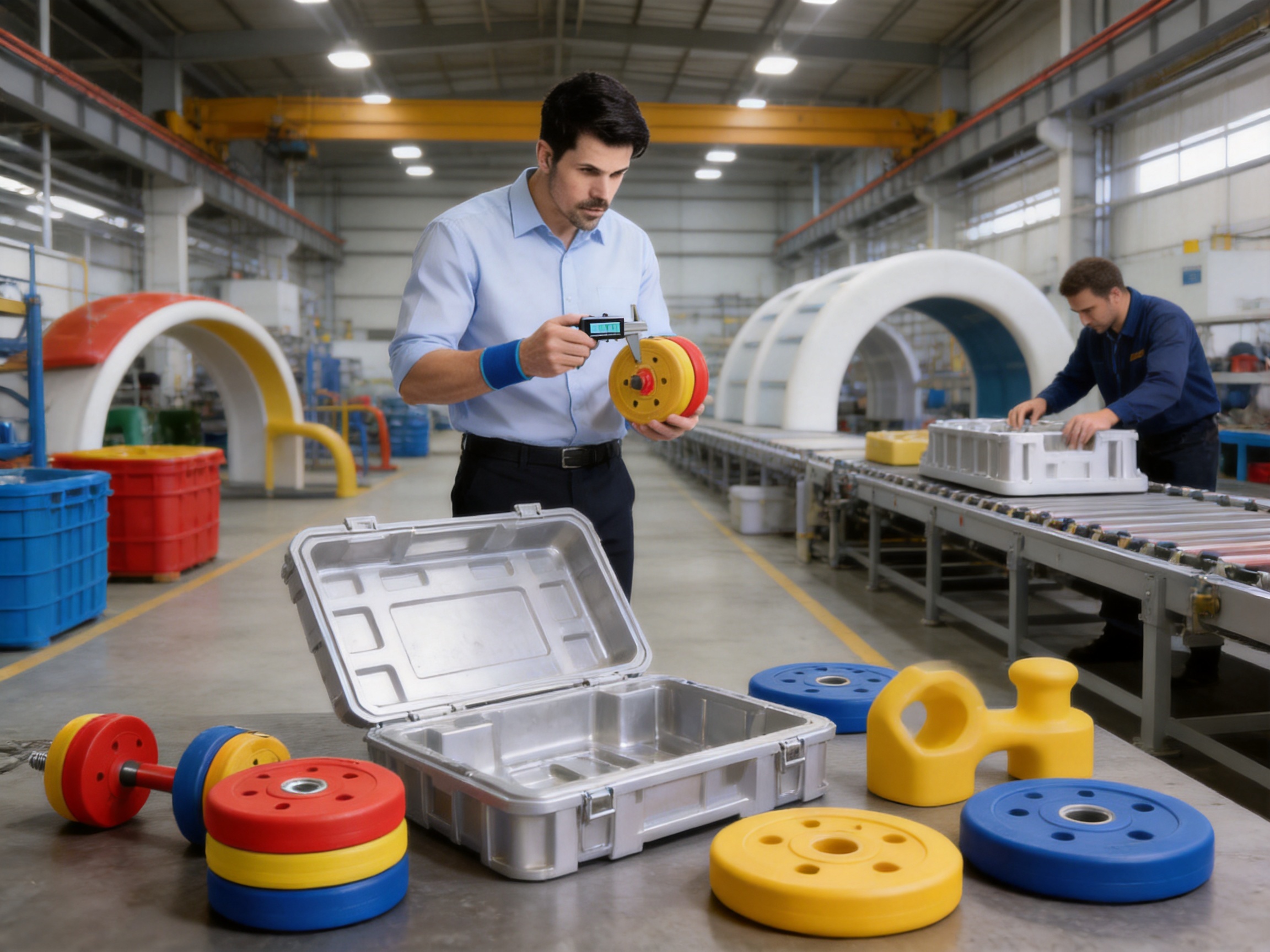
Trial molding is particularly valuable. It allows the manufacturer and customer to examine the product under actual or representative production conditions. The sample can be checked for size, shape, surface quality, wall distribution, release performance, and appearance. Adjustments can then be completed before final approval, helping prevent costly problems after the mold enters full production.
| Tooling Type | Typical Material | Suitable Application | Primary Advantage | Important Consideration |
| Dumbbell Plate Mold | Sand-cast aluminum | Customized weight plates and compact fitness products | Flexible design, manageable weight, and practical thermal performance | Requires accurate machining and surface finishing |
| Premium Fitness Mold | Forged aluminum alloy | High-quality fitness equipment and demanding production programs | Strength and dimensional stability | Higher material and manufacturing investment |
| Large Outdoor Equipment Mold | Engineered aluminum | Playground components, outdoor fitness products, and large hollow structures | Adaptability to complex shapes and easier handling than heavier tooling | Requires reinforcement, thermal planning, and careful parting-line design |
| Prototype or Development Mold | Application-specific aluminum | New product testing and design validation | Supports rapid evaluation and product improvement | Production objectives should be confirmed before final material selection |
Advanced Manufacturing Process for Sports Equipment Molds
The manufacturing process begins with an understanding of the product and the customer’s production objectives. A mold cannot be designed effectively without knowing the product’s dimensions, structure, material, expected output, heating equipment, surface requirements, and intended service conditions.
1. Product Review and Requirement Confirmation
The first stage is a detailed review of product drawings, three-dimensional files, physical samples, technical specifications, and production plans. Engineers examine the product’s overall shape, wall requirements, openings, inserts, ribs, edges, handles, logos, and other details that may affect mold construction.
At this stage, the manufacturer also confirms whether the product will be produced by rotational molding or another forming method. Heating and cooling equipment, machine capacity, arm configuration, loading requirements, and expected cycle times may influence the mold’s size and structure.
Early communication helps identify potential problems before they become expensive. For example, a product feature that looks attractive in a computer model may create a difficult undercut or restrict demolding. A narrow cavity section may require special venting or affect material distribution. Early engineering review gives the customer an opportunity to improve the product design before tooling begins.
2. Product Structure Optimization
Product structure optimization connects the final product with realistic manufacturing conditions. Engineers may evaluate wall thickness, corner radii, transition areas, parting lines, shrinkage, inserts, fasteners, and demolding direction. The objective is to preserve the intended product function while making production stable and repeatable.
For dumbbell plates, optimization may focus on the central opening, peripheral edge, weight distribution, markings, and stacking geometry. For larger outdoor equipment, the review may address internal supports, mounting areas, curved transitions, and reinforcement zones. These design decisions influence both the finished product and the mold’s service life.
3. Three-Dimensional Modeling and Mold Design
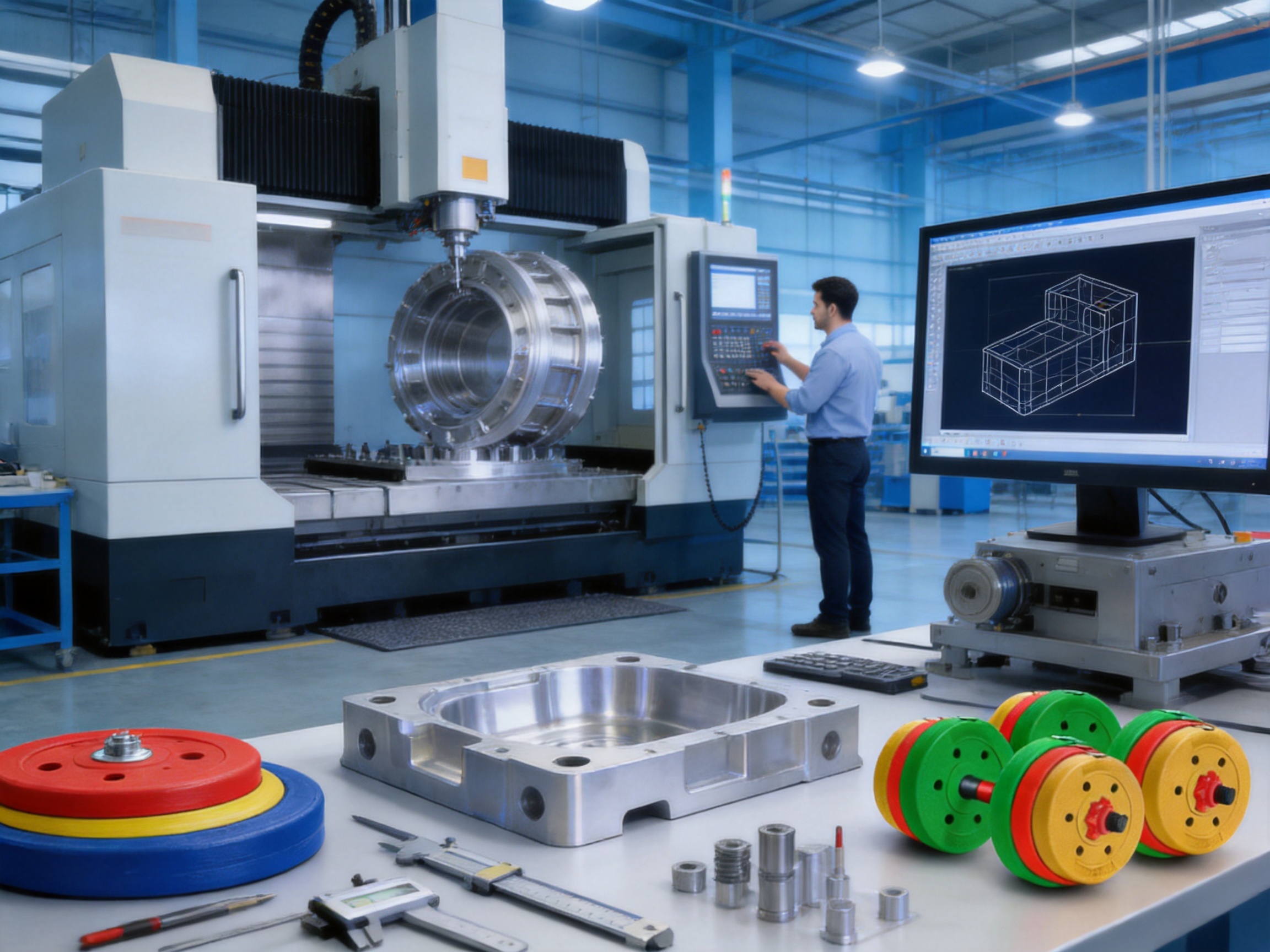
After the product structure is confirmed, the mold is developed using three-dimensional modeling and engineering design software. The model must represent the cavity, parting surfaces, fasteners, vents, inserts, reinforcement, lifting points, and other components required for production.
Three-dimensional design makes it easier to identify interference, review assembly, calculate dimensions, and communicate the proposed tooling structure. It also enables the customer to confirm important features before machining begins. This reduces misunderstandings and provides a clear reference for later inspection.
The design stage also considers shrinkage and process behavior. The mold dimensions may need to account for the characteristics of the selected plastic material and the rotational molding cycle. The exact allowance depends on the material, product geometry, processing conditions, and customer requirements.
4. Casting or Forging Preparation
Once the mold structure is approved, the selected material process is prepared. For sand-cast aluminum, the casting pattern, mold preparation, alloy selection, pouring conditions, and solidification requirements must be controlled. The objective is to create a sound base structure with sufficient allowance for machining and finishing.
For forged aluminum alloy, the material preparation and forming process are selected according to the required dimensions and performance objectives. The forged material must then be prepared for precision machining. The choice between casting and forging is made according to the product and operating requirements rather than by applying one method to every project.
Quality at this stage influences the later manufacturing process. Material defects, insufficient allowance, distortion, or unsuitable structure may complicate machining and reduce final performance. A disciplined manufacturer therefore controls the early material process as part of the overall mold quality system.
5. Precision Computer Numerical Control Machining
Computer numerical control machining is used to achieve the required cavity dimensions, parting surfaces, holes, mounting features, and product details. Precision machining is especially important for dumbbell plates because small errors may affect balance, appearance, fit, and repeatability.
Machining programs are developed from the approved three-dimensional model. Operators and engineers must verify the workpiece, tooling, coordinate systems, cutting conditions, and inspection requirements. Different regions of the mold may require different machining strategies depending on their depth, curvature, surface tolerance, and accessibility.
Complex curved surfaces require particular attention. Large outdoor sports products and recreational equipment often contain smooth transitions that must be accurately reproduced. Poorly controlled curvature can affect product appearance, wall distribution, or demolding. Advanced machining capability helps the manufacturer produce these shapes with greater consistency.
6. Surface Treatment and Finishing
After machining, the mold surface is finished according to the product requirements. This may involve deburring, smoothing, polishing, texture treatment, edge refinement, and cleaning. The surface condition must be uniform and suitable for the intended plastic material and production process.
Surface finishing is not purely cosmetic. It can influence release performance, product appearance, cleaning, and the reproduction of fine details. The correct finish depends on whether the customer wants a smooth, matte, textured, patterned, or specialized surface.
7. Assembly, Inspection, and Mold Testing
After the individual components are completed, the mold is assembled and inspected. Engineers check dimensions, alignment, fasteners, parting lines, vents, inserts, lifting features, and other functional details. The objective is to confirm that the mold is ready for a controlled production trial.
Mold testing may include trial assembly, dimensional verification, and rotational molding evaluation. The mold must be compatible with the intended machine and loading method. Any problem identified during testing can be analyzed and corrected before the tool is delivered or accepted.
8. Sample Validation
Sample validation provides practical evidence of mold performance. A trial product is reviewed for dimensions, wall distribution, shape, surface finish, markings, release behavior, and general appearance. The result is compared with the approved product requirements.
If the sample reveals an issue, the mold can be adjusted. Possible improvements may involve surface finishing, parting-line correction, venting, cavity modification, or process parameter recommendations. This stage is one of the most effective ways to reduce production risk because it connects the theoretical design with actual manufacturing behavior.
9. Final Quality Inspection and Delivery
Before delivery, the completed mold undergoes final inspection. Documentation may include dimensional records, sample confirmation, material information, operating recommendations, and maintenance guidance. Clear information helps the customer integrate the tooling into its production system.
Delivery is not the end of the engineering relationship. Technical support may continue through installation, initial production, process adjustment, maintenance advice, and future design changes. This long-term approach is especially valuable for manufacturers that plan to develop multiple sports equipment products.
Manufacturing Strengths and Integrated Technical Capabilities
Jiangsu Zhroto Mould Co., Ltd. operates a modern facility in Jiangyan District, Taizhou City, Jiangsu Province. The company’s facility covers approximately 18,000 square meters, including more than 12,000 square meters of standardized production workshops. This provides a structured environment for mold design, machining, assembly, inspection, and product processing.
The company has an annual production capacity of more than 800 mold sets and approximately 3,600 tons of plastic products. This capacity demonstrates the ability to support both individual customized projects and ongoing production programs. It also provides experience across different product sizes, structures, and application fields.
The company’s capabilities cover product design, mold development, rotational molding, finished product processing, quality inspection, and technical support. This one-stop model can reduce communication gaps between separate suppliers. When the same technical team understands the product, mold, and production process, it is easier to identify the cause of problems and coordinate improvements.
Jiangsu Zhroto Mould Co., Ltd. serves applications including outdoor facilities, amusement equipment, tanks, containers, vehicle components, agricultural machinery, water treatment equipment, industrial products, and sports-related products. Experience across these sectors can be valuable because many tooling principles are shared. Large hollow products, for example, require careful attention to wall distribution, heat transfer, venting, curved surfaces, and demolding regardless of the specific market.
The company supports molds used with conventional gas-heated rotational molding machines as well as electric-heated systems. Electric heating can provide more precise temperature control, but it also places greater emphasis on mold design and heat transfer behavior. The mold must work reliably with the selected heating method and machine configuration.
Quality and environmental management are also important parts of the company’s operating structure. The company has obtained ISO 9001:2015, ISO 14001:2015, and ISO 45001 certifications. These certifications reflect systems related to quality management, environmental management, and occupational health and safety. While certification does not replace product-specific inspection, it supports a more organized approach to project execution and factory management.
Applications Beyond Dumbbell Plate Molds
Dumbbell plates are an important sports equipment application, but the same mold engineering principles can be adapted to many other products. Fitness equipment manufacturers may require molds for kettlebells, hollow training accessories, exercise supports, balance products, protective components, storage products, and outdoor training structures.
Outdoor fitness equipment often requires larger cavities and stronger structural arrangements. Products may be exposed to sunlight, rain, temperature changes, repeated public use, and occasional impact. The mold must reproduce smooth and durable surfaces while supporting efficient production of large hollow components.
Playground and recreational products introduce additional design considerations. A durable playground equipment mold may need to produce large curved shapes, rounded edges, mounting areas, handles, steps, or enclosed structures. Parting lines should be positioned carefully so that they do not create undesirable marks or affect the safety and appearance of the finished product.
Specialized fitness products may also require multiple integrated features. These can include grip zones, recessed panels, textured surfaces, internal cavities, fastening areas, and product identification markings. A customized sports equipment mold allows these features to be developed as part of the product rather than added through excessive secondary operations.
For plastic athletic goods manufacturing, rotational molding is particularly useful when the product is hollow, large, impact-resistant, or difficult to produce economically through other processes. The method can support low-to-medium production volumes, customized designs, seamless structures, and relatively flexible product development.
Material Selection for Different Production Objectives
The best mold material depends on the relationship between product requirements and production objectives. No single material is ideal for every sports equipment application. An engineering evaluation should be completed before the mold construction method is confirmed.
For Flexible Product Customization
Sand-cast aluminum is often suitable when the customer needs several sizes or variations of a product. It supports practical customization and can be adapted to different cavity geometries. It is a strong option for manufacturers entering a new market or developing a family of dumbbell plates and fitness accessories.
For Long-Term Dimensional Stability
Forged aluminum alloy may be preferred when the product will be manufactured in high volume or when repeated thermal cycling creates greater demands on the mold. Its material structure can support stable geometry and long service performance when combined with accurate design and machining.
For Large Outdoor Products
Engineered aluminum tooling can provide a practical balance between strength and handling efficiency. Large molds may require reinforcement, lifting points, structural supports, and carefully positioned parting lines. The mold design must account for the size of the cavity and the conditions under which it will be installed and operated.
For Premium Surface Requirements
When appearance is a major selling point, the material choice should be considered together with machining and surface treatment. The final finish of the cavity must be capable of reproducing the intended product surface consistently. Forged aluminum may be selected for demanding applications, although a well-designed sand-cast mold can also provide excellent results when properly machined and finished.
For Prototype Development
Prototype tooling should be designed with the future production plan in mind. A low-cost prototype may be suitable for early shape verification, but it may not represent the final production mold. If the prototype will transition directly into mass production, the material, structure, and inspection strategy should be selected accordingly.
How to Improve Mold Service Life
A mold’s service life depends on material quality, design, manufacturing accuracy, operating conditions, maintenance, and handling. Even a high-quality mold can experience premature damage if it is installed incorrectly, overheated, dropped, or neglected during storage.
Operators should follow the recommended heating and cooling conditions for the mold and plastic material. Sudden or excessive thermal changes may increase stress. The mold should be inspected regularly for wear, loose fasteners, damaged vents, surface contamination, corrosion, or parting-line changes.
Cleaning should be performed using methods that do not damage the cavity surface. Residual plastic, dust, or release agents may affect product appearance and demolding. Any cleaning tool or chemical should be evaluated for compatibility with the mold material and surface treatment.
Handling procedures should be planned according to the mold’s weight and lifting points. Cranes, carts, fixtures, or other equipment should be used where appropriate. Operators should avoid impact against the cavity, parting surfaces, and precision features.
When a mold is stored for an extended period, it should be cleaned, protected, and placed in a suitable environment. Maintenance records can help identify recurring problems and plan preventive service. A disciplined maintenance program reduces unexpected downtime and helps preserve dimensional stability.
Quality Control from Design to Delivery
Quality control should be integrated into every stage of mold production. It should not begin only after machining is complete. Early design review, material verification, process control, dimensional inspection, sample testing, and final documentation all contribute to the result.
During design, engineers verify that the mold can be manufactured and operated as intended. During material preparation, the selected aluminum and production method are checked against the project requirements. During machining, critical dimensions and surfaces are monitored. During assembly, alignment and functional features are inspected.
Sample validation provides a practical check of the entire system. It can reveal issues that are not obvious from drawings alone. For example, a product may meet cavity dimensions but still require adjustment because of release behavior, wall distribution, or surface appearance. Resolving these issues before delivery helps the customer begin production with greater confidence.
Documentation is also valuable. A clear record of material, dimensions, testing, and maintenance recommendations supports future production and troubleshooting. If the customer later develops a related product, the information can serve as a technical reference for new tooling.
Choosing a Reliable Sports Equipment Mold Manufacturer
Manufacturers should evaluate more than the quoted mold price when selecting a tooling partner. A lower initial cost may create higher expenses later if the mold requires repeated correction, produces inconsistent products, or has a short service life.
Important evaluation factors include engineering experience, material options, machining capability, inspection equipment, trial molding capacity, production scale, quality systems, communication, and after-sales support. The supplier should be able to explain why a particular material and structure are suitable for the product.
Customers should also ask how the supplier manages design changes. Sports equipment products often develop during the project. A supplier with integrated design and manufacturing capabilities can evaluate changes more efficiently than a supplier that only performs basic machining.
Another important factor is experience with the intended production method. Rotational molding requires an understanding of heat transfer, powder loading, rotation, venting, cooling, shrinkage, and demolding. A supplier that understands these factors can design a mold that performs in the actual production environment.
Jiangsu Zhroto Mould Co., Ltd. provides project evaluation, product structure optimization, three-dimensional modeling, mold design confirmation, precision computer numerical control manufacturing, testing, sample validation, quality inspection, delivery, and technical support. This integrated service helps customers manage the complete tooling process through one coordinated source.
Frequently Asked Questions
Q1: What material is generally suitable for a dumbbell plate mold?
Sand-cast aluminum is suitable for many dumbbell plate applications because it provides practical customization, manageable weight, useful thermal conductivity, and integrated mold construction. Forged aluminum alloy may be selected when the customer requires higher strength, improved dimensional stability, or extended performance under demanding production conditions.
Q2: Why is aluminum commonly used for rotational molding molds?
Aluminum combines relatively low weight, good heat transfer, machining flexibility, and suitability for customized geometries. These characteristics help manufacturers handle the mold efficiently while supporting stable heating and consistent product formation.
Q3: Is sand-cast aluminum suitable for high-volume production?
Sand-cast aluminum can be suitable for high-volume production when the mold is correctly designed, machined, finished, tested, and maintained. However, production volume and service conditions should be evaluated carefully. Forged aluminum alloy may be more appropriate when the mold will experience especially demanding thermal and mechanical conditions.
Q4: What information should a customer provide before mold design begins?
Useful information includes product drawings or three-dimensional files, product dimensions, material specifications, target production volume, surface requirements, heating method, machine information, insert requirements, packaging considerations, and expected service conditions. Physical samples may also be helpful during the engineering review.
Q5: Can a sports equipment mold be customized for different sizes?
Yes. The mold can be designed for different product sizes, shapes, thicknesses, edge profiles, openings, markings, and functional features. Manufacturers producing several related products may develop separate molds based on a shared product design concept.
Q6: How does trial molding improve the final result?
Trial molding allows engineers to evaluate the product under representative production conditions. The sample can be checked for dimensions, wall distribution, surface finish, release performance, markings, and overall appearance. Necessary corrections can be completed before mass production, reducing the risk of costly tooling problems.
Q7: What makes a durable playground equipment mold reliable?
A reliable mold for playground or outdoor equipment requires suitable material selection, accurate machining, appropriate reinforcement, controlled parting lines, effective venting, proper surface treatment, and thorough sample validation. The final result depends on the complete tooling system rather than material choice alone.
Q8: Can the molds operate with electric-heated rotational molding machines?
Yes. Molds can be designed for use with conventional gas-heated systems or electric-heated rotational molding equipment. Electric heating may require particularly careful attention to heat transfer, mold structure, wall thickness, and temperature management.
Q9: Does mold surface finish affect the finished sports product?
Yes. Mold surface finish can influence product texture, appearance, release performance, cleaning, and the reproduction of details. The correct finish should be selected according to the product design and customer expectations.
Q10: What services are available during a complete mold project?
A complete project may include product evaluation, structure optimization, three-dimensional modeling, mold design, material selection, casting or forging preparation, computer numerical control machining, surface treatment, assembly, testing, sample validation, final inspection, delivery, maintenance guidance, and technical support.
Conclusion
A high-quality sports equipment mold is the foundation of consistent, efficient, and competitive product manufacturing. For dumbbell plates, fitness accessories, outdoor exercise products, and large recreational equipment, the mold must do more than reproduce a basic shape. It must support dimensional accuracy, stable wall distribution, smooth surfaces, efficient heating, reliable demolding, and long-term production performance.
Sand-cast aluminum offers a practical combination of flexibility, manageable weight, thermal performance, and customization. Forged aluminum alloy provides an additional option for applications that require greater strength, dimensional stability, and demanding service performance. The best choice depends on product structure, production volume, mold size, operating conditions, and required quality.
The manufacturing process is equally important. Product review, structure optimization, three-dimensional modeling, controlled material preparation, precision computer numerical control machining, surface treatment, inspection, trial molding, and sample validation must work together. An integrated workflow helps reduce production risk and enables the mold to perform as intended in the customer’s factory.
With a modern facility, substantial production capacity, certified management systems, broad rotational molding experience, and one-stop technical capabilities, Jiangsu Zhroto Mould Co., Ltd. supports manufacturers seeking dependable sports equipment tooling. Its approach combines customized engineering with practical production knowledge, helping customers develop products that are consistent, durable, attractive, and competitive in the market.
References
1. Rotational Molding Industry Association, rotational molding process principles and tooling considerations.
2. International Organization for Standardization, ISO 9001:2015 Quality Management Systems.
3. International Organization for Standardization, ISO 14001:2015 Environmental Management Systems.
4. International Organization for Standardization, ISO 45001:2018 Occupational Health and Safety Management Systems.
5. Aluminum Association, aluminum alloy selection, casting, and forming guidelines.
6. Plastics engineering literature covering rotational molding, polymer processing, mold heating, cooling, and wall distribution.
7. General manufacturing references on computer numerical control machining, surface finishing, dimensional inspection, and preventive mold maintenance.
Product: Sports equipment mold


We provide customers with one-stop services ranging from product design, mold manufacturing to finished product production.
-
 +86-18006248936
-
 ricky.t@zhroto.com
-
 No.9 Jiangyuan Road, Luotang Street, Jiangyan District, Taizhou City,Jiangsu Province, China
Copyright © Jiangsu Zhroto Mould Co., Ltd. Rights Reserved.Custom Rotational Plastic Molding Factory
