 en
 中文简体
 русский
 Español
 Deutsch
 Polskie
 REQUEST A QUOTE

 Home / Author / Mei-Rong Alvarado — Product After-Sales Service Manager / Advanced Rotational Molding Solutions for Agricultural Machinery Parts
Advanced Rotational Molding Solutions for Agricultural Machinery Parts
Content
- 1 Why Agricultural Machinery Parts Require Specialized Molds
- 2 Core Product Advantages of Rotational Molding Tooling
- 3 Applications of Agricultural Machinery Parts Molds
- 4 Manufacturing Process from Product Concept to Finished Mold
- 5 Heating Systems and Their Influence on Mold Performance
- 6 Quality Assurance and Technical Strengths
- 7 Advantages Compared with Competing Tooling Approaches
- 8 Maintenance and Service-Life Management
- 9 How to Select the Right Agricultural Machinery Parts Mold
- 10 Customer Benefits of an Integrated Manufacturing Partner
- 11 Frequently Asked Questions
- 11.1 Q1: What is an agricultural machinery parts mold?
- 11.2 Q2: Why is rotational molding suitable for agricultural machinery?
- 11.3 Q3: Does rotational molding produce completely stress-free parts?
- 11.4 Q4: What materials are commonly used for rotational molds?
- 11.5 Q5: Can the mold include mounting points, ribs, logos, or textures?
- 11.6 Q6: What is the difference between gas-heated and electric-heated rotational molding?
- 11.7 Q7: How is mold quality verified before delivery?
- 11.8 Q8: How long can an agricultural machinery parts mold last?
- 11.9 Q9: Can a supplier modify an existing mold?
- 11.10 Q10: What information should a customer provide when requesting a quotation?
- 11.11 Q11: Does Jiangsu Zhroto Mould Co., Ltd. provide finished plastic parts as well as molds?
- 11.12 Q12: Which certifications support the company’s manufacturing system?
- 12 Conclusion
- 13 References
- 14 Product: Agricultural machinery parts mold
Agricultural machinery operates in some of the most demanding working environments in modern manufacturing. Tractors, harvesters, seeders, sprayers, irrigation systems, tillage equipment, and material-handling machines are regularly exposed to dust, mud, moisture, fertilizers, pesticides, ultraviolet radiation, vibration, impact, temperature changes, and continuous outdoor use. Every protective cover, tank, housing, guard, panel, and enclosure must therefore combine strength, dimensional stability, chemical resistance, and dependable long-term performance.
The agricultural machinery parts mold is one of the most important tools in achieving these requirements. A mold determines the geometry, wall consistency, surface finish, repeatability, and production efficiency of the finished component. When the tooling is poorly designed or manufactured, even a high-quality polymer may produce parts with distortion, weak areas, inconsistent thickness, difficult demolding, or unacceptable surface defects. By contrast, a professionally engineered rotational mold creates a stable foundation for reliable agricultural component production.
Jiangsu Zhroto Mould Co., Ltd. specializes in the design and manufacture of rotational molding molds and the production of large plastic components. Its agricultural machinery parts mold solutions are developed for manufacturers that require durable tooling, complex curved geometries, efficient changeovers, and consistent output. Through integrated digital design, precision machining, trial molding, inspection, and technical support, the company provides a complete approach rather than treating mold manufacturing as an isolated machining activity.
Rotational molding is particularly suitable for large hollow agricultural components. The process can produce seamless parts with relatively uniform wall thickness, integrated curves, and reduced structural weakness compared with products assembled from multiple welded sections. It also allows manufacturers to develop large and complex parts without the extensive tooling complexity often associated with other molding technologies.
This article examines the construction, performance advantages, manufacturing process, applications, quality controls, maintenance requirements, and competitive strengths of agricultural machinery parts molds. It also explains how an experienced rotational molding supplier can help agricultural equipment manufacturers reduce production risk and improve total lifecycle value.
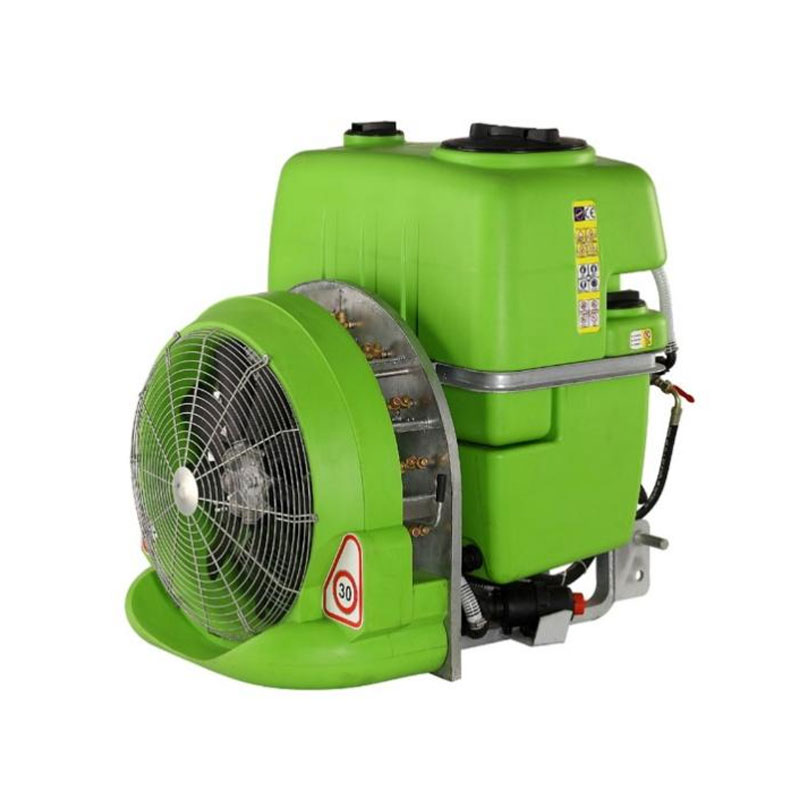
Agricultural machinery parts mold
Why Agricultural Machinery Parts Require Specialized Molds
Agricultural machinery parts differ significantly from many indoor industrial or consumer plastic products. They must function in uncontrolled environments where operating conditions can change quickly. A tractor component may be exposed to intense sunlight during the day, mud and water during field operations, and freezing temperatures during storage. A chemical tank may come into contact with fertilizers, herbicides, cleaning agents, and other aggressive substances. A machine housing may receive repeated impacts from stones, branches, tools, or transported materials.
These conditions create several demands for the mold and the finished component. The tooling must maintain its shape through repeated heating and cooling cycles. The cavity surface must preserve the required texture and appearance over many production runs. Corners, transitions, mounting points, and openings must be designed to prevent excessive stress concentration. The mold must also allow the finished part to release without excessive force that could damage either the component or the tooling.
Large agricultural components present additional challenges. A broad protective panel or equipment cover can experience uneven heating if the mold is not designed correctly. Uneven heating may lead to inconsistent polymer distribution, localized thin walls, distortion, or surface variation. Large hollow parts also require carefully planned loading, ventilation, cooling, and demolding procedures. The mold structure must be rigid enough to maintain dimensional accuracy while remaining practical for handling and production.
A specialized agricultural machinery parts mold is therefore more than a negative shape cut into metal. It is a complete production tool that integrates geometry, material behavior, heating requirements, demolding strategy, mounting features, inspection access, and maintenance considerations. When these factors are addressed at the design stage, manufacturers can reduce corrective modifications and achieve more stable production after the first trial.
Core Product Advantages of Rotational Molding Tooling
Seamless Structures for Large Hollow Parts
One of the main advantages of rotational molding is its ability to produce large hollow structures without conventional weld seams in the main body. A seamless component can offer improved leak resistance, impact performance, and visual continuity. This is especially important for fluid tanks, reservoirs, protective housings, fenders, covers, and other parts where a continuous structure is preferred.
Traditional assembly methods may require several sections to be joined by welding, fasteners, or adhesives. Each joint introduces a possible weakness, leakage path, stress concentration, or cosmetic inconsistency. Rotational molding simplifies the main body of the component by creating the shape in a single molding cycle. This does not eliminate the need for inserts, hardware, or secondary operations in every application, but it can substantially reduce the number of structural joints.
For agricultural equipment, seamless construction can improve reliability in applications involving vibration and repeated impact. A protective housing that is exposed to field debris benefits from a continuous shell. A tank containing agricultural fluid benefits from fewer potential leakage points. A curved machine cover benefits from a smooth, integrated surface that can be cleaned more easily and assembled with fewer visible joints.
Reduced Residual Stress and Improved Dimensional Stability
Rotational molding generally uses a relatively low-pressure process in which polymer powder is heated inside a rotating mold. Because the material is not forced into the cavity under the same high pressure used in some other molding processes, the finished part can have lower residual stress when the process is properly controlled. This characteristic is valuable for large components with broad surfaces and complex curves.
Reduced residual stress can help lower the risk of warping, cracking, and dimensional drift caused by uneven stress release. The final performance still depends on resin selection, mold design, temperature control, cooling conditions, wall thickness, and processing discipline. However, the process provides a strong foundation for producing durable agricultural components with stable geometry.
The one-piece mold structures developed by Jiangsu Zhroto Mould Co., Ltd. are intended to support this advantage. By reducing unnecessary structural discontinuities in the tooling, the mold can provide a more consistent cavity and a more predictable production environment. A stable mold is particularly important when the finished component must align with metal frames, engines, hydraulic systems, control equipment, or other assemblies.
Design Freedom for Complex Agricultural Components
Agricultural machinery often requires components that are not simple boxes or flat panels. Equipment housings may contain deep curves, compound surfaces, integrated ribs, mounting locations, handles, recesses, and access openings. Tractor covers, fenders, air intake housings, hopper liners, tanks, and operator protection elements all require different combinations of geometry and function.
Rotational molding supports a broad range of large, hollow, and curved forms. The process can accommodate shapes that would be difficult or expensive to produce with conventional sheet-metal assembly or highly complex high-pressure tooling. Features can be incorporated directly into the mold design, including surface textures, logos, mounting points, ribs, and selected contours.
This flexibility is valuable for agricultural manufacturers that offer multiple machine sizes or model variations. A modular tooling strategy can allow product changes without redesigning every aspect of the production system. The relatively simple mold structure also supports faster product changeovers than some more complex tooling approaches, helping manufacturers respond to different production schedules and customer requirements.
High-Quality Surfaces and Consistent Appearance
Many agricultural components are visible to operators, customers, and service technicians. Surface quality affects the perceived value of the equipment, but it also affects practical performance. Smooth and consistent surfaces are easier to clean and can reduce the accumulation of soil, plant residue, fertilizer, and moisture. Controlled textures may improve grip, conceal minor visual variation, or support a specific design language across a product family.
The mold cavity directly influences the appearance of the finished part. Precision machining, careful finishing, and appropriate surface treatment help create repeatable results. A properly prepared mold can support uniform gloss, texture, branding details, and geometric transitions. Consistent surfaces also reduce the risk of rework and help maintain a stable appearance across high-volume production.
Efficient Tooling for Large Parts
Large agricultural components can be expensive to produce if tooling is unnecessarily complicated. Rotational molding offers an efficient solution because the mold can often be manufactured with a comparatively simple structure while still producing large and complex parts. Tooling can be developed for single-cavity or multi-cavity requirements depending on the product design, production volume, available machinery, and cycle-time objectives.
The economic advantage is not based only on the initial mold price. A durable mold can reduce maintenance interruptions, scrap, rework, and unexpected dimensional corrections. Faster changeovers can improve equipment utilization. Consistent production can also reduce downstream assembly problems. For this reason, agricultural manufacturers should evaluate tooling according to total cost of ownership rather than comparing only the initial quotation.
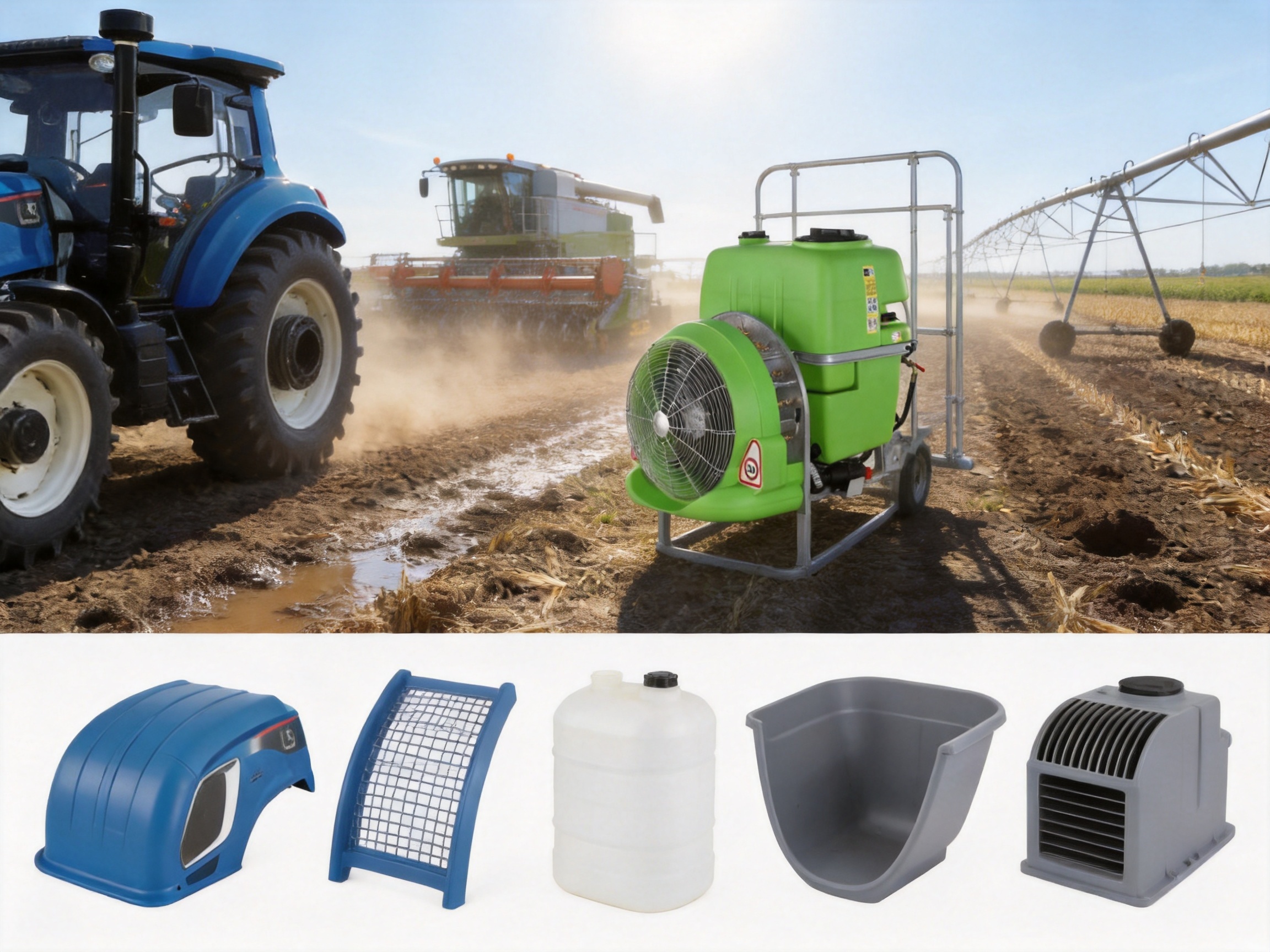
Applications of Agricultural Machinery Parts Molds
Tractor Covers, Fenders, and Protective Panels
Tractor covers and fenders must protect internal systems while maintaining an attractive and functional exterior. They may need to accommodate complex curves around wheels, engines, operator areas, or hydraulic equipment. The parts must be lightweight enough to avoid unnecessary machine mass while remaining sufficiently robust for field use.
A rotational agricultural machinery parts mold can produce large curved panels with integrated contours and consistent surfaces. The mold can be designed around the assembly structure of the tractor, including clearances, fastener locations, ventilation paths, and access areas. Properly engineered edges and transitions help reduce local stress and support reliable installation.
For replacement or upgraded components, the manufacturer may use three-dimensional scanning, reverse engineering, or existing part data to recreate the desired geometry. This is useful when the original tooling is unavailable or when a legacy component requires improvement. Digital modeling allows the engineering team to review fit, wall distribution, draft, parting areas, and mounting features before machining begins.
Fuel Tanks, Water Tanks, and Agricultural Fluid Reservoirs
Fluid-handling components are among the most important applications for rotational molding. Agricultural machinery may use tanks and reservoirs for water, fuel, hydraulic fluids, cleaning solutions, fertilizers, or crop-protection chemicals. These parts require careful attention to leak resistance, wall uniformity, chemical compatibility, structural support, and dimensional accuracy.
A seamless molded tank can reduce the number of joints in the main fluid container. The mold must support the intended volume while also allowing suitable access openings, mounting areas, baffles, filler necks, drain features, and inspection points. Where inserts or secondary fittings are required, their locations must be planned so that they do not create unnecessary distortion or interfere with demolding.
Thermal management is especially important for tanks. Uneven heating may cause differences in wall thickness that affect strength and capacity. Consistent heating and controlled cooling help produce a more predictable structure. Electric-heated rotational molding systems can provide independent heating zones and precise temperature management for products with complicated geometry or demanding wall-thickness requirements. Gas-heated systems remain useful for many applications and can provide efficient processing when correctly configured.
Machine Housings and Equipment Enclosures
Equipment housings protect engines, pumps, electronic controls, hydraulic systems, sensors, and other internal assemblies. These enclosures may need to provide impact protection, weather resistance, ventilation, access for maintenance, and compatibility with metal frames or mounting brackets.
Rotational molding allows housing designers to create broad curves and hollow structures while avoiding excessive assembly complexity. The mold can incorporate recesses, openings, ribs, logos, and attachment features. The resulting part may be lighter than a comparable metal enclosure while offering strong resistance to corrosion and many agricultural chemicals.
Because housings often have irregular contours, the engineering stage is critical. Parting lines must be placed where they will not interfere with appearance or assembly. Draft and release angles must be sufficient for safe demolding. Deep sections and narrow transitions must be reviewed for material flow and heating behavior. A professional mold supplier evaluates these issues before finalizing the tooling rather than waiting for defects to appear during production.
Hopper Liners and Material-Handling Components
Seeders, spreaders, harvesters, and feed-handling equipment may use hoppers, liners, chutes, and covers that come into contact with grains, fertilizer, soil, seeds, or other bulk materials. These components require smooth surfaces, abrasion resistance, appropriate geometry, and easy cleaning.
A rotationally molded liner can reduce corrosion concerns compared with unprotected metal surfaces. Its curved geometry may help material flow and reduce accumulation in corners. The mold surface determines the quality of the internal finish, so careful cavity preparation is important. If the product requires a low-friction or textured surface, the desired finish must be incorporated into the mold design.
Air Intake Housings and Protective Guards
Air intake housings and protective guards must balance airflow, structural protection, service access, and environmental resistance. These parts may be exposed to dust, crop residue, rain, and vibration. Their geometry often includes curved ducts, mounting flanges, screens, or integrated protection features.
A specialized mold can help produce smooth internal passages and stable external contours. Maintaining dimensional consistency is essential because poor fit can allow dust or moisture to enter sensitive systems. The mold may also integrate external ribs or reinforcement features where additional stiffness is required without greatly increasing wall thickness.
Manufacturing Process from Product Concept to Finished Mold
Project Evaluation and Application Analysis
The manufacturing process begins with an understanding of the intended product and production environment. Engineers review the component’s dimensions, material, function, expected volume, operating conditions, mounting method, allowable tolerances, surface requirements, and anticipated cycle time.
At this stage, the customer and mold manufacturer should discuss whether the component is best produced as a single molded structure or as several assembled parts. The analysis should also consider chemical exposure, impact requirements, UV exposure, operating temperature, storage conditions, and maintenance access. These details influence mold material, wall design, surface treatment, heating strategy, and inspection criteria.
Three-Dimensional Modeling and Product Optimization
Three-dimensional CAD modeling provides a digital environment for reviewing the product before tooling is manufactured. Engineers can inspect complex curves, identify potential undercuts, evaluate parting locations, and check whether the component can be removed from the mold without damage.
Product optimization may include adjusting wall transitions, adding appropriate radii, modifying draft, strengthening mounting zones, and improving material distribution. It may also involve reviewing how the part connects to neighboring components. A minor geometry change at this stage can prevent a major tooling modification later.
For existing components, reverse engineering can help reproduce or improve a part. Digital measurement data can be converted into a usable model, allowing the engineering team to identify dimensional variation and propose improvements. This capability is valuable for replacement parts, equipment upgrades, and older agricultural machinery programs.
Mold Design Confirmation
After product geometry is reviewed, the mold design is developed. The design must address cavity shape, mold thickness, structural reinforcement, handles, hinges, mounting points, vents, parting areas, loading access, and demolding requirements. The mold also needs to be compatible with the rotational molding machine and its heating system.
Large molds require sufficient rigidity to resist deformation during repeated thermal cycles. Reinforcement should be positioned to preserve the cavity shape without interfering with heat transfer or part removal. Corners and transitions must be designed for both product quality and mold durability. Accessible areas simplify inspection and cleaning, which can significantly reduce long-term maintenance effort.
Precision CNC Machining
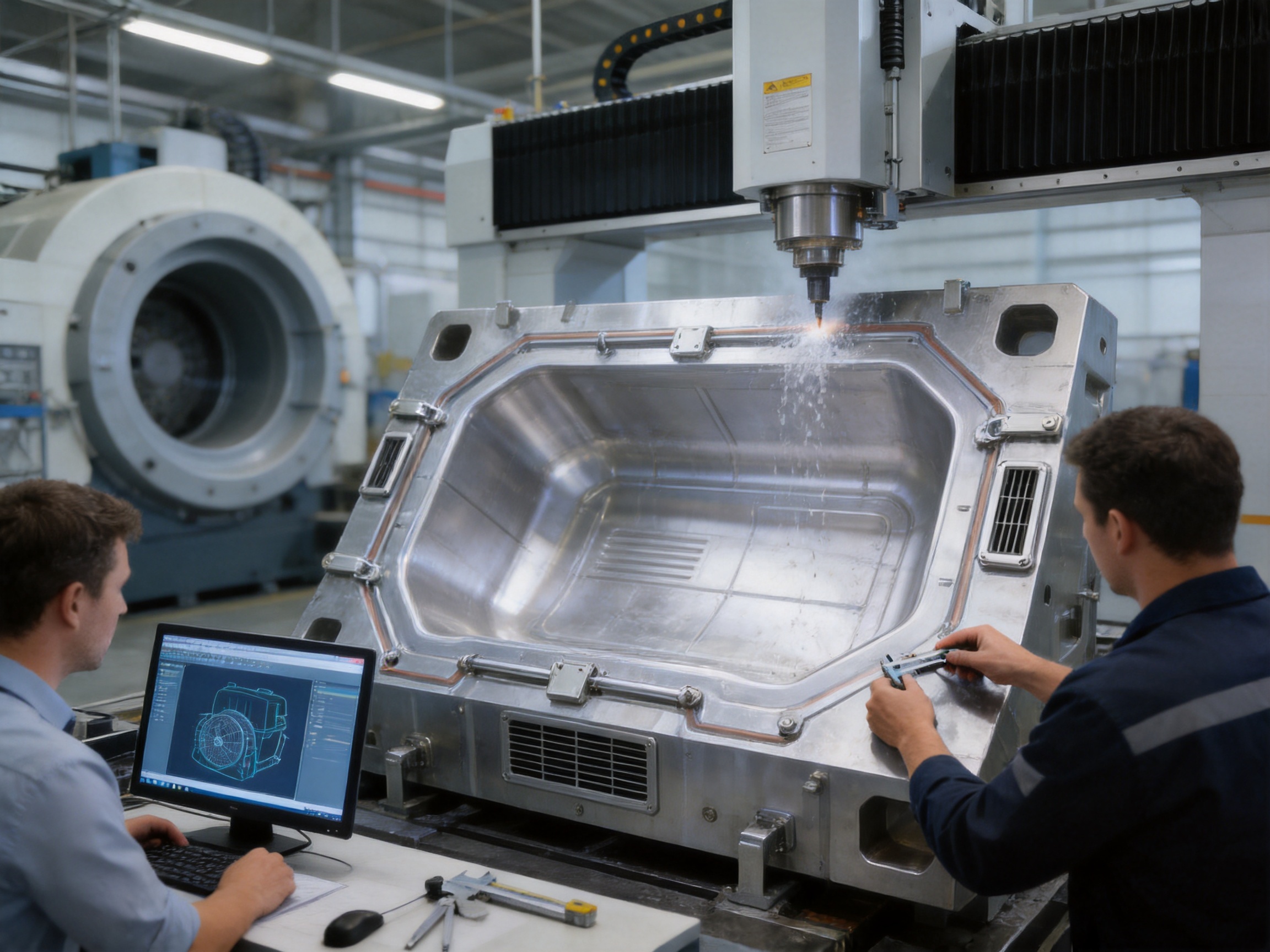
Once the design is approved, precision machining creates the mold cavity and associated features. Jiangsu Zhroto Mould Co., Ltd. uses CNC machining capabilities, including high-speed five-axis gantry machining centers, to produce complex contours and detailed surfaces. Five-axis machining can reduce the number of setups required for complicated geometries and improve the continuity of curved surfaces.
Machining accuracy influences the final product in several ways. It affects dimensional consistency, assembly fit, surface quality, cavity symmetry, and the repeatability of design details. A high-quality machined cavity also reduces the need for extensive manual correction and supports more predictable trial results.
Surface Finishing and Assembly
After machining, the mold surface is inspected and finished according to the product’s requirements. The desired finish may be smooth, textured, matte, or designed to reproduce a specific pattern. Surface transitions, corners, openings, and parting areas receive particular attention because small defects in these locations can affect demolding or finished-part appearance.
The mold is then assembled with frames, supports, handles, hinges, vents, inserts, and other required hardware. Assembly quality is important because loose or poorly aligned components can cause vibration, leakage, dimensional variation, or handling problems during production.
Trial Molding and Sample Validation
Every agricultural machinery parts mold should undergo trial production before delivery. Trial molding provides evidence that the tooling performs as intended under actual processing conditions. Engineers can evaluate heating behavior, material distribution, wall thickness, surface appearance, demolding, dimensions, and fit.
Sample validation may include visual inspection, dimensional measurement, wall-thickness checks, leak testing, assembly verification, and functional evaluation. If an issue is identified, the mold can be adjusted before it enters regular production. This process reduces the risk of delivering a tool that appears acceptable in isolation but fails to meet the customer’s actual production requirements.
Trial production also helps establish operating parameters. Heating time, cooling conditions, rotation settings, powder loading, demolding procedure, and inspection points can be documented for production operators. A repeatable process is essential to achieving the full benefit of a well-designed mold.
Heating Systems and Their Influence on Mold Performance
Heating uniformity is a central factor in rotational molding. The polymer must receive enough heat to melt and form a continuous layer against the cavity surface. If the mold is overheated in one area and underheated in another, the finished part may have inconsistent wall thickness, incomplete fusion, discoloration, distortion, or reduced performance.
Conventional gas-heated systems remain widely used because they are adaptable and can be suitable for many agricultural component programs. Their performance depends on burner arrangement, airflow, mold movement, insulation, cycle control, and operator experience. Properly configured gas heating can produce large components efficiently.
Electric-heated rotational molding provides another option for manufacturers that require precise control. Independent heating zones can help manage complicated geometries and reduce temperature differences across the mold. Digital control systems can also support more repeatable cycles and easier process documentation.
Jiangsu Zhroto Mould Co., Ltd. has capabilities related to both gas-heated and electric-heated rotational molding systems. The appropriate choice depends on the product geometry, production volume, polymer, cycle requirements, available equipment, and desired level of process control. The mold must be designed with the selected heating system in mind so that heat can reach all relevant areas efficiently and consistently.
| Component Type | Primary Performance Requirement | Important Mold Consideration | Typical Heating Priority |
|---|---|---|---|
| Tractor covers and fenders | Impact resistance, appearance, and dimensional fit | Large curved surfaces, rigid support, controlled surface finish | Uniform heating across broad panels |
| Water and agricultural fluid tanks | Leak resistance, wall consistency, and chemical compatibility | Seamless cavity, stable openings, accurate mounting points | Precise control around deep and enclosed areas |
| Equipment housings | Protection, assembly accuracy, and service access | Complex geometry, draft, parting areas, and integrated features | Balanced heating across irregular contours |
| Hopper liners and chutes | Cleanability, abrasion resistance, and material flow | Smooth internal surfaces and consistent corners | Stable heating for uniform inner walls |
| Air intake housings | Dimensional accuracy and environmental protection | Sealing areas, ducts, ribs, and mounting interfaces | Controlled heating around narrow passages |
Quality Assurance and Technical Strengths
High-Grade Tooling Materials
The choice of mold material affects thermal response, durability, machinability, surface quality, and maintenance requirements. High-grade aluminum alloys are commonly used for rotational molding molds because they offer a useful combination of heat transfer, relatively low weight, corrosion resistance, and machinability.
The material must retain its shape through repeated thermal cycles. It must also withstand handling, cleaning, clamping, and demolding operations. Material verification at the beginning of production helps ensure that the mold is manufactured according to the agreed specification.
Digital Engineering and Process Simulation
Digital tools allow engineers to evaluate the relationship between product geometry and mold behavior before production begins. CAD and CAM systems support accurate modeling, machining-path development, and design communication. Simulation and engineering review can help identify areas where powder distribution, heat exposure, or demolding may be difficult.
Digital engineering is especially valuable for large agricultural components because small design problems can become expensive when multiplied across a large cavity. Identifying an interference, insufficient draft angle, or poorly positioned parting line before machining can save substantial time and material.
Multi-Stage Inspection
Quality assurance should extend through every stage of mold production. Incoming material inspection verifies the tooling substrate. Machining inspection confirms dimensions and surface geometry. Assembly inspection checks alignment, hardware, vents, hinges, and support structures. Trial molding confirms that the mold performs correctly in practical operation.
Finished mold dimensional checks may include cavity measurements, critical feature verification, surface inspection, and comparison with approved three-dimensional data. Sample parts can be checked for wall thickness, visual appearance, dimensional accuracy, and release performance. This multi-stage approach is more reliable than relying on a single final inspection.
Integrated Production Capability
Jiangsu Zhroto Mould Co., Ltd. provides integrated services covering product design, mold engineering, CNC machining, mold testing, quality inspection, rotational molding, and technical support. This structure allows the company to understand both the tooling side and the finished-product side of the process.
A supplier that only machines the mold may not fully understand how the tool behaves during production. An integrated manufacturer can use trial results and product inspection to improve the mold design and processing parameters. This feedback loop can shorten development time and improve the connection between the customer’s product requirements and the final tooling solution.
The company was founded in 2015 and moved to a modern facility in Jiangyan District, Taizhou City, in 2021. Its facility covers approximately 18,000 square meters, including more than 12,000 square meters of standardized production workshops. The company reports annual capacity exceeding 800 mold sets and 3,600 tons of plastic products. Such capacity supports both customized development and ongoing production programs.
Its management and quality systems include ISO 9001:2015, ISO 14001:2015, and ISO 45001:2018 certifications. These certifications reflect structured approaches to quality management, environmental management, and occupational health and safety. For international agricultural equipment manufacturers, documented systems can improve supplier evaluation, project communication, and production confidence.
Advantages Compared with Competing Tooling Approaches
Compared with Fabricated Multi-Part Tooling
Fabricated tooling assembled from numerous sections may create additional seams, alignment requirements, and maintenance points. Although fabricated construction can be useful in certain applications, a one-piece or highly integrated rotational mold can simplify the cavity structure and reduce potential discontinuities.
For large agricultural parts, fewer structural interruptions may support better surface continuity and more stable dimensional behavior. The final choice depends on geometry and production requirements, but integrated construction is often attractive when the component demands a broad, smooth, and seamless cavity.
Compared with High-Pressure Injection Tooling
Injection molding is highly effective for many small and medium-sized precision parts, but the tooling can become expensive and structurally complex when the product is very large, hollow, or deeply curved. High-pressure injection also requires substantial clamping force and carefully designed gates, runners, and cooling channels.
Rotational molding is often more economical for large hollow agricultural components because it uses a simpler mold and does not require the same high-pressure filling system. It also supports seamless hollow shapes and relatively easy product changes. Injection molding may remain preferable for small, highly detailed, high-volume components with strict tolerances, but rotational molding offers a strong competitive alternative for large protective and fluid-handling parts.
Compared with Metal Fabrication
Metal components can provide excellent stiffness and heat resistance, but they may be heavier and more vulnerable to corrosion when exposed to moisture, fertilizer, pesticides, and outdoor conditions. Metal fabrication may also require welding, coating, bending, and multiple assembly steps.
Rotomolded polymer components can reduce weight, provide corrosion resistance, and integrate complex curves without numerous joints. Lower weight may contribute to easier installation, reduced machine mass, and improved fuel efficiency. The correct polymer must be selected according to the operating environment, strength requirements, UV exposure, and chemical contact.
Compared with Thermoformed Assemblies
Thermoformed parts can be efficient for certain large panels, but they may require separate components, trimming, joining, or reinforcement. Rotational molding can produce a three-dimensional hollow structure with integrated curves and selected features in one main operation.
This can reduce assembly steps and create a more continuous structure. Rotational molding is not the ideal solution for every thin-walled panel or high-speed production requirement, but it is highly competitive when the product requires a robust three-dimensional shell, enclosed volume, or complex hollow geometry.
Maintenance and Service-Life Management
The life of an agricultural machinery parts mold depends on more than the initial manufacturing quality. Proper handling, cleaning, storage, inspection, and process control are essential for preserving the tool. Even a high-quality mold can suffer damage if operators use excessive force during demolding or store it in an unsuitable environment.
Routine inspection should examine the cavity surface, parting areas, mounting points, vents, hinges, handles, reinforcement, and hardware. Operators should look for scratches, dents, distortion, loose components, contamination, corrosion, and changes in the finished part. A small defect can become more serious if it is not identified early.
Cleaning should remove residual polymer, dust, release-agent buildup, and agricultural contaminants without damaging the mold surface. Abrasive tools or unsuitable chemicals may create scratches or alter the finish. Cleaning procedures should therefore be matched to the mold material and surface treatment.
Storage conditions also matter. Molds should be protected from accidental impact, excessive moisture, contamination, and unstable support. Large molds should be positioned so that their weight does not create unnecessary deformation. Openings and vents should be protected from blockage, while moving components should be secured appropriately.
Production records can help identify gradual changes in performance. Useful records may include cycle counts, heating parameters, repairs, dimensional inspection results, cleaning dates, and operator observations. If a finished part slowly becomes distorted or difficult to release, the change may indicate a tooling or process issue that should be investigated before product quality is affected.
Correct demolding is particularly important. Operators should follow the approved cooling procedure and avoid using excessive mechanical force. Tools that contact the mold or part should be designed to minimize scratches and impact. Training and clear work instructions can prevent many avoidable failures.
How to Select the Right Agricultural Machinery Parts Mold
The first consideration is the product itself. Manufacturers should define the component’s size, shape, wall thickness, material, operating environment, assembly method, and expected service life. The production volume and required cycle time should also be identified because these factors influence mold construction and heating-system selection.
The second consideration is the supplier’s engineering capability. A supplier should be able to review product geometry, recommend design improvements, create accurate three-dimensional models, and explain how the part will be molded. Engineering support is particularly important for components with compound curves, deep sections, integrated features, or tight assembly requirements.
The third consideration is manufacturing capacity. The supplier should have suitable machining equipment, assembly facilities, testing capability, and quality-control procedures. High-speed five-axis CNC machining can be valuable for complex contours, while a dedicated trial-molding capability helps verify the mold before shipment.
The fourth consideration is after-sales support. A reliable supplier should be able to provide operating guidance, maintenance recommendations, troubleshooting assistance, replacement components, and future modifications when necessary. Long-term technical support can be more valuable than a small reduction in initial tooling cost.
The fifth consideration is certification and production transparency. Quality, environmental, and occupational safety certifications can provide useful evidence of a structured manufacturing system. Customers should also request information about inspection procedures, material traceability, trial reports, dimensional records, and delivery schedules.
Finally, manufacturers should consider whether the supplier can support both tooling and finished-product development. An integrated partner may be able to identify problems that would remain hidden when mold production and plastic-part production are handled by disconnected companies.
Customer Benefits of an Integrated Manufacturing Partner
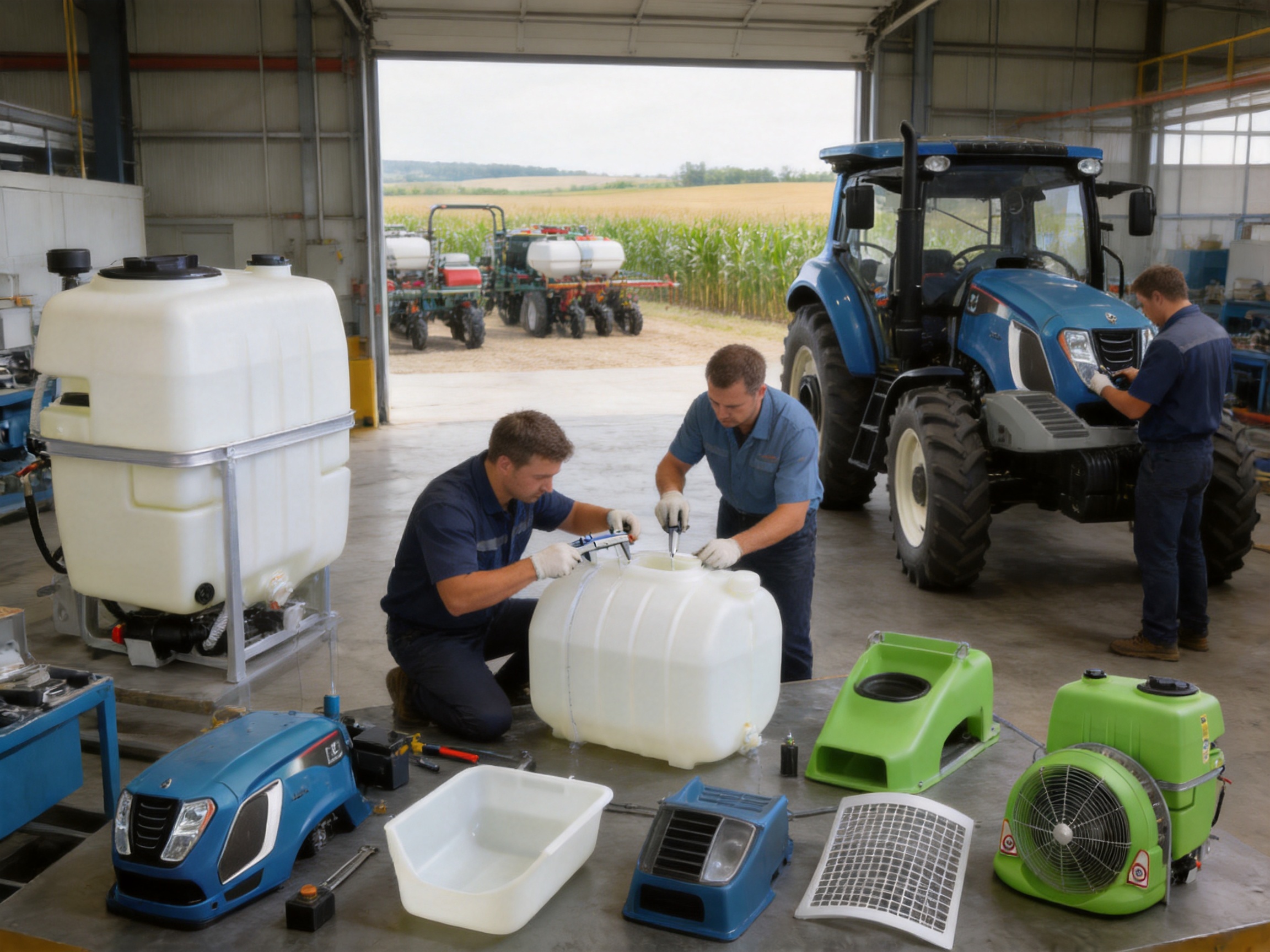
Working with an integrated rotational molding manufacturer can simplify communication. Product design, mold design, machining, trial production, and inspection are coordinated within one technical workflow. This reduces the risk of inconsistent information being passed between separate suppliers.
Integrated manufacturing can also shorten the path from concept to production. When a trial part reveals a problem, the engineering team can evaluate whether the solution involves product geometry, mold construction, heating parameters, or demolding practice. The responsible departments can then work together on a correction.
Another benefit is improved cost visibility. The customer can evaluate mold investment and finished-part production as part of one program. Decisions about wall thickness, integrated features, secondary operations, multi-cavity production, and material selection can be made according to total lifecycle value.
Jiangsu Zhroto Mould Co., Ltd. serves industries including agricultural machinery, automotive parts, industrial equipment, hydrogen energy storage and transportation, water treatment, and outdoor facilities. Experience across these sectors can support cross-industry problem solving. For example, lessons learned from fluid tanks, outdoor enclosures, or industrial housings may be relevant to agricultural equipment applications.
The company’s own factory, rotational molding equipment, CNC centers, assembly lines, and technical team allow it to offer a one-stop service from product design and mold manufacturing to finished-product production. This capability is useful for agricultural equipment manufacturers developing new machines, updating existing models, or sourcing replacement tooling for established product lines.
Frequently Asked Questions
Q1: What is an agricultural machinery parts mold?
An agricultural machinery parts mold is a specialized tool used to produce plastic components for tractors, harvesters, seeders, sprayers, irrigation systems, and related equipment. It can be designed for covers, guards, housings, tanks, hopper liners, fenders, air intake components, and other large or complex parts.
Q2: Why is rotational molding suitable for agricultural machinery?
Rotational molding is suitable because it can create large hollow parts with seamless structures, complex curves, relatively uniform walls, and low residual stress when the process is properly controlled. It is also adaptable to protective covers, tanks, housings, and other components exposed to vibration, impact, chemicals, moisture, and outdoor conditions.
Q3: Does rotational molding produce completely stress-free parts?
Rotational molding can produce parts with relatively low residual stress because the process uses low pressure and gradual material formation. However, finished-part performance still depends on resin selection, mold design, heating, cooling, wall thickness, and operating conditions. It is more accurate to describe the process as minimizing residual stress rather than assuming that every part is entirely free of stress under all conditions.
Q4: What materials are commonly used for rotational molds?
High-grade aluminum alloys are commonly used because they provide useful thermal conductivity, machinability, corrosion resistance, and manageable weight. The best material depends on the mold size, product geometry, heating system, production volume, surface requirements, and expected service conditions.
Q5: Can the mold include mounting points, ribs, logos, or textures?
Yes. Depending on the product design and molding process, the mold can incorporate selected mounting points, ribs, surface textures, logos, recesses, and other features. These details should be reviewed during three-dimensional product and mold design to ensure proper material distribution and reliable demolding.
Q6: What is the difference between gas-heated and electric-heated rotational molding?
Gas-heated systems are widely used and can provide efficient heating for many products. Electric-heated systems can offer more precise temperature control and independent heating zones, which may be beneficial for complicated geometries or demanding wall-thickness requirements. The correct system depends on the component, polymer, production volume, cycle time, and available equipment.
Q7: How is mold quality verified before delivery?
Verification may include raw-material inspection, dimensional checks, surface inspection, assembly review, trial molding, sample-part measurement, wall-thickness evaluation, appearance inspection, and release testing. The exact inspection plan should be established according to the product’s function and customer requirements.
Q8: How long can an agricultural machinery parts mold last?
Mold lifespan varies according to tooling material, design, production frequency, heating and cooling cycles, handling, cleaning, storage, polymer choice, and maintenance. A rigid and accurately manufactured mold supported by preventive inspection and correct operating procedures can provide reliable service for many production cycles.
Q9: Can a supplier modify an existing mold?
In many cases, an existing mold can be inspected and modified if its material, condition, geometry, and structural design permit the required changes. Modifications may include adjusting openings, mounting areas, surface details, or product dimensions. A technical assessment should be completed before modification work begins.
Q10: What information should a customer provide when requesting a quotation?
Useful information includes product drawings or three-dimensional files, overall dimensions, material requirements, target wall thickness, expected production volume, surface finish, operating environment, machine interface, required tolerances, delivery schedule, and whether trial molding or finished-part production is needed. The more complete the information, the more accurately the supplier can recommend a tooling solution.
Q11: Does Jiangsu Zhroto Mould Co., Ltd. provide finished plastic parts as well as molds?
Yes. The company provides integrated services covering product design, mold manufacturing, rotational molding, finished-product production, quality inspection, delivery, and technical support. This allows customers to source tooling and molded agricultural components through one coordinated manufacturing partner.
Q12: Which certifications support the company’s manufacturing system?
The company reports ISO 9001:2015 quality management certification, ISO 14001:2015 environmental management certification, and ISO 45001:2018 occupational health and safety certification. These systems support structured manufacturing, environmental responsibility, and workplace safety management.
Conclusion
Agricultural machinery parts must withstand demanding environments while remaining lightweight, accurate, attractive, and economical to produce. The mold used to manufacture these components has a direct influence on every one of these requirements. A well-engineered agricultural machinery parts mold supports consistent geometry, uniform material distribution, reliable demolding, stable surfaces, and long-term production efficiency.
Rotational molding is a strong solution for large hollow agricultural components because it supports seamless structures, complex curves, integrated features, and relatively low residual stress. Compared with competing approaches, it can reduce assembly requirements, tooling complexity, component weight, corrosion concerns, and development cost for suitable applications.
Jiangsu Zhroto Mould Co., Ltd. strengthens these process advantages through digital product development, three-dimensional mold engineering, high-speed five-axis CNC machining, trial molding, multi-stage inspection, rotational molding production, and technical support. Its facilities, certifications, manufacturing capacity, and experience across agricultural and industrial applications provide a foundation for customized tooling programs.
The best results are achieved when mold design, product engineering, heating control, material selection, production methods, and maintenance are considered as one connected system. Manufacturers that evaluate these factors early can improve dimensional consistency, reduce production interruptions, extend tooling service life, and lower total lifecycle costs.
For tractor covers, fenders, tanks, housings, hopper liners, air intake components, guards, and other large agricultural parts, a precision-engineered rotational mold can provide a practical path to durable and repeatable production. By selecting an experienced manufacturing partner and validating the tooling through trial production, agricultural equipment manufacturers can build a stronger foundation for reliable field performance and long-term product competitiveness.
References
1. ASTM International. Standards and Recommended Practices for Rotational Molding Materials and Processes.
2. Association of Rotational Molders. Technical Guidance on Rotational Molding Design, Processing, and Quality Control.
3. ISO. ISO 9001:2015, Quality Management Systems — Requirements.
4. ISO. ISO 14001:2015, Environmental Management Systems — Requirements with Guidance for Use.
5. ISO. ISO 45001:2018, Occupational Health and Safety Management Systems — Requirements with Guidance for Use.
6. Modern Plastics Handbook. Polymer Selection, Mold Design, and Processing Considerations for Agricultural Components.
7. Plastics Engineering Reference Guide. Rotational Molding of Large Hollow Components and Industrial Housings.
8. Jiangsu Zhroto Mould Co., Ltd. Product and Manufacturing Information for Rotational Molding Molds and Agricultural Machinery Components.
Product: Agricultural machinery parts mold


We provide customers with one-stop services ranging from product design, mold manufacturing to finished product production.
-
 +86-18006248936
-
 ricky.t@zhroto.com
-
 No.9 Jiangyuan Road, Luotang Street, Jiangyan District, Taizhou City,Jiangsu Province, China
Copyright © Jiangsu Zhroto Mould Co., Ltd. Rights Reserved.Custom Rotational Plastic Molding Factory
