 en
 中文简体
 русский
 Español
 Deutsch
 Polskie
 REQUEST A QUOTE

 Home / Author / Linnea Qiao — International Sales Manager / Ergonomic Pet Bathtub Molds for Durable, Hygienic, and Efficient Rotomolded Equipment
Ergonomic Pet Bathtub Molds for Durable, Hygienic, and Efficient Rotomolded Equipment
Content
- 1 1. Why the Pet Bathtub Mold Matters
- 2 2. Main Advantages of Rotational Molding
- 3 3. Ergonomic Design for Professional Grooming
- 4 4. Veterinary and Rehabilitation Applications
- 5 5. Heavy-Duty Commercial Dog Wash Station Tooling
- 6 6. Cast Aluminum Alloy Tooling
- 7 7. Advanced Manufacturing Process
- 8 8. Compatibility with Different Heating Systems
- 9 9. Competitive Advantages of a Professionally Engineered Mold
- 10 10. Company Manufacturing Strengths
- 11 11. Quality Control and Validation
- 12 12. Material and Product Performance
- 13 13. Selecting the Right Pet Bathtub Mold Supplier
- 14 14. Recommended Development Workflow
- 15 15. Frequently Asked Questions
- 15.1 Q1: What is a pet bathtub mold used for?
- 15.2 Q2: Why is rotational molding suitable for pet bathtubs?
- 15.3 Q3: What advantages does cast aluminum tooling provide?
- 15.4 Q4: Can the mold be customized for different animal sizes?
- 15.5 Q5: How does a commercial dog wash station mold differ from a household bathtub mold?
- 15.6 Q6: How can the mold improve hygiene?
- 15.7 Q7: What materials are commonly used for the finished bathtub?
- 15.8 Q8: Can the mold work with electric-heated rotational molding equipment?
- 15.9 Q9: What information should a customer provide before requesting a quotation?
- 15.10 Q10: What services does Jiangsu Zhroto Mould Co., Ltd. provide?
- 16 16. Conclusion
- 17 References
- 18 Product: Pet bathtub mold
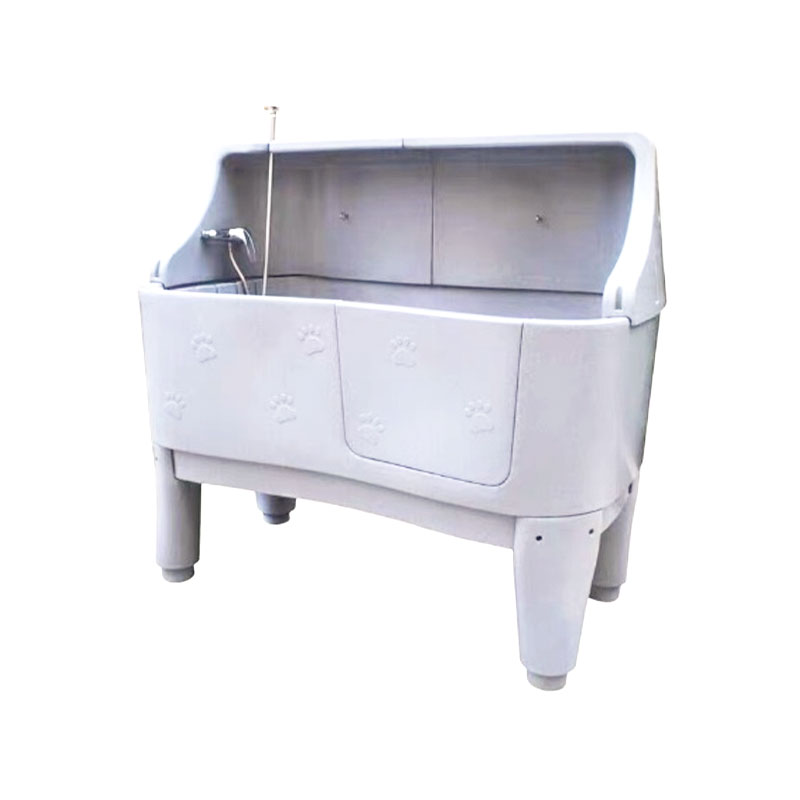
A pet bathtub mold is more than a production tool. It is the foundation for a bathing system that must protect animals, support professional operators, withstand repeated exposure to water and cleaning chemicals, and maintain consistent quality through many manufacturing cycles. When the mold is correctly engineered, it enables manufacturers to produce a seamless, durable, and easy-to-clean bathtub with a practical shape, stable dimensions, and dependable long-term performance.
Rotational molding is particularly well suited to pet bathing equipment because it can produce large, hollow plastic structures with smooth curves, rounded transitions, and integrated functional features. Unlike products assembled from multiple panels, a rotomolded bathtub can be formed as a one-piece structure without unnecessary joints or seams. This helps reduce potential contamination points, improves resistance to impact, and simplifies cleaning in professional environments.
Jiangsu Zhroto Mould Co., Ltd. specializes in rotational molding mold design, precision tooling manufacture, rotomolded product processing, and integrated technical support. The company develops molds for professional grooming bathtubs, veterinary washing equipment, commercial dog wash stations, and other large hollow plastic products. Its capabilities combine product engineering, cast aluminum tooling, CNC machining, mold trials, sample inspection, material recommendations, and production support.
The product advantages of a high-quality pet bathtub mold are closely connected with the quality of its design and manufacturing process. A mold must reproduce safe internal geometry, appropriate working dimensions, reliable drainage areas, stable wall distribution, and smooth surfaces. At the same time, the tooling must tolerate repeated heating, rotation, cooling, opening, closing, and handling without losing dimensional accuracy.
Pet bathtub mold
1. Why the Pet Bathtub Mold Matters
The final bathtub is only as reliable as the mold used to produce it. A poorly designed mold can create uneven walls, difficult-to-clean corners, excessive weight, unstable dimensions, weak attachment points, or uncomfortable areas that interfere with animal movement. These problems may increase production costs and create safety concerns for both pets and operators.
A professionally engineered pet bathtub mold addresses these requirements at the beginning of product development. The design process considers the intended animal size range, the installation environment, the working height, operator reach, drainage route, cleaning procedure, material selection, production quantity, and expected service conditions.
For a grooming salon, the bathtub must support repeated washing throughout the day. For a veterinary facility, the product may need to accommodate nervous, elderly, injured, or recovering animals. For a commercial dog wash station, the equipment must support high throughput, frequent cleaning, and continuous operator movement. These applications share a need for durability, but their ergonomic priorities may be different.
The mold can incorporate the geometry required for each application. Rounded internal corners help prevent sharp contact areas and make hair or residue easier to remove. Smooth sidewalls can guide animal movement without creating uncomfortable pressure points. Drainage provisions can be positioned to support rapid water removal while avoiding obstacles inside the bathing area. External reinforcement can be added where the bathtub requires extra stability during handling or installation.
Because these details are created in the mold, they are more effective and economical when considered before tooling begins. Correcting fundamental design problems after production has started can require mold modification, new samples, additional testing, or even complete tooling replacement. Early engineering review reduces these risks.
2. Main Advantages of Rotational Molding
Rotational molding uses heat and controlled rotation to distribute plastic material across the internal surface of a mold. As the mold rotates through heating, the polymer melts and gradually coats the mold wall. After sufficient material distribution and fusion, the mold is cooled while rotation continues. The finished part is then removed from the opened mold.
This process is highly suitable for pet bathtubs because it creates a hollow product without requiring complex internal cores or extensive assembly. The resulting structure can be large, lightweight, and resistant to impact. The process also allows manufacturers to create smooth curves and integrated contours that would be difficult or expensive to produce with other methods.
2.1 Seamless One-Piece Construction
A rotomolded bathtub can be manufactured as an integrated body with fewer seams, joints, and assembled panels. This seamless construction offers several advantages. It reduces locations where water, shampoo, hair, and dirt can accumulate. It also eliminates many potential weak points caused by mechanical fastening or bonding.
For professional users, easy sanitation is a major benefit. A smooth, continuous interior can be rinsed quickly between animals and cleaned with less effort. Fewer joints also help reduce long-term maintenance requirements. The one-piece structure can provide a clean appearance while supporting reliable impact resistance.
2.2 Lightweight but Durable Structure
Rotational molding produces a hollow body rather than a solid block. This allows the bathtub to maintain useful structural strength without unnecessary weight. A relatively lightweight product is easier to install, relocate, handle, and maintain. It can also reduce the load placed on supporting floors and work platforms.
Low weight is especially valuable for facilities that rearrange equipment, operate in rented premises, or require occasional relocation. It can also simplify transportation and reduce handling risks during installation. Proper mold design and process control are essential because lightweight construction must still deliver adequate rigidity and resistance to repeated use.
2.3 Corrosion Resistance
Pet bathing environments expose equipment to water, shampoos, conditioners, detergents, disinfectants, and other cleaning agents. Rotomolded polyethylene provides useful resistance to many of these substances. When the correct material and processing conditions are selected, the finished bathtub can remain functional and visually stable under regular chemical exposure.
Unlike certain metal structures that may corrode if protective coatings are damaged, polyethylene does not rely on a thin surface coating for its basic corrosion resistance. This makes it a practical material for wet environments. The finished product should still be cleaned according to the recommended procedures for the selected polymer and application.
2.4 Flexible Product Customization
Rotational molding supports customization of size, shape, surface finish, drainage position, accessory interfaces, reinforcement areas, and external contours. This flexibility allows manufacturers to develop products for different animal sizes, installation arrangements, and commercial workflows.
A pet bathtub mold can be adapted for compact grooming spaces, large professional salons, veterinary treatment areas, rehabilitation facilities, or high-volume wash centers. The same basic manufacturing technology can support multiple product families while allowing the mold geometry to reflect the specific operating environment.
3. Ergonomic Design for Professional Grooming
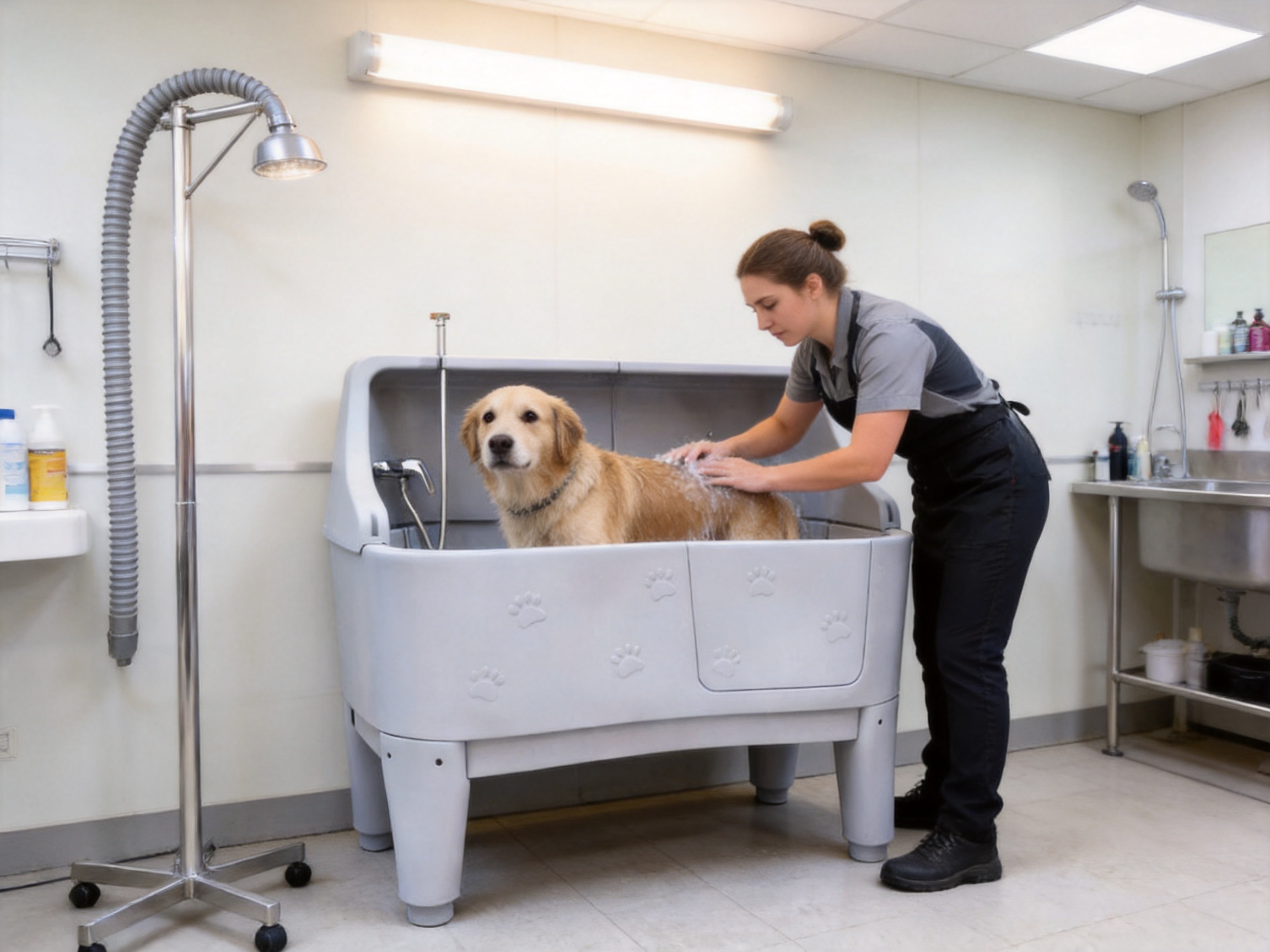
Professional grooming equipment is used repeatedly and often under time pressure. Operators may wash several animals during one working shift, so small ergonomic problems can become significant sources of fatigue. A bathtub that is too low can cause repeated bending. A structure that is too high may make it difficult to lift or control larger animals. A narrow internal area can restrict access, while poorly placed drainage features can interrupt the washing process.
The pet bathtub mold should therefore be designed around the complete relationship between the animal, the operator, and the workstation. The working height should be evaluated according to the typical animal size and the operator’s posture. Internal contours should offer sufficient space for washing while helping the animal remain within a stable area. The operator should be able to reach the animal from practical positions without excessive twisting or stretching.
Rounded internal geometry is one of the most important features. Sharp corners can increase the risk of injury, collect residue, and make cleaning difficult. Smooth transitions allow water to move more naturally toward the drainage area and create fewer locations where hair can become trapped.
The bathtub opening should also provide suitable access. An opening that is too small can complicate animal placement and removal. An opening that is excessively large may reduce containment and make nervous animals more difficult to manage. The mold designer must balance accessibility with safety according to the target product category.
External contours are important as well. The bathtub may need flat or reinforced areas for mounting, support frames, plumbing connections, splash guards, or accessories. These features should be integrated into the tooling rather than added in ways that create unnecessary stress concentrations or difficult-to-seal joints.
3.1 Cleaning Efficiency
Cleaning is part of the daily operating workflow, not an afterthought. A professional bathtub should allow staff to rinse away hair, shampoo residue, and dirt without spending excessive time on manual scrubbing. Smooth surfaces and rounded corners support faster cleaning and help improve hygiene between appointments.
The mold design determines whether these surfaces are continuous and accessible. Draft angles, corner transitions, drainage slopes, and accessory locations must be reviewed together. A drainage feature that works well hydraulically may still be inconvenient if it creates a raised obstruction or a difficult-to-reach recess.
Seamless rotomolded construction is particularly useful in this context. Compared with multi-piece products, a one-piece bathtub generally has fewer joints that require inspection and cleaning. This can help professional facilities maintain a more consistent sanitation routine.
3.2 Animal Stability and Comfort
Animals respond to their surroundings through movement, posture, and contact with the bathtub surface. A nervous animal may attempt to turn, climb, or shift its weight. A bathtub should provide sufficient internal space while using curved geometry to reduce abrupt movement and uncomfortable contact.
The mold may be designed with stable floor areas, gentle sidewall transitions, and carefully positioned accessory interfaces. These features can help operators manage animals without relying on sharp barriers or uncomfortable restraints. The final design should always be evaluated for the intended animal size and operating method.
4. Veterinary and Rehabilitation Applications
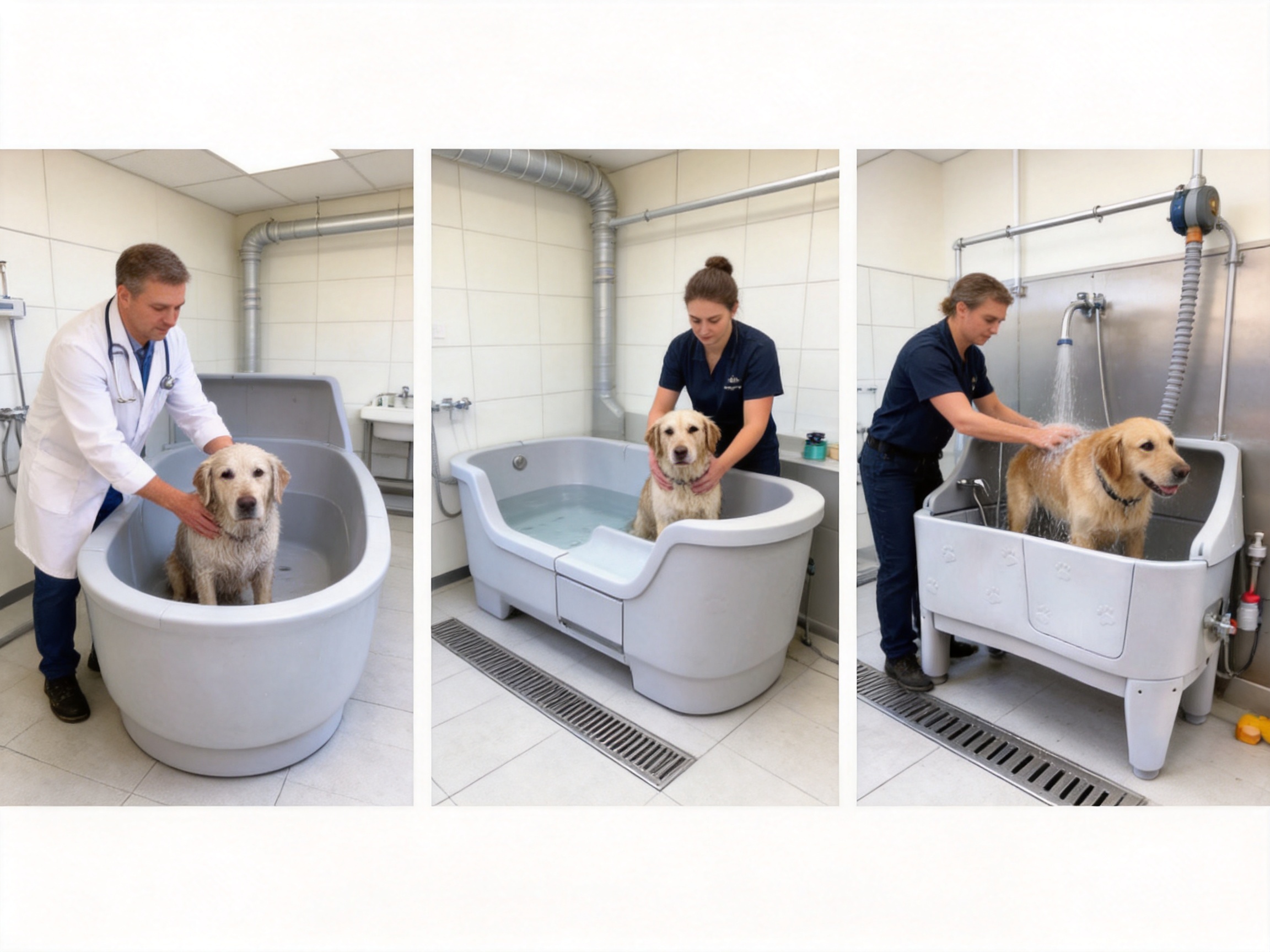
Veterinary and rehabilitation facilities have more specialized requirements than general grooming salons. Animals may be injured, elderly, recovering from surgery, or unable to stand securely. In these situations, the bathtub should support controlled handling and predictable movement.
Veterinary equipment molding places greater emphasis on smooth transitions, stable support, easy access, sanitation, and compatibility with additional equipment. The mold can be adapted to include drainage fittings, support locations, side access areas, or interfaces for related care equipment. Such features must be integrated carefully to avoid sharp edges, stress concentrations, or cleaning difficulties.
A veterinary bathtub may need to accommodate several animal sizes. The internal dimensions should be selected according to the intended clinical application rather than based only on external appearance. A product designed for small animals will have different access and containment requirements from one intended for large dogs or rehabilitation work.
Controlled access is especially important when animals are weak or uncomfortable. Staff may need to reach the animal from multiple sides, support its body, or assist with entry and removal. An ergonomic mold can provide wider working zones and smoother external transitions that make these movements safer.
Sanitation is another critical concern. Veterinary facilities need surfaces that can be disinfected efficiently and repeatedly. The bathtub should minimize deep recesses, narrow gaps, and unnecessary attached components. The rotational molding process can create a continuous body with smooth interior surfaces that support cleaning and reduce residue retention.
Material stability must also be considered. The finished product may encounter water, cleaning agents, disinfectants, and frequent temperature changes. Material selection and process control should be coordinated with the expected conditions so that the bathtub maintains its function over time.
4.1 Rehabilitation-Oriented Features
Rehabilitation applications can require greater control over animal movement. The bathtub may be used for therapeutic washing, recovery support, controlled exercise, or treatment preparation. In these cases, the internal geometry should avoid sudden steps or sharp transitions that could catch paws or interfere with assisted movement.
Operators may require additional clearance around the animal. The mold can be engineered to provide practical access for hands, hoses, support devices, or monitoring equipment. These details should be reviewed in three-dimensional design before the tooling is manufactured.
The strength of the finished product is also important. Even when the bathtub is lightweight, its floor and sidewalls must resist deformation under normal loading. Reinforcement geometry can be incorporated into the product design while maintaining a smooth surface that remains easy to clean.
5. Heavy-Duty Commercial Dog Wash Station Tooling
Commercial dog wash stations operate at a higher frequency than household bathing products. They may be used continuously throughout the day, exposed to repeated loading and unloading, and cleaned many times between customers. This creates demanding requirements for both the mold and the final bathtub.
Commercial dog wash station tooling should be designed around workflow efficiency. The operator must be able to guide the animal into the tub, secure it appropriately, wash and rinse it, remove it, drain the water, and prepare the area for the next customer. Every unnecessary step can reduce productivity.
The mold should reproduce stable contours that support quick animal placement and removal. Drainage areas should be positioned to prevent water accumulation without interfering with the animal. External surfaces should be compatible with mounting systems, work platforms, splash protection, and plumbing connections.
Durability is equally important. A commercial bathtub must tolerate repeated impact from animals, equipment, hoses, and cleaning tools. It should resist common chemicals and maintain its shape through long-term use. The mold itself must maintain dimensional accuracy so that each production batch remains consistent.
High-grade cast aluminum alloy is well suited to repeated rotational molding cycles. It provides useful structural stability, good thermal conductivity, and the ability to reproduce curved and detailed surfaces. Properly manufactured aluminum tooling can support efficient heating and cooling while remaining manageable for machine handling.
For high-volume production, repeatability becomes a major competitive advantage. Consistent tooling helps reduce variation in wall distribution, dimensions, drainage openings, and accessory interfaces. This makes downstream assembly and quality inspection more predictable.
| Product Application | Primary Ergonomic Priority | Important Mold Features | Main Production Advantage |
|---|---|---|---|
| Professional grooming bathtub | Operator access and cleaning speed | Rounded corners, practical working height, integrated drainage | Seamless construction for repeated daily use |
| Veterinary bathtub | Animal safety and controlled handling | Smooth transitions, stable support areas, sanitation-friendly surfaces | Adaptable geometry for specialized care environments |
| Rehabilitation bathtub | Controlled movement and staff access | Open working zones, gentle curves, reinforced floor structure | Customized tooling for therapeutic applications |
| Commercial dog wash station | Workflow efficiency and durability | Fast drainage, impact-resistant structure, accessory interfaces | Repeatable production for high-volume operations |
6. Cast Aluminum Alloy Tooling
The mold material has a direct influence on production stability, heat transfer, service life, and finished product quality. High-grade cast aluminum alloy is widely used for rotational molding tools because it combines structural strength with relatively low weight and good thermal conductivity.
Cast aluminum alloy can support the manufacture of large and curved mold sections without creating excessive handling loads. Its thermal performance helps transfer heat efficiently during the heating stage and release heat during cooling. Stable thermal behavior contributes to more consistent polymer distribution and more predictable cycle times.
Aluminum tooling can also reproduce complex product geometry. A pet bathtub may include curved sidewalls, rounded corners, external ribs, mounting interfaces, drainage provisions, and customized surface details. These features require accurate machining and careful control of parting surfaces.
Typical tooling may use an alloy such as A356, selected according to the mold size, design complexity, thermal requirements, and expected production conditions. The appropriate alloy and casting method should be confirmed through engineering evaluation rather than selected only by price.
The mold surface requires careful finishing. A smooth internal mold surface helps create a clean product surface and reduces the risk of unwanted texture or defects. Parting lines should be positioned and finished so that they do not create sharp or excessive flash on the final bathtub.
Tooling components must also be inspected for dimensional accuracy. Small deviations in the mold can influence the final product, particularly around drainage openings, mounting interfaces, and interlocking mold sections. Precision CNC machining helps achieve the consistency required for repeatable production.
7. Advanced Manufacturing Process
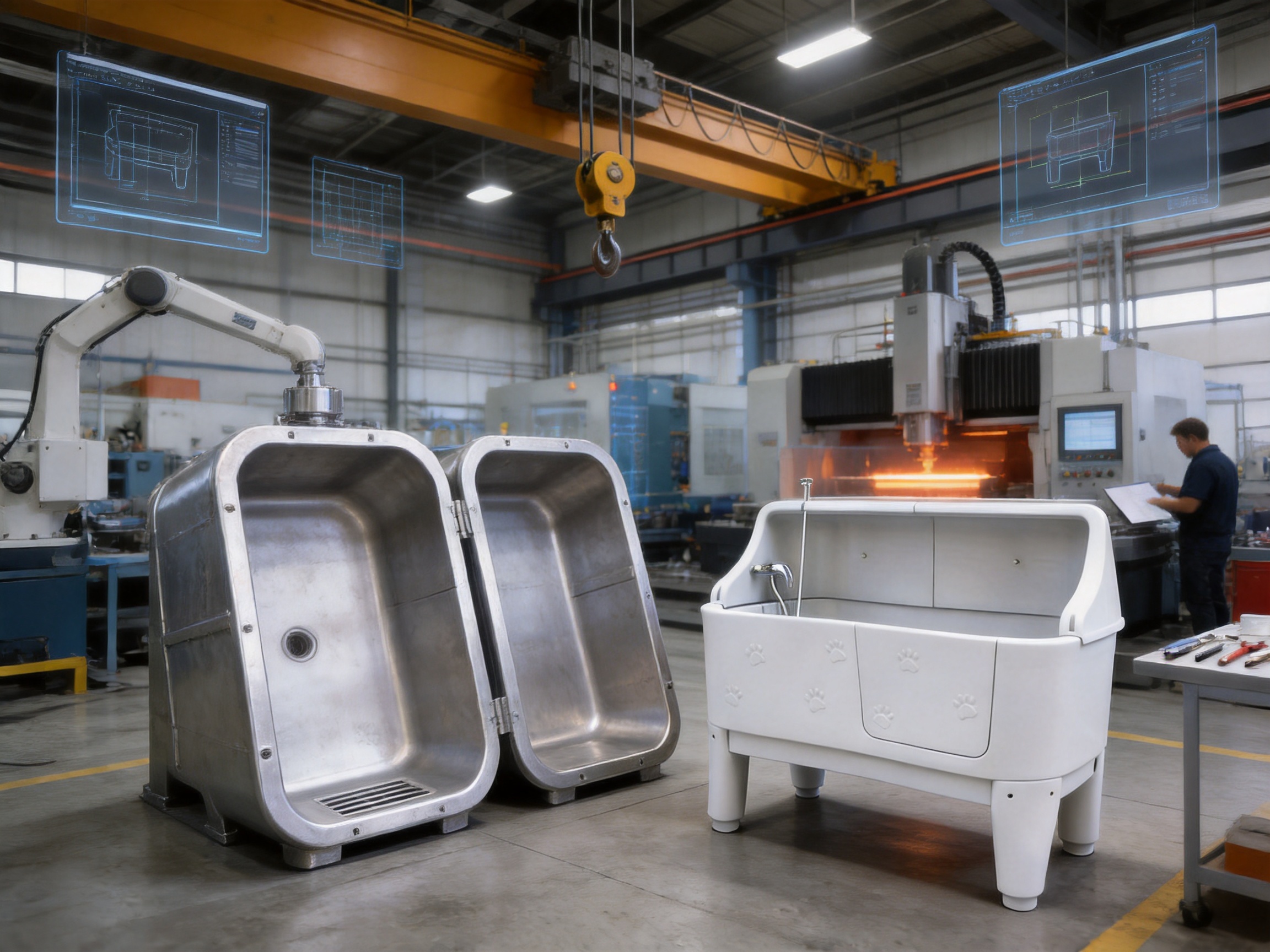
The manufacture of a pet bathtub mold requires more than casting or machining a basic shell. It involves a coordinated engineering process that connects product requirements with mold structure, machine compatibility, material behavior, and production validation.
7.1 Project Consultation and Application Review
The process begins with a review of the product application. Engineers evaluate the intended animal size, working environment, installation method, production quantity, material, heating equipment, drainage system, accessories, and target service life.
Customer drawings, three-dimensional data, sample products, or preliminary concepts can be used as starting points. If the product is still at the concept stage, the engineering team can help identify practical dimensions and features for rotational molding.
Application review is important because the best mold geometry depends on how the bathtub will be used. A small salon bathtub, a veterinary treatment tub, and a high-volume commercial station may require different dimensions and reinforcement strategies.
7.2 Product Design Optimization
Product design should be optimized for both ergonomics and manufacturing. The design team reviews wall transitions, draft, parting lines, corner radii, drainage features, insert locations, reinforcement areas, and demolding requirements.
Rotational molding allows considerable design freedom, but the product must still support uniform material distribution. Deep narrow sections, abrupt thickness changes, enclosed pockets, or difficult-to-reach areas can influence powder movement and heating behavior. Early design review helps prevent these problems.
The team also considers cleaning access and operator interaction. A feature that appears attractive on a drawing may create an inconvenient recess in production. Engineering analysis helps ensure that the product remains practical after molding.
7.3 Three-Dimensional CAD Engineering
Three-dimensional CAD modeling allows the mold and final bathtub to be reviewed before manufacturing begins. Engineers can evaluate internal volume, external dimensions, wall transitions, accessory locations, parting areas, and machine installation requirements.
CAD data also supports mold section development and CNC programming. Accurate digital models reduce communication errors between design, machining, assembly, and inspection teams. They provide a common reference for future modifications or related products.
During this stage, the customer can review the proposed product structure and confirm important dimensions. Adjustments are less expensive before casting and machining than after tooling has been completed.
7.4 Precision Casting and CNC Machining
After design approval, aluminum mold sections are produced using an appropriate casting process. The cast sections are then machined to achieve the required dimensions and surface quality. Large-scale CNC equipment is useful for complex curved surfaces and large mold components.
Machining accuracy is essential around the parting line, mold flanges, fastener locations, inserts, and functional interfaces. Surface finishing is performed to support reliable demolding and an acceptable final product appearance.
Zhroto Mould has experience in large-scale mold machining and curved-surface manufacturing. Its factory covers approximately 18,000 square meters, including more than 12,000 square meters of standardized production workshops. This provides space for mold fabrication, assembly, inspection, trial production, and related processing activities.
7.5 Assembly and Trial Production
Once machined, mold sections are assembled and inspected. The tooling is then tested under production conditions. Trial molding helps evaluate filling behavior, heating response, cooling performance, demolding, surface quality, wall distribution, and dimensional accuracy.
Trial production is not merely a final demonstration. It provides practical information about how the mold performs in the intended manufacturing system. Adjustments may be made to venting, inserts, parting areas, surface finish, heating parameters, or product geometry when necessary.
Sample inspection confirms whether the bathtub meets the approved design. Measurements can include overall dimensions, drainage location, mounting interfaces, wall thickness, surface condition, and functional fit. The sample validation stage helps reduce the risk of problems during mass production.
7.6 Production Support and Maintenance
Tooling performance should be maintained throughout its service life. Regular inspection of mold surfaces, parting areas, fasteners, hinges, inserts, and venting components can help prevent production variation. Cleaning and storage procedures should also be established according to the mold design and material.
Technical support is valuable when production conditions change. A manufacturer may introduce a different polymer grade, increase production volume, install new heating equipment, or modify a product feature. The mold supplier can help evaluate the effect of these changes and recommend suitable adjustments.
8. Compatibility with Different Heating Systems
Rotational molding molds must be compatible with the heating and cooling equipment used by the manufacturer. Conventional gas-heated machines remain widely used because they offer established production performance and broad application range. Electric-heated systems are increasingly attractive because they can provide more precise temperature control and independent heating zones.
The mold design may need to reflect the selected heating method. Large hollow products can experience different thermal conditions across their surfaces. Areas with complex curves, deep sections, or varying distances from the heat source may require special attention during process development.
Electric heating can help operators manage these conditions through zoned temperature control and improved process monitoring. This may support more consistent material distribution and reduce variation between different areas of a large bathtub.
Jiangsu Zhroto Mould Co., Ltd. has experience supporting both conventional gas-heated rotational molding equipment and electric-heated systems. Since 2023, the company has invested in electric-heating technology to improve temperature control, heating-zone management, and process monitoring.
The correct heating method depends on product size, polymer type, production volume, machine configuration, cycle requirements, and desired process control. Mold design should be developed in coordination with the intended machine rather than treated as an isolated component.
9. Competitive Advantages of a Professionally Engineered Mold
A high-quality pet bathtub mold can provide several advantages over basic or poorly engineered alternatives. These advantages affect the final product, manufacturing efficiency, operating costs, and customer satisfaction.
9.1 Better Safety
Rounded corners, burr-free parting areas, smooth surfaces, and stable geometry help protect animals and operators. Safety features are created through both product design and manufacturing accuracy. A mold that reproduces these features consistently is more valuable than one that only achieves an acceptable outer shape.
9.2 Improved Hygiene
Seamless construction and accessible surfaces reduce locations where hair, dirt, and chemical residue can remain. This supports faster cleaning and more consistent hygiene management. For professional grooming and veterinary facilities, the time saved between animals can improve daily productivity.
9.3 Greater Durability
Rotomolded polyethylene provides useful impact resistance, low weight, and chemical resistance. When the product is supported by correct wall distribution and reinforcement geometry, it can withstand repeated commercial use. Cast aluminum tooling contributes to repeatable production and long service life.
9.4 Lower Tooling Cost for Suitable Volumes
Rotational molding tooling is often more economical than comparable injection or blow molding tooling for large hollow products, custom designs, and low-to-medium production volumes. The mold structure is generally less complex than a multi-part injection mold, while still allowing extensive customization.
This cost advantage is especially relevant when manufacturers are introducing a new pet-care product, testing a specialized design, or producing several product sizes. The final tooling choice should be based on product geometry, quantity, cycle requirements, and total production economics.
9.5 Faster Product Development
An integrated workflow reduces the distance between product concept, engineering, tooling, testing, and production. When one technical team manages these stages, design changes can be communicated more efficiently. This helps reduce delays caused by unclear drawings, incompatible dimensions, or incomplete manufacturing information.
9.6 Stable Repeatability
Precision tooling and controlled processing help manufacturers produce bathtubs with consistent dimensions and appearance. Repeatability is important when products must fit support frames, plumbing components, covers, accessories, or standardized packaging.
10. Company Manufacturing Strengths
Jiangsu Zhroto Mould Co., Ltd. was founded in 2015 and focuses on rotational molding mold design, rotomolded product processing, and integrated technical solutions. The company moved to a modern facility in Jiangyan District, Taizhou City, in 2021. The facility covers approximately 18,000 square meters, including more than 12,000 square meters of standardized production workshops.
The company has an annual capacity exceeding 800 mold sets and approximately 3,600 tons of plastic products. Its experience covers pet-care products as well as hydrogen energy storage and transportation, automotive components, industrial equipment, agricultural machinery, water treatment, outdoor facilities, tanks, containers, and other large hollow structures.
This broad application experience is valuable because pet bathtubs share engineering principles with many other rotomolded products. Large hollow parts require reliable heat transfer, uniform material distribution, practical demolding, structural reinforcement, and careful control of curved surfaces. Experience across industries can support stronger problem-solving during custom development.
The company provides services from product concept review and structural optimization through CAD modeling, mold manufacturing, material recommendations, trial production, sample validation, inspection, delivery, and ongoing technical support. This one-stop structure can reduce communication gaps between product design and tooling production.
Its management systems are supported by ISO 9001:2015 quality certification, ISO 14001:2015 environmental certification, and ISO 45001 occupational health and safety certification. These systems help establish consistent procedures for quality control, environmental management, and workplace safety.
11. Quality Control and Validation
Quality control begins with the design and continues through production and delivery. For a pet bathtub mold, inspection should cover both the tooling and the molded sample.
Tooling inspection may include dimensional verification, surface finish review, parting-line inspection, insert confirmation, fastener checking, and assembly alignment. The purpose is to confirm that the mold is structurally sound and ready for production.
Sample validation evaluates the final bathtub under practical conditions. Important factors include external dimensions, internal clearance, corner quality, drainage position, wall distribution, surface appearance, demolding performance, and compatibility with accessories or supporting structures.
For commercial products, repeated trial cycles may be useful. One sample can confirm general geometry, but multiple cycles provide more information about repeatability and thermal behavior. Production parameters should be recorded so that approved conditions can be reproduced later.
Quality documentation is also important for future maintenance. Approved drawings, inspection records, material specifications, sample images, and process recommendations can help the manufacturer manage later production or product revisions.
12. Material and Product Performance
The material used for the finished bathtub must match the intended application. Rotomolded polyethylene is commonly selected for its balance of impact resistance, chemical resistance, processability, and relatively low density. The precise grade should be selected according to temperature, loading, color, surface requirements, and chemical exposure.
Uniform wall distribution contributes to predictable performance. Excessively thin areas may reduce impact resistance, while unnecessarily thick areas can increase weight, cycle time, and material consumption. Mold geometry, polymer quantity, heating conditions, and rotation must be coordinated to achieve an appropriate structure.
The finished product should also maintain stable dimensions during normal use. Support ribs, floor geometry, and external reinforcement can help reduce deformation. These features should be designed to support strength without creating difficult-to-clean cavities.
Surface quality affects both appearance and hygiene. A smooth surface is easier to rinse and disinfect. It can also reduce the tendency of hair and residue to adhere to the bathtub. Mold finishing, material selection, and process temperature all influence the result.
Color and surface texture can be customized according to the product positioning. A manufacturer may require a professional neutral finish, a branded color, a textured external surface for handling, or a smoother internal surface for cleaning. Such requirements should be incorporated into the mold and material plan.
13. Selecting the Right Pet Bathtub Mold Supplier
Choosing a mold supplier should involve more than comparing the initial tooling quotation. Manufacturers should evaluate engineering capability, mold material, machining precision, trial-production support, communication quality, production capacity, and after-sales service.
The supplier should understand the final product rather than simply manufacture a shape from a drawing. Questions should address animal size, operator workflow, cleaning procedures, drainage, installation, machine compatibility, production quantity, and expected service life.
Experience with large curved surfaces is important because pet bathtubs often have substantial dimensions and complex transitions. The supplier should be able to explain how the design will be heated, cooled, demolded, inspected, and maintained.
Customers should also request information about sample validation. A responsible supplier should be prepared to test the mold, inspect trial parts, identify potential issues, and make reasonable corrections before final acceptance.
Technical support after delivery is another consideration. A mold may be used for many years, and production conditions may change. Access to maintenance advice, process recommendations, and modification support can protect the tooling investment.
14. Recommended Development Workflow
A practical development workflow begins with a product brief. The brief should identify the target animals, working environment, overall dimensions, installation method, drainage arrangement, accessories, production quantity, polymer, color, surface finish, and machine type.
The next stage is concept evaluation. Engineers review the product for ergonomics, manufacturability, structural stability, material distribution, cleaning access, and demolding. This stage is an opportunity to identify problems before they become tooling costs.
After the design is approved, detailed CAD data and mold drawings are prepared. Parting lines, inserts, fasteners, vents, support areas, and machining references are confirmed. Customers should approve the key dimensions before casting begins.
Tooling is then cast, machined, finished, assembled, and inspected. Trial production follows, using the planned material and machine conditions whenever possible. The resulting sample is measured and evaluated against the approved design.
Any necessary corrections should be completed before final delivery. Once the mold is accepted, the supplier can provide information about production parameters, cleaning, storage, inspection, and maintenance.
15. Frequently Asked Questions
Q1: What is a pet bathtub mold used for?
A pet bathtub mold is a specialized tool used to produce integrated plastic bathtubs for grooming salons, veterinary facilities, rehabilitation centers, commercial dog wash stations, and related pet-care applications. It determines the bathtub’s shape, dimensions, internal contours, drainage features, surface transitions, and structural details.
Q2: Why is rotational molding suitable for pet bathtubs?
Rotational molding can create large, hollow, seamless structures with rounded corners and relatively uniform wall distribution. It supports lightweight construction, good impact resistance, chemical resistance, and extensive customization. These characteristics are well suited to wet, high-use pet-care environments.
Q3: What advantages does cast aluminum tooling provide?
Cast aluminum alloy offers useful thermal conductivity, structural stability, relatively low weight, and the ability to reproduce complex curved surfaces. It can support repeated heating and cooling cycles while remaining practical to handle on rotational molding equipment.
Q4: Can the mold be customized for different animal sizes?
Yes. The mold can be developed around different external dimensions, internal clearances, floor areas, sidewall heights, drainage arrangements, and accessory interfaces. The intended animal size and application should be defined before detailed engineering begins.
Q5: How does a commercial dog wash station mold differ from a household bathtub mold?
Commercial tooling is generally designed for more frequent use, greater durability, faster cleaning, improved drainage, and more efficient operator movement. It may also require stronger mounting features, reinforced floor geometry, and compatibility with commercial plumbing or support systems.
Q6: How can the mold improve hygiene?
A seamless one-piece bathtub has fewer joints where water, hair, dirt, and shampoo residue can collect. Rounded corners and smooth surfaces are easier to rinse and disinfect. The mold can also be designed to reduce deep recesses and difficult-to-access areas.
Q7: What materials are commonly used for the finished bathtub?
Rotomolded polyethylene is commonly used because it offers a practical combination of low weight, impact resistance, chemical resistance, durability, and processing flexibility. The exact grade should be selected according to the intended conditions and performance requirements.
Q8: Can the mold work with electric-heated rotational molding equipment?
Yes. Tooling can be developed for electric-heated rotational molding systems as well as conventional gas-heated machines. The heating method should be considered during mold design because product geometry and thermal behavior influence process performance.
Q9: What information should a customer provide before requesting a quotation?
Useful information includes product drawings or concepts, overall dimensions, animal size range, intended application, production quantity, polymer type, color, surface finish, drainage requirements, accessories, machine type, and installation method. The more complete the product brief, the more accurately the tooling can be evaluated.
Q10: What services does Jiangsu Zhroto Mould Co., Ltd. provide?
The company supports product consultation, structural optimization, three-dimensional engineering, rotational mold design, cast aluminum tooling, CNC machining, trial production, sample validation, material and process recommendations, quality inspection, delivery, and production support.
16. Conclusion
A pet bathtub mold is the foundation of a safe, hygienic, durable, and efficient bathing product. Its design influences animal comfort, operator posture, drainage, cleaning, structural strength, appearance, production repeatability, and long-term maintenance.
Rotational molding provides a strong manufacturing solution for this application. It can create seamless hollow structures with smooth curves, rounded corners, consistent material distribution, low weight, and useful resistance to water and cleaning chemicals. Compared with basic assembled products, a well-designed rotomolded bathtub can offer better hygiene, fewer weak points, improved customization, and practical durability.
The advantages depend on the quality of the tooling. High-grade cast aluminum alloy, accurate CAD engineering, precision CNC machining, controlled thermal performance, trial production, and sample validation are all important. When these stages are managed as one integrated process, manufacturers can reduce design risk and improve the reliability of the finished product.
Jiangsu Zhroto Mould Co., Ltd. combines rotational molding expertise with large-scale manufacturing capability, product development support, and experience across multiple industrial sectors. Its production capacity, standardized facilities, ISO management systems, aluminum tooling capabilities, and support for both gas-heated and electric-heated equipment make it a suitable partner for customized pet-care tooling.
For professional grooming, veterinary treatment, rehabilitation, and commercial dog wash applications, the right mold can convert ergonomic ideas into a dependable product. By considering safety, hygiene, operator access, material performance, thermal behavior, and production efficiency from the beginning, manufacturers can create pet bathing equipment that performs reliably in demanding real-world environments.
References
1. Association of Rotational Molders. Rotational Molding Process Principles and Product Design Considerations.
2. ASTM International. Standard Practices for Rotational Molding and Evaluation of Plastic Products.
3. Plastics Industry Association. Guidelines for Polymer Selection in Rotationally Molded Applications.
4. Aluminum Association. Aluminum Alloy Selection, Casting Characteristics, and Thermal Performance.
5. International Organization for Standardization. ISO 9001:2015 Quality Management Systems.
6. International Organization for Standardization. ISO 14001:2015 Environmental Management Systems.
7. International Organization for Standardization. ISO 45001 Occupational Health and Safety Management Systems.
8. Human Factors and Ergonomics Society. Principles of Ergonomic Workstation Design.
9. Rotational Molding Technical Association. Mold Construction, Heating, Cooling, and Process Control Practices.
10. Jiangsu Zhroto Mould Co., Ltd. Product Engineering, Tooling Manufacturing, and Rotomolded Product Development Information.
Product: Pet bathtub mold


We provide customers with one-stop services ranging from product design, mold manufacturing to finished product production.
-
 +86-18006248936
-
 ricky.t@zhroto.com
-
 No.9 Jiangyuan Road, Luotang Street, Jiangyan District, Taizhou City,Jiangsu Province, China
Copyright © Jiangsu Zhroto Mould Co., Ltd. Rights Reserved.Custom Rotational Plastic Molding Factory
