 en
 中文简体
 русский
 Español
 Deutsch
 Polskie
 REQUEST A QUOTE

 Home / Author / Linnea Qiao — International Sales Manager / Custom Military Box Mold for Durable Rotomolded Protective Cases
Custom Military Box Mold for Durable Rotomolded Protective Cases
Content
- 1 Why Military Box Mold Quality Matters
- 2 6061-T6 Forged Aluminum Alloy for Military Box Molds
- 3 Heavy-Duty Transport Case Mold Design
- 4 Rugged Tactical Equipment Case Tooling
- 5 Waterproof Equipment Case Production Molds
- 6 Advanced Military Box Mold Manufacturing Process
- 7 Compatibility with Gas-Heated and Electric-Heated Rotomolding
- 8 Advantages Compared with Basic or Poorly Engineered Tooling
- 9 Manufacturing Strengths and Integrated Services
- 10 Quality Control for Military Box Mold Projects
- 11 Maintenance and Service Life of Military Box Molds
- 12 How to Select a Military Box Mold Manufacturer
- 13 Frequently Asked Questions
- 13.1 Q1: What material is commonly used for a durable military box mold?
- 13.2 Q2: Why is forged aluminum suitable for rotational molding molds?
- 13.3 Q3: Can a military box mold include custom handles, hinges, ribs, and latch areas?
- 13.4 Q4: How does a heavy-duty transport case mold differ from a tactical case mold?
- 13.5 Q5: Why is mold accuracy important for waterproof equipment cases?
- 13.6 Q6: Can the tooling be used with both gas-heated and electric-heated machines?
- 13.7 Q7: What is the purpose of trial production?
- 13.8 Q8: What information should a customer provide when requesting a military box mold?
- 13.9 Q9: Does the mold manufacturer support product design optimization?
- 13.10 Q10: How can mold service life be extended?
- 13.11 Q11: What services does Jiangsu Zhroto Mould Co., Ltd. provide?
- 13.12 Q12: What makes a military box mold more competitive than basic tooling?
- 14 Conclusion
- 15 References
- 16 Product: Military box mold
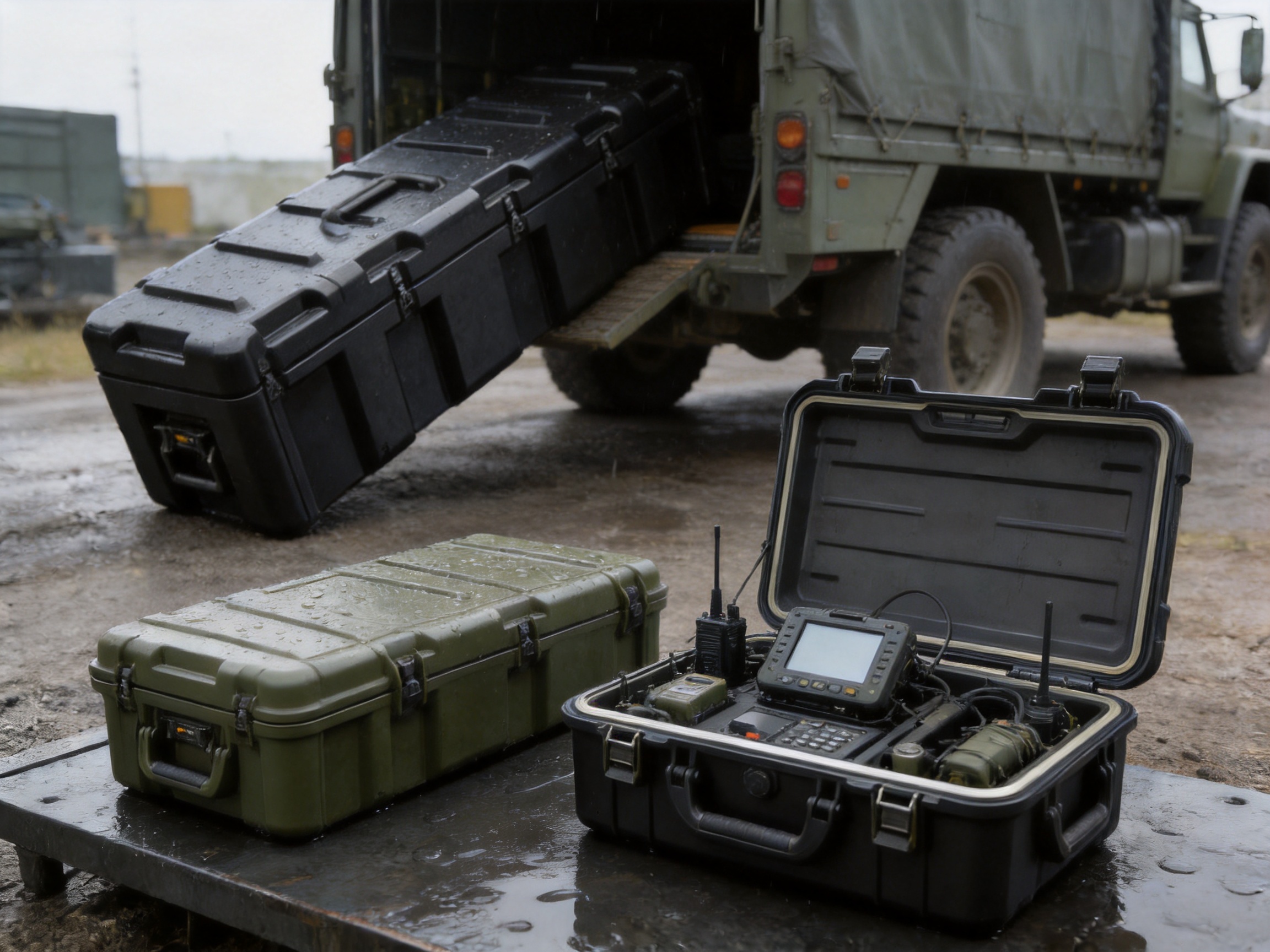
Military and industrial equipment cases must protect valuable contents through transportation, storage, field deployment, repeated handling, and exposure to demanding environmental conditions. The finished case must be strong, dimensionally stable, impact resistant, and capable of supporting reliable sealing and assembly. Behind these performance requirements is a critical manufacturing foundation: the military box mold.
A high-quality military box mold does more than define the external shape of a rotationally molded case. It controls the consistency of the cavity, influences polymer distribution, supports accurate structural details, affects product release, and contributes to repeatable production over many molding cycles. When the mold is designed and manufactured correctly, it helps manufacturers produce rugged cases with dependable geometry and stable quality.
Custom military box molds made from 6061-T6 forged aluminum alloy offer an effective solution for demanding rotational molding applications. The alloy combines strength, durability, machinability, and favorable surface characteristics. When paired with 3D engineering, precision CNC machining, professional polishing, controlled testing, and process-specific thermal design, it provides a strong foundation for heavy-duty transport cases, tactical equipment cases, waterproof cases, and other protective containers.
Jiangsu Zhroto Mould Co., Ltd. specializes in the design and manufacture of rotational molding molds and provides integrated technical services from product development to mold testing and production support. Its experience across industrial equipment, automotive components, agricultural machinery, water treatment, outdoor facilities, and other sectors supports the development of customized tooling for military-style boxes and rugged equipment cases.
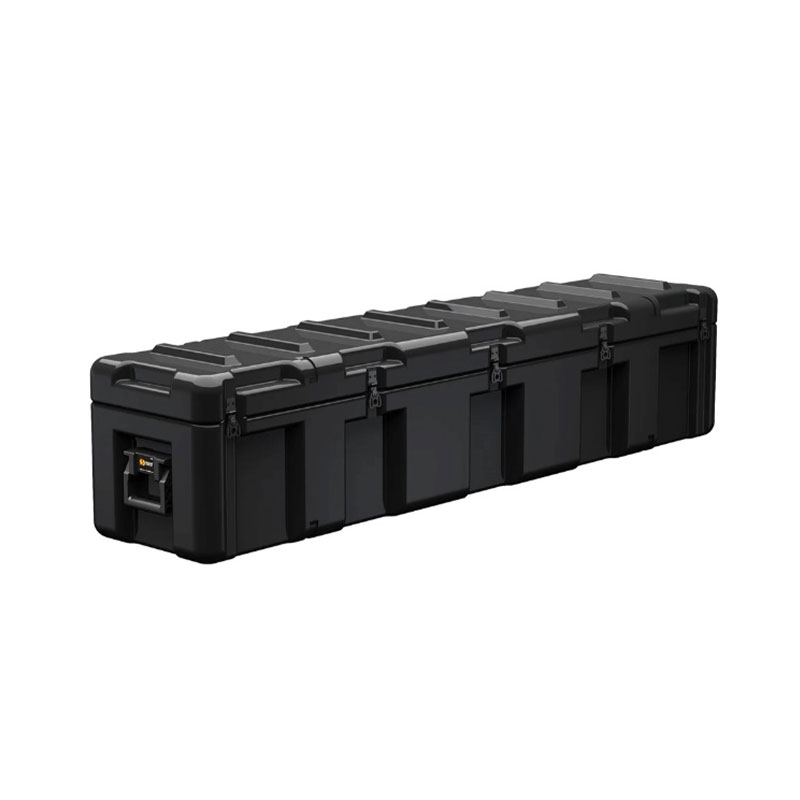
Military box mold
Why Military Box Mold Quality Matters
The performance of a rotomolded military box begins long before plastic powder enters the molding machine. Mold quality influences the product's dimensions, wall distribution, corner geometry, surface finish, assembly interfaces, and ability to reproduce details accurately. A mold that is poorly designed or inaccurately machined may create variation that cannot be corrected through production adjustments alone.
Military and protective cases frequently include reinforced corners, integrated handles, hinge areas, latching features, gasket interfaces, ribs, mounting points, and customized internal structures. Each of these details must be considered during mold development. The tooling must reproduce the features without creating unnecessary sharp transitions, difficult demolding conditions, or areas where polymer distribution becomes inconsistent.
Rotational molding is especially dependent on the interaction between mold geometry, heating conditions, polymer movement, and cooling behavior. During production, the mold rotates around multiple axes while the polymer melts and coats the internal cavity. The finished wall must develop evenly across large flat sections, curved corners, ribs, and local reinforcements. Mold geometry therefore needs to support a balanced and predictable molding process.
For military applications, the acceptable quality standard is usually higher than that of a basic storage container. A transport case may be exposed to impacts, vibration, lifting, stacking, temperature variation, dust, moisture, and rough handling. A tactical equipment case may need to protect sensitive instruments or communication components. A waterproof case may depend on accurate mating surfaces and sealing interfaces. These different requirements must be reflected in the mold design from the beginning.
From Product Concept to Production Tooling
A professional military box mold project should start with the finished product and its operating environment rather than with a standard mold size. Product dimensions, expected loading, equipment weight, wall thickness, closure method, accessories, production volume, heating system, and service conditions all influence the tooling strategy.
During the initial evaluation, the manufacturer can review product drawings, three-dimensional data, reference samples, or an early concept. The engineering team then considers whether the product is suitable for rotational molding and whether the proposed features can be produced consistently. If necessary, the product structure can be optimized to improve strength, simplify demolding, control wall distribution, and reduce unnecessary manufacturing complexity.
This early review is particularly valuable for customized cases. A design that appears suitable in a digital model may require modifications to corners, ribs, interfaces, or mounting areas before mold machining begins. Addressing these issues during design is more efficient than discovering them after tooling has been completed.
6061-T6 Forged Aluminum Alloy for Military Box Molds
Material selection is one of the most important decisions in military box mold manufacturing. The mold material must withstand repeated heating and cooling cycles, maintain dimensional stability, support accurate machining, and provide a surface that can be finished effectively. For many rotational molding applications, 6061-T6 forged aluminum alloy provides a strong balance of these characteristics.
6061-T6 forged aluminum alloy is valued for its combination of strength, durability, machinability, and corrosion resistance. The forging process produces a dense internal structure that is suitable for precision tooling. A dense and consistent material structure helps support stable machining and reduces the risk of internal weaknesses that could affect long-term mold performance.
The surface quality of the alloy is also important. A mold with a clean, consistent surface can be polished more effectively and finished to meet the requirements of the product. Smooth mold surfaces may support more reliable product release and help produce a cleaner external appearance on the finished plastic case.
Another advantage is the alloy's ability to support customized cavity configurations. Military boxes are rarely identical to ordinary commercial containers. They may have deep corners, curved panels, recessed areas, reinforcing details, custom lid profiles, and specialized equipment interfaces. 6061-T6 aluminum can be machined into complex shapes while maintaining the precision required for repeatable rotational molding.
Strength and Long-Term Tooling Stability
Military box molds must remain stable over repeated production cycles. The tooling is exposed to thermal changes, mechanical handling, cleaning, maintenance, and continuous contact with plastic materials. A mold that changes shape or develops surface defects can gradually affect product quality and increase maintenance requirements.
The strength of 6061-T6 forged aluminum provides a suitable foundation for molds used in demanding applications. Its performance is particularly useful when the mold includes reinforced areas, large panels, deep cavity sections, or complex structural features. Proper mold design remains essential, but the material provides the mechanical foundation required for long-term use.
Compared with lower-quality or less suitable tooling materials, forged aluminum can offer advantages in cavity integrity, machining consistency, heat response, and finishing potential. The most appropriate material depends on the product and production process, but 6061-T6 forged aluminum is a practical choice for customized military and protective cases.
Surface Finish and Product Release
Surface finish influences both the appearance of the finished product and the efficiency of the molding cycle. Uneven or damaged mold surfaces may transfer defects to the product or make release more difficult. A carefully machined and polished cavity can help create a more consistent surface and reduce the risk of unwanted marks.
Polishing must be selected according to the product requirements. Some military cases require a clean technical appearance, while others may need a textured surface for improved handling or a specific visual effect. The mold manufacturer should consider the relationship between cavity finish, product release, texture, wall distribution, and the intended application.
6061-T6 forged aluminum offers favorable conditions for controlled finishing. After CNC machining, the mold can be inspected, refined, and polished according to the required surface standard. This combination of accurate machining and suitable finishing supports dependable product quality across repeated cycles.
Heavy-Duty Transport Case Mold Design
Heavy-duty transport cases are designed to protect equipment during movement between manufacturing sites, storage locations, transport vehicles, and field operations. They may be lifted, stacked, loaded, unloaded, and exposed to vibration or impact. The mold must therefore support a case structure with reliable corners, stable panels, durable interfaces, and sufficient resistance to deformation.
The design of a heavy-duty transport case should balance structural strength with efficient rotational molding. Excessive material concentration in one area can lead to uneven heating, inconsistent wall thickness, extended cycle times, or local weakness elsewhere in the product. A well-designed mold helps guide the polymer toward the intended surfaces and supports a more balanced shell.
Large panels require particular attention. Broad flat surfaces can be vulnerable to distortion if they lack suitable curvature, reinforcement, or structural support. The mold may incorporate ribs, recessed features, curved transitions, or other design elements that improve product stiffness while remaining suitable for rotational molding.
Reinforced Corners and Load-Bearing Areas
Case corners often experience concentrated loads during handling and impact. They may also be exposed to abrasion when a case is placed on the ground or moved across a surface. For this reason, corners should be reviewed carefully during product and mold development.
Reinforced corners can be incorporated through suitable geometry, controlled transitions, and localized structural features. The mold must reproduce these features accurately without creating sharp areas that interfere with polymer flow or product release. Smooth transitions are generally preferable because they support better material distribution and reduce stress concentration.
Load-bearing areas around handles, hinges, latches, wheels, and mounting points also require careful engineering. These interfaces may need additional structural support in the finished case. The mold can be designed to produce suitable bosses, recesses, ribs, or mounting surfaces, depending on the product architecture.
- Reinforced corners can improve resistance to repeated impacts and handling loads.
- Rounded transitions can support more consistent polymer distribution.
- Accurate mounting areas can simplify assembly and improve component fit.
- Large curved surfaces can help maintain dimensional stability.
- Controlled cavity finishing can support consistent product release.
Dimensional Consistency in Transport Cases
Dimensional consistency is essential when a case includes a separate lid, gasket, hinge, latch, tray, insert, or protective frame. Even small variations in key areas can affect assembly or sealing. The mold must therefore maintain accurate relationships between panels, interfaces, and functional features.
Precision CNC machining is used to produce the cavity and critical details according to the approved three-dimensional model. After machining, important dimensions can be inspected and compared with the engineering data. Trial production then provides an opportunity to evaluate the finished product under actual rotational molding conditions.
This combination of digital design, machining inspection, and sample validation is more reliable than depending only on visual assessment. It allows potential issues to be identified before final production release and helps confirm that the mold performs correctly on the customer's equipment.
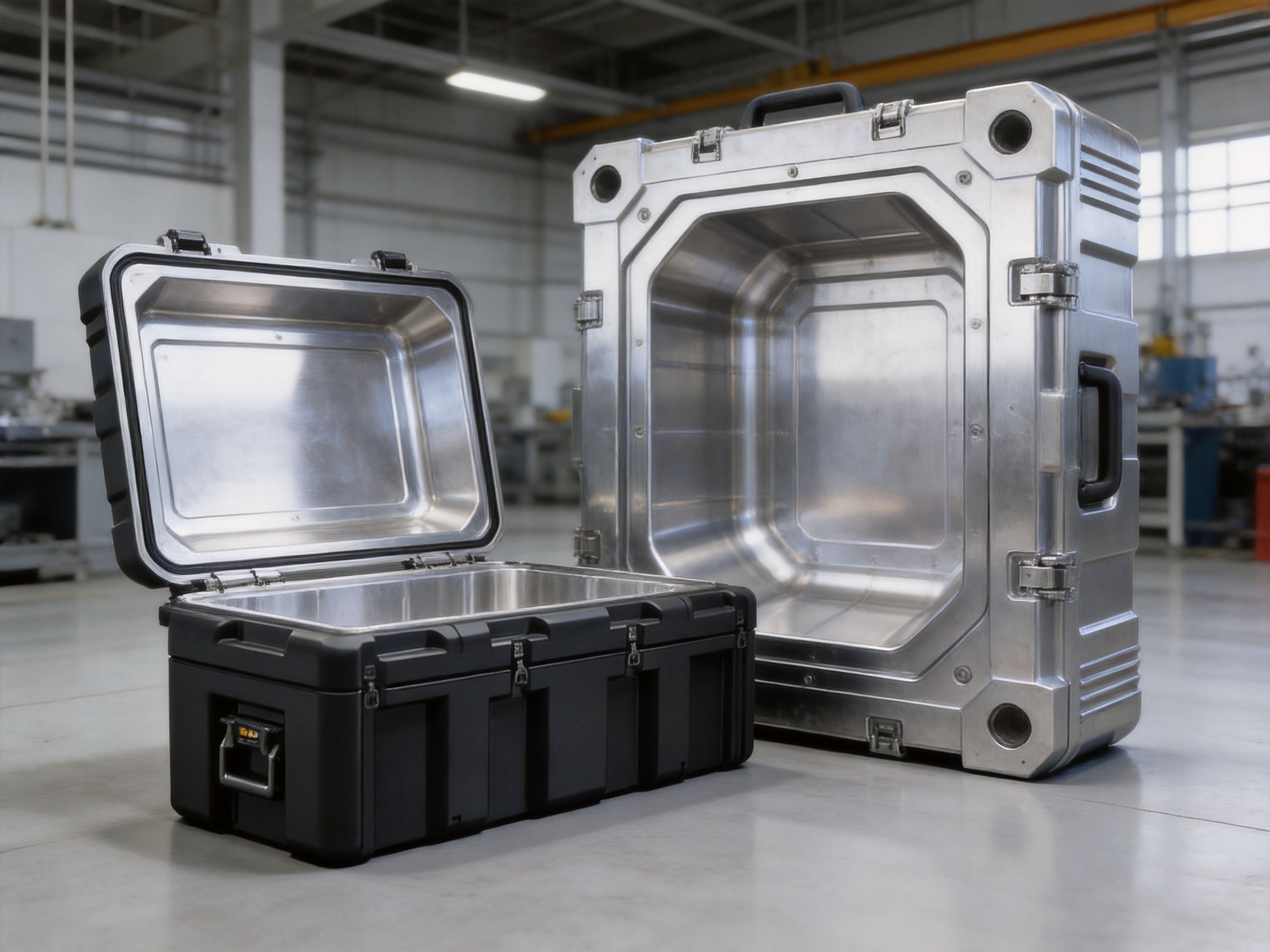
Rugged Tactical Equipment Case Tooling
Tactical equipment cases are often customized around the dimensions and operating requirements of specific tools, instruments, communication systems, sensors, field equipment, or electronic components. The case may require unusual proportions, specialized interfaces, reinforced mounting areas, and compatibility with internal protective inserts.
The tooling for a tactical case must reproduce the outer shell accurately while supporting the details needed for assembly and field use. These may include handles, latches, hinges, gasket channels, drainage features, protective ribs, equipment mounts, and customized lid structures. Each detail should be considered in relation to the rotational molding process.
A tactical case mold should not simply copy a product shape without evaluating how that shape will behave during heating, rotation, cooling, and demolding. The engineering team must review the relationship between flat sections and curved areas, the location of ribs and recesses, the depth of cavity features, and the accessibility of all surfaces for machining and finishing.
Complex Geometry and Smooth Transitions
The transition between flat and curved surfaces is especially important in a tactical case. Abrupt changes can create localized material variation or make the finished product more difficult to remove from the mold. Smooth transitions generally provide a better foundation for predictable polymer movement.
When a product includes deep recesses or narrow structural details, the manufacturer should evaluate whether the feature can be molded consistently and whether it will require special process control. The mold design may need to adjust the feature's radius, depth, orientation, or connection to adjacent surfaces.
Three-dimensional engineering allows these details to be reviewed before manufacturing. A digital mold model can help confirm cavity accessibility, parting arrangements, assembly relationships, and critical dimensions. It also provides a common reference for communication between the customer, product designer, mold engineer, and production team.
Protection for Sensitive Equipment
A tactical case may be used to protect equipment that is sensitive to shock, moisture, dust, vibration, or electrostatic conditions. The mold itself does not provide every protective function, but it establishes the outer structure that supports lids, seals, internal inserts, and mounting systems.
For example, the case shell may need stable interfaces for a gasket or a protective insert. It may require sufficient rigidity to prevent excessive deflection when the case is closed or stacked. It may also need external ribs or reinforced surfaces to improve durability without making the product unnecessarily heavy.
These requirements should be evaluated together. Adding more material is not always the best solution because excessive weight can make the case difficult to transport and may increase material use. Good mold engineering seeks a balance between strength, weight, manufacturability, and service performance.
Waterproof Equipment Case Production Molds
Waterproof equipment cases depend on accurate mating surfaces, reliable closure systems, and consistent sealing interfaces. The mold must help create a shell that maintains the required dimensions around the lid, gasket area, fasteners, hinges, and other protective features.
A waterproof case is not defined only by a closed shape. Its protective performance depends on how well the lid and base fit together, how consistently the sealing area is produced, and how accurately the accessories are installed. Mold variation around these areas can affect compression, alignment, and final assembly.
For this reason, the mold should be engineered with close attention to the relationship between cavity geometry and the intended sealing system. The product designer and mold manufacturer should confirm whether the case uses a gasket, compression seal, overlapping lip, mechanical latch, or another protective arrangement.
Sealing Interfaces and Mating Surfaces
Sealing areas often include relatively narrow or detailed surfaces that must be reproduced consistently. These areas should be machined accurately and inspected carefully. Surface defects, unwanted burrs, or dimensional variation may affect how components fit together.
A smooth and stable mold surface can support reliable release and help maintain the intended appearance of the sealing area. The mold should also allow the finished product to be removed without damaging delicate interface features.
Where the case includes a separate lid and base, the tooling strategy may involve multiple mold sections or coordinated molds. The dimensional relationship between these components must be considered as part of the complete product system rather than evaluated separately.
Environmental Protection Features
Waterproof and outdoor equipment cases may also require drainage paths, protective overhangs, recessed fasteners, covered hinges, and raised surfaces that reduce direct contact with water or dirt. These features should be designed with suitable radii and transitions to support rotational molding.
In addition to water resistance, the case may need to withstand ultraviolet exposure, temperature changes, dust, and repeated cleaning. The mold cannot determine the performance of the polymer material or accessories, but it must provide consistent product geometry so that the complete protective system can function as intended.
Accurate tooling is particularly valuable when the finished case is produced in large quantities. Repeatable dimensions help reduce assembly variation and support more stable quality control. They also make it easier to replace accessories or components during the product's service life.
Advanced Military Box Mold Manufacturing Process
Advanced manufacturing is not limited to the final machining operation. It includes the complete workflow used to convert a product requirement into reliable tooling. A professional process typically includes project evaluation, product structure review, three-dimensional engineering, material selection, mold design confirmation, rough and precision machining, finishing, testing, inspection, and production support.
Project Consultation and Product Evaluation
The project begins with a review of the customer's requirements. This may include product drawings, three-dimensional files, physical samples, target production volume, available molding equipment, polymer type, heating method, expected service environment, and required delivery schedule.
Product evaluation focuses on whether the design is suitable for rotational molding and whether its structure can be produced consistently. Engineers may recommend changes to wall transitions, corners, ribs, mounting points, lid interfaces, or other areas that could affect moldability.
This consultation stage helps prevent avoidable problems. A product that is optimized before mold construction is more likely to achieve stable quality during trial production and regular manufacturing.
CAD-Based Three-Dimensional Engineering
Three-dimensional engineering provides a detailed digital representation of the product and mold. It allows the engineering team to study cavity geometry, parting arrangements, tooling thickness, structural reinforcement, machining access, and component relationships.
Three-dimensional modeling is especially useful for customized military cases because the products may include complex shapes and multiple functional interfaces. The approved model becomes a reference for CNC programming, inspection, communication, and future modifications.
Before production begins, the mold design can be confirmed with the customer. This step ensures that product dimensions, appearance, functional features, and manufacturing assumptions are aligned.
Precision CNC Machining
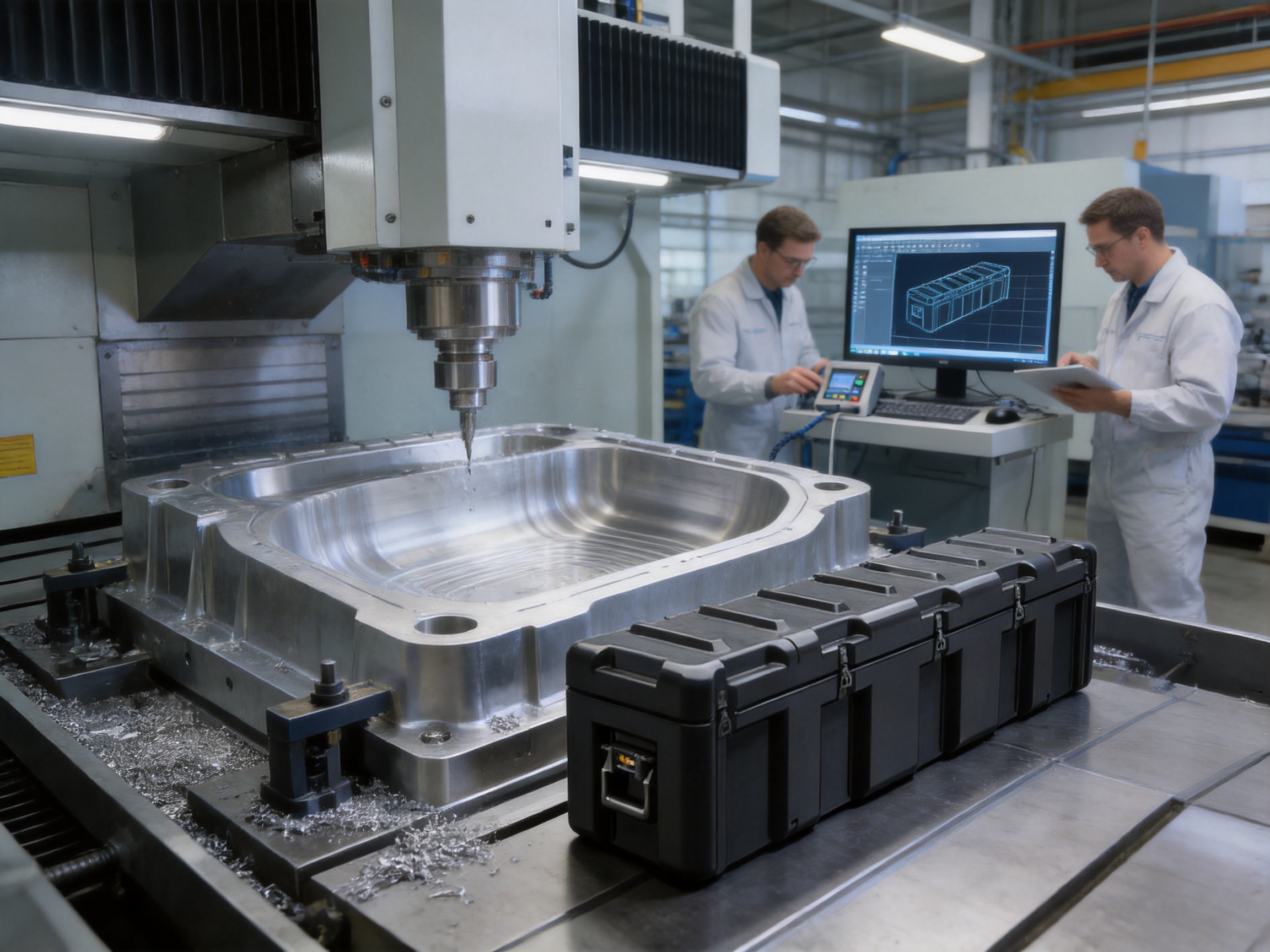
After design approval, the 6061-T6 forged aluminum material is prepared for machining. CNC equipment is used to create the cavity and structural details according to the digital model. Large-scale machining capability is important for military cases because protective containers can have substantial dimensions and broad curved surfaces.
CNC machining supports repeatable dimensional control and allows complex shapes to be produced with a high degree of accuracy. The process may include rough machining to remove excess material, semi-finishing to establish the main geometry, and precision finishing for critical surfaces and interfaces.
Machining strategy must be selected according to the mold size, product geometry, cavity depth, required surface quality, and available equipment. Tool access and machining direction should be considered to reduce unnecessary variation and achieve a consistent result across the cavity.
Inspection and Dimensional Verification
Inspection confirms whether the manufactured mold corresponds to the approved design. Critical dimensions, cavity features, mating areas, and structural details should be checked before the mold enters trial production.
Visual inspection is also important. The manufacturer should review the cavity for machining marks, unwanted defects, sharp edges, incomplete features, and areas requiring additional polishing. Both dimensional accuracy and surface condition contribute to the mold's performance.
Inspection records provide a basis for quality control and customer acceptance. They also support future maintenance, repair, or modification work by documenting the condition of the tooling at delivery.
Polishing and Surface Treatment
After machining and inspection, the mold may receive controlled polishing or another specified surface finish. The correct finish depends on the customer's product requirements. The objective may be a smooth technical surface, a particular texture, improved release performance, or a consistent visual appearance.
Polishing should be performed without changing critical dimensions or weakening functional details. Special attention is needed around corners, narrow recesses, sealing interfaces, and areas where the product must release cleanly.
Mold Testing and Sample Validation
Trial production is a key part of the development process. The mold is installed on suitable rotational molding equipment and used to produce samples under controlled conditions. The samples can then be evaluated for dimensions, wall distribution, surface quality, structural details, assembly fit, and general appearance.
Testing can also reveal issues related to heating, cooling, rotation, demolding, or local geometry. If changes are needed, the engineering and production teams can review the results and determine whether mold modification or process adjustment is appropriate.
Sample validation provides more meaningful evidence than mold inspection alone because it demonstrates how the tooling performs in actual production conditions. For military cases, this may include checking reinforced corners, handle areas, lid interfaces, gasket channels, latch mounts, and other important features.
Compatibility with Gas-Heated and Electric-Heated Rotomolding
Military box molds must be compatible with the customer's rotational molding machine and heating method. Traditional gas-heated systems remain widely used because of their flexibility and suitability for many large hollow products. Electric-heated systems provide more precise temperature management and can use independently controlled heating zones.
The heating method influences mold engineering. A mold developed for a conventional gas-heated machine may require a different thermal design from one intended for an electric-heated system. The manufacturer should understand the equipment layout, heating zones, rotation system, mold mounting arrangement, and production cycle before finalizing the tooling.
Gas-Heated Rotational Molding
Gas-heated rotational molding is used for a wide range of products and can accommodate large cases and containers. Its established operating principles make it suitable for manufacturers with existing gas-fired equipment and familiar process procedures.
For gas-heated applications, the mold must support efficient heat transfer and predictable temperature development across the cavity. Large flat areas, deep corners, and reinforced sections may heat differently from thinner or more exposed surfaces. Mold geometry and process parameters should therefore be considered together.
A properly engineered aluminum mold can provide a practical balance of heat response, strength, and machinability. The final result depends on the complete production system, including the machine, burner arrangement, rotation speed, polymer material, cycle settings, and cooling process.
Electric-Heated Rotational Molding
Electric-heated rotational molding systems offer more precise temperature management and may provide independently controlled heating zones. This can be useful for products with complex geometry or areas that require closer thermal control.
Since 2023, Jiangsu Zhroto Mould Co., Ltd. has invested in electric-heated rotational molding technology. The company states that its electric-heated systems can achieve temperature control accuracy of approximately 1 to 2 degrees Celsius, thermal efficiency above 95 percent, and potential energy consumption reductions of 30 to 50 percent under suitable production conditions.
These capabilities increase the importance of process-specific mold engineering. The mold must respond predictably to the controlled heating environment, and the design should support effective temperature distribution across the product. Independent heating zones can be particularly useful when the case includes different wall geometries or localized structural features.
Electric heating does not eliminate the need for careful mold design. Instead, it allows the machine and mold to work together with greater control. Product geometry, material distribution, cavity finish, heating zones, rotation, and cooling must still be evaluated as a complete system.
Advantages Compared with Basic or Poorly Engineered Tooling
Not all military box molds provide the same level of performance. Basic tooling may produce an initial sample, but it may not provide the dimensional consistency, surface quality, durability, and process stability required for long-term production.
More Consistent Product Geometry
Precision design and CNC machining help maintain the intended dimensions across the cavity. This is important for lids, gaskets, hinges, latches, handles, and internal accessories. Consistent product geometry can reduce assembly problems and support more predictable performance.
Improved Surface Quality
6061-T6 forged aluminum, accurate machining, and controlled polishing provide a strong foundation for clean cavity surfaces. The result can include more consistent product appearance and reliable release, particularly when the product has broad curved panels or detailed interfaces.
Better Customization Capability
Military and tactical cases often require unique sizes, shapes, mounting arrangements, and protection features. A custom mold manufacturer can adapt the tooling to the actual product instead of forcing the product into a standard mold configuration.
Greater Process Compatibility
A mold should be designed for the customer's specific rotational molding equipment. Support for both gas-heated and electric-heated systems allows the tooling approach to be matched to the available production technology.
Lower Risk During Production Launch
Design review, sample testing, dimensional inspection, and acceptance procedures help identify problems before full-scale production. This can reduce the risk of delays, repeated modifications, and inconsistent product quality after delivery.
Long-Term Technical Support
A mold is a production asset that may require maintenance, adjustment, and process support over its service life. A manufacturer that provides technical assistance after delivery can help customers address production questions and maintain stable performance.
| Evaluation Area | Basic Tooling Approach | Advanced Custom Mold Approach | Benefit for Military Cases |
|---|---|---|---|
| Material | General-purpose material with limited process evaluation | 6061-T6 forged aluminum selected for strength and machinability | Improved tooling stability and finishing potential |
| Product design | Limited review before machining | Product optimization and rotational molding analysis | Better structural performance and manufacturability |
| Engineering | Basic two-dimensional interpretation | Detailed CAD-based three-dimensional development | More accurate complex geometry and interfaces |
| Machining | Limited control of cavity details | Precision CNC machining with dimensional inspection | Improved repeatability and assembly fit |
| Finishing | Inconsistent surface preparation | Controlled polishing and specified surface treatment | Cleaner appearance and easier release |
| Validation | Visual approval of the mold | Trial production and sample evaluation | Reduced production launch risk |
| Technical support | Limited assistance after delivery | Integrated production and maintenance support | More stable long-term operation |
Manufacturing Strengths and Integrated Services
Jiangsu Zhroto Mould Co., Ltd. was founded in 2015 and moved to a modern facility in Jiangyan District, Taizhou City, in 2021. The facility covers approximately 18,000 square meters, including more than 12,000 square meters of standardized production workshops.
The company reports an annual production capacity exceeding 800 mold sets and approximately 3,600 tons of plastic products. Its experience covers rotational molding mold design, mold manufacturing, rotomolded product processing, and integrated technical solutions.
This broader manufacturing scope is valuable for military box mold projects because it connects tooling development with finished-product production. A company that understands both mold construction and rotational molding can evaluate how design decisions affect actual processing and product performance.
The company serves applications including hydrogen energy storage and transportation, automotive parts, industrial equipment, agricultural machinery, water treatment, outdoor facilities, and other sectors. Although these products differ from military cases, they share important technical requirements such as large-scale machining, hollow product design, structural durability, repeatable dimensions, and controlled rotational molding.
Quality and Management Certifications
Jiangsu Zhroto Mould Co., Ltd. has obtained ISO 9001:2015, ISO 14001:2015, and ISO 45001 certifications. These standards provide a structured foundation for quality management, environmental management, and occupational health and safety management.
Certification does not replace product-specific engineering or testing, but it can support more systematic business processes. Documented procedures, controlled production activities, inspection records, and corrective actions help create a more consistent manufacturing environment.
For customers developing customized cases, a structured management system can simplify communication and support clearer project milestones. It can also provide confidence that design review, production, inspection, and delivery are handled through an organized workflow.
One-Stop Project Support
The company provides services that can include project consultation, product structure optimization, three-dimensional design, mold design confirmation, precision manufacturing, material recommendations, trial production, quality inspection, acceptance, delivery, production support, and maintenance advice.
This integrated model reduces the need for customers to coordinate separate product designers, mold manufacturers, and trial-production suppliers. It also allows technical questions to be addressed by teams familiar with the complete process.
For a military box project, one-stop support is especially useful when the product is still being developed or when the customer needs assistance converting an existing design into rotational molding tooling. It can help identify potential conflicts between product requirements and manufacturing conditions before they become expensive problems.
Quality Control for Military Box Mold Projects
Quality control should continue through every stage of mold development. It begins with confirming the product requirements and continues through material selection, design approval, machining, finishing, trial production, inspection, and acceptance.
Design Review
The design review should confirm the case's dimensions, structural features, functional interfaces, production equipment, expected service conditions, and required surface finish. Special attention should be given to corners, sealing areas, handles, hinges, latches, ribs, and mounting points.
Material Verification
The mold material should be checked against the agreed specification. For 6061-T6 forged aluminum, the manufacturer should maintain suitable material documentation and confirm that the material is appropriate for the intended machining and service requirements.
Machining Inspection
Machining inspection should focus on critical dimensions, mating areas, cavity geometry, detail definition, and general surface quality. The inspection method should be suitable for the size and complexity of the mold.
Trial Sample Evaluation
Trial samples should be assessed for dimensions, wall distribution, visual quality, structural features, release behavior, and assembly compatibility. Where required, the samples may also be evaluated through practical handling or functional checks.
Final Acceptance
Final acceptance should be based on agreed technical requirements rather than appearance alone. The customer and manufacturer can review inspection results, sample measurements, functional details, and any approved modifications before production release.
Maintenance and Service Life of Military Box Molds
Even a well-manufactured mold requires appropriate maintenance. Regular cleaning helps prevent polymer residue, dust, and foreign material from affecting the cavity surface. Inspection after production cycles can identify wear, damage, or changes in critical areas.
Operators should handle aluminum molds carefully during installation, removal, cleaning, and storage. Impacts from tools or lifting equipment can damage cavity surfaces or mating areas. Suitable storage conditions can help reduce contamination and unnecessary surface deterioration.
Maintenance records should include production cycles, repairs, polishing, dimensional checks, and any process changes. A clear record allows the manufacturer and customer to monitor tooling condition and plan corrective actions before a problem affects a large production run.
If a product design changes, the customer should consult the mold manufacturer before modifying the tooling. Changes to wall geometry, lids, hinges, latches, or sealing interfaces may affect the mold's structure and production behavior. Professional evaluation can determine whether the existing mold can be modified or whether new tooling is more appropriate.
How to Select a Military Box Mold Manufacturer
When selecting a mold supplier, customers should consider more than the initial quotation. The supplier's engineering ability, material knowledge, machining capacity, testing process, equipment compatibility, quality system, and technical support all affect the total value of the project.
- Confirm experience with rotational molding and hollow protective products.
- Review the proposed mold material and its suitability for the application.
- Ask how product geometry will be evaluated before tooling begins.
- Confirm the supplier's three-dimensional design and CNC machining capabilities.
- Discuss compatibility with gas-heated or electric-heated molding equipment.
- Request information about trial production and sample validation.
- Clarify inspection, acceptance, delivery, and maintenance support.
- Evaluate whether the supplier can support future product modifications.
A supplier with integrated capabilities can often identify technical risks earlier than a supplier focused only on machining. The most suitable partner should be able to explain how the mold will support the finished case and how the tooling will perform in the customer's actual production environment.
Frequently Asked Questions
Q1: What material is commonly used for a durable military box mold?
6061-T6 forged aluminum alloy is commonly selected for demanding rotational molding tooling because it combines strength, durability, machinability, a dense internal structure, and favorable surface quality. It can be precision-machined and polished to support customized military and protective case designs.
Q2: Why is forged aluminum suitable for rotational molding molds?
Forged aluminum provides a stable material structure and can be machined into large, complex cavities. Its strength supports repeated production cycles, while its surface characteristics allow effective polishing and finishing. It also provides a practical balance between durability, heat response, and manufacturing efficiency.
Q3: Can a military box mold include custom handles, hinges, ribs, and latch areas?
Yes. Custom rotational molding tooling can be designed to reproduce handles, hinges, ribs, latches, mounting areas, recessed features, gasket interfaces, and other product details. These features should be evaluated during three-dimensional engineering to ensure that they are suitable for molding and demolding.
Q4: How does a heavy-duty transport case mold differ from a tactical case mold?
A heavy-duty transport case mold generally emphasizes structural durability, reinforced corners, stable panels, and reliable performance during repeated movement and handling. A tactical case mold may place greater emphasis on customized interfaces, specialized equipment protection, detailed mounting features, and compatibility with internal inserts.
Q5: Why is mold accuracy important for waterproof equipment cases?
Waterproof cases depend on accurate mating surfaces, lid geometry, gasket areas, hinges, and fastening interfaces. Consistent mold dimensions help the finished components fit together correctly and support repeatable sealing performance.
Q6: Can the tooling be used with both gas-heated and electric-heated machines?
Yes. Military box molds can be engineered for conventional gas-heated rotational molding machines or electric-heated systems. The mold design should be matched to the equipment, heating zones, temperature-control method, mounting arrangement, and production cycle.
Q7: What is the purpose of trial production?
Trial production verifies how the mold performs under actual rotational molding conditions. Samples can be evaluated for dimensions, wall distribution, surface quality, structural details, release behavior, and assembly fit. Trial results may also identify areas requiring mold or process adjustments before production approval.
Q8: What information should a customer provide when requesting a military box mold?
The customer should provide product drawings or three-dimensional files, overall dimensions, expected wall requirements, material information, production volume, available molding equipment, heating method, required accessories, sealing details, surface finish expectations, and service conditions. Samples or reference products can also be useful during the design review.
Q9: Does the mold manufacturer support product design optimization?
Professional mold manufacturers can review the product structure and recommend changes to improve rotational moldability, wall distribution, demolding, corner strength, sealing interfaces, and production efficiency. Early optimization can reduce the risk of expensive modifications after machining.
Q10: How can mold service life be extended?
Regular cleaning, careful handling, correct storage, inspection of critical surfaces, controlled maintenance, and accurate production records can help extend mold service life. Operators should avoid impacts, unauthorized modifications, and cleaning methods that could damage the aluminum cavity or surface finish.
Q11: What services does Jiangsu Zhroto Mould Co., Ltd. provide?
The company provides project evaluation, product optimization, three-dimensional engineering, mold design confirmation, CNC manufacturing, material and process recommendations, mold testing, sample validation, quality inspection, delivery, production support, and maintenance advice. It can work from a product concept, an existing drawing, a three-dimensional file, or a new development requirement.
Q12: What makes a military box mold more competitive than basic tooling?
A more competitive mold combines suitable 6061-T6 forged aluminum material, accurate three-dimensional engineering, precision CNC machining, controlled surface finishing, equipment compatibility, trial validation, and long-term technical support. These factors help improve repeatability, reduce production risk, and support the finished case's durability and functionality.
Conclusion
A military box mold is a critical production asset for manufacturers of rugged transport cases, tactical equipment cases, waterproof containers, and other protective products. Its quality directly affects dimensional consistency, structural performance, sealing interfaces, surface finish, production efficiency, and long-term product reliability.
6061-T6 forged aluminum alloy provides a strong technical foundation because of its dense internal structure, strength, durability, machinability, and suitability for polishing. When combined with optimized product geometry, CAD-based three-dimensional engineering, precision CNC machining, controlled finishing, and trial validation, it supports the manufacture of customized tooling for demanding applications.
Jiangsu Zhroto Mould Co., Ltd. offers integrated capabilities covering rotational mold design, mold manufacturing, rotomolded product processing, electric-heated and gas-heated process support, quality inspection, and technical services. Its modern facility, production capacity, industry experience, and quality management certifications provide a structured foundation for customized military box mold projects.
The most dependable results come from treating the mold, product, machine, material, and process as one connected system. By beginning with the finished case requirements and continuing through design review, precision manufacturing, trial production, and maintenance support, manufacturers can establish tooling that delivers consistent performance over a long production life.
References
1. Aluminum Association. Aluminum Standards and Data: Properties and Applications of Aluminum Alloys.
2. ASTM International. Standard Specifications and Test Methods for Aluminum and Aluminum-Alloy Products.
3. Society of Plastics Engineers. Rotational Molding Technology and Processing Principles.
4. ISO 9001:2015. Quality Management Systems — Requirements.
5. ISO 14001:2015. Environmental Management Systems — Requirements with Guidance for Use.
6. ISO 45001:2018. Occupational Health and Safety Management Systems — Requirements with Guidance for Use.
7. Technical information supplied for 6061-T6 forged aluminum alloy rotational molding tooling.
8. Product development and manufacturing information supplied by Jiangsu Zhroto Mould Co., Ltd.
Product: Military box mold


We provide customers with one-stop services ranging from product design, mold manufacturing to finished product production.
-
 +86-18006248936
-
 ricky.t@zhroto.com
-
 No.9 Jiangyuan Road, Luotang Street, Jiangyan District, Taizhou City,Jiangsu Province, China
Copyright © Jiangsu Zhroto Mould Co., Ltd. Rights Reserved.Custom Rotational Plastic Molding Factory
