 en
 中文简体
 русский
 Español
 Deutsch
 Polskie
 REQUEST A QUOTE

 Home / Author / Linnea Qiao — International Sales Manager / Custom Off-Road Bumper Mold for Durable and Efficient Rotational Molding
Custom Off-Road Bumper Mold for Durable and Efficient Rotational Molding
Content
- 1 Understanding the Off-Road Bumper Mold
- 2 Why Rotational Molding Is Suitable for Off-Road Bumpers
- 3 One-Piece Molding for Durability and Appearance
- 4 Key Advantages Compared with Alternative Tooling Approaches
- 5 Material Selection for the Off-Road Bumper Mold
- 6 Design Engineering for Large and Complex Bumpers
- 7 Advanced Manufacturing Processes
- 8 Gas-Heated and Electric-Heated Rotational Molding Solutions
- 9 Impact-Resistant Materials for Off-Road Bumpers
- 10 Quality Control for Reliable Bumper Production
- 11 Company Manufacturing Strengths
- 12 Applications for the Off-Road Bumper Mold
- 13 How to Select the Right Off-Road Bumper Mold
- 14 Recommended Development Workflow
- 15 Frequently Asked Questions
- 15.1 What is the best material for an off-road bumper mold?
- 15.2 Why is rotational molding suitable for large off-road bumpers?
- 15.3 Can the bumper mold support customized designs?
- 15.4 What makes an off-road bumper impact resistant?
- 15.5 How does aluminum tooling compare with steel tooling?
- 15.6 Can the mold be used with electric-heated rotational molding equipment?
- 15.7 What services are available for the bumper mold project?
- 15.8 How can mold service life be improved?
- 15.9 What should be checked during trial molding?
- 15.10 Why choose an integrated mold and product manufacturer?
- 16 Conclusion
- 17 References
- 18 Product: Off-road bumper mold
Off-road vehicles require bumper systems that can withstand impacts, vibration, abrasion, moisture, mud, temperature variation, and demanding operating conditions. Behind every reliable rotomolded bumper is a carefully engineered mold that determines the product’s geometry, wall consistency, surface quality, and production stability. A high-quality off-road bumper mold must do more than reproduce a shape. It must support efficient heating, balanced material distribution, repeatable cooling, accurate dimensions, and dependable long-term production.
The off-road bumper mold described in this article is designed for large and complex automotive components manufactured through rotational molding. Its one-piece molding concept supports a seamless finished structure, while the appropriate selection of tooling materials, mold geometry, heating method, and production parameters helps create bumpers with a strong combination of durability, appearance, and impact resistance.
Jiangsu Zhroto Mould Co., Ltd. provides integrated services for rotational molding mold design, manufacturing, product processing, testing, and production support. The company’s capabilities cover product consultation, three-dimensional engineering, mold development, CNC machining, trial molding, inspection, delivery, and technical assistance. With experience in large hollow products and automotive components, the company can support projects from the initial concept through stable mass production.
<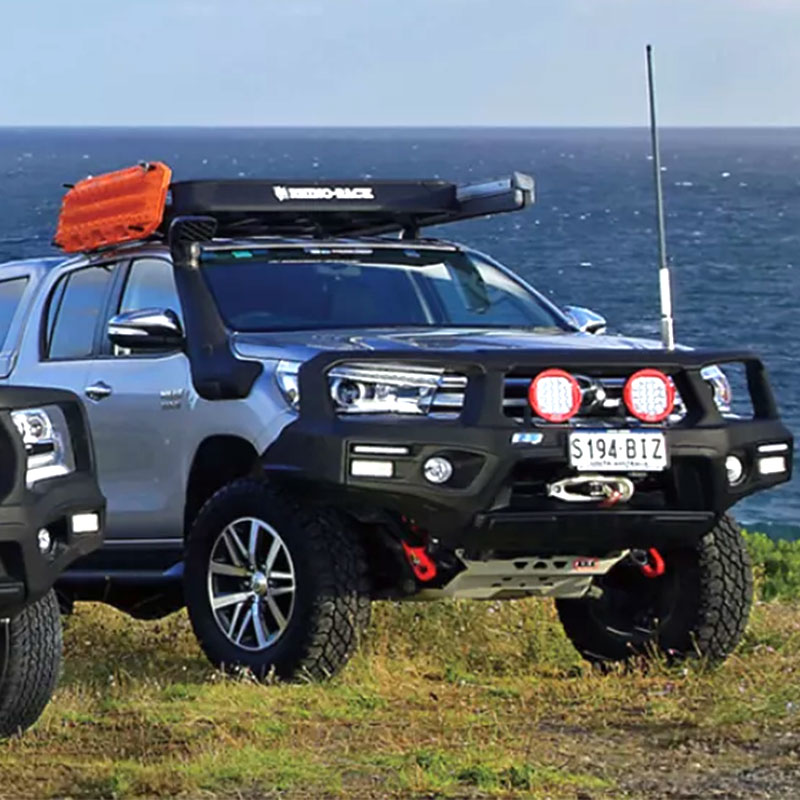
Off-road bumper mold
Understanding the Off-Road Bumper Mold
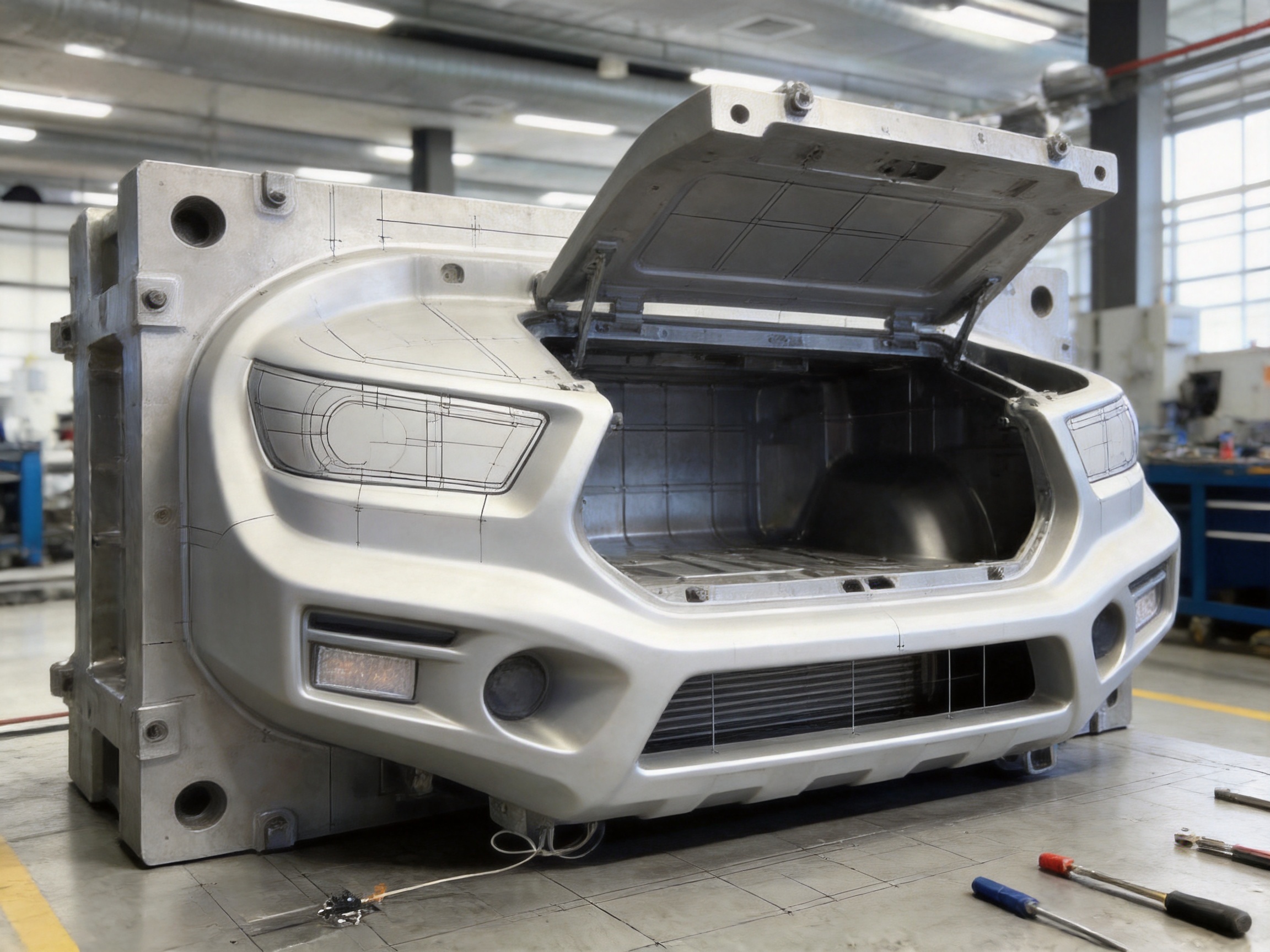
An off-road bumper mold is a specialized tool used to form a bumper or protective exterior component from a polymer during the rotational molding process. Unlike conventional injection molds, rotational molding molds are generally hollow tools that rotate around multiple axes while the polymer is heated inside the mold. As the material melts, it gradually coats the internal surface and forms the desired component.
This process is particularly suitable for large bumpers because it can create hollow, seamless structures without requiring multiple assembled sections across the main molded body. The mold can be developed with curved surfaces, deep contours, integrated design features, mounting areas, and styling details while maintaining a relatively simple overall tooling structure.
The quality of the finished bumper depends heavily on the quality of the mold. A poorly designed tool may cause uneven wall thickness, incomplete material coverage, excessive buildup in corners, surface defects, dimensional variation, or difficulty during demolding. A professionally designed off-road bumper mold addresses these risks before production begins by considering product geometry, material flow, heating conditions, cooling behavior, mold release, and expected service conditions.
The mold also influences production efficiency. Stable heat transfer can shorten or balance molding cycles, while accurate geometry reduces the need for corrective work after molding. A tool that is easy to install, clean, inspect, and maintain can also reduce downtime over the product’s service life.
Why Rotational Molding Is Suitable for Off-Road Bumpers
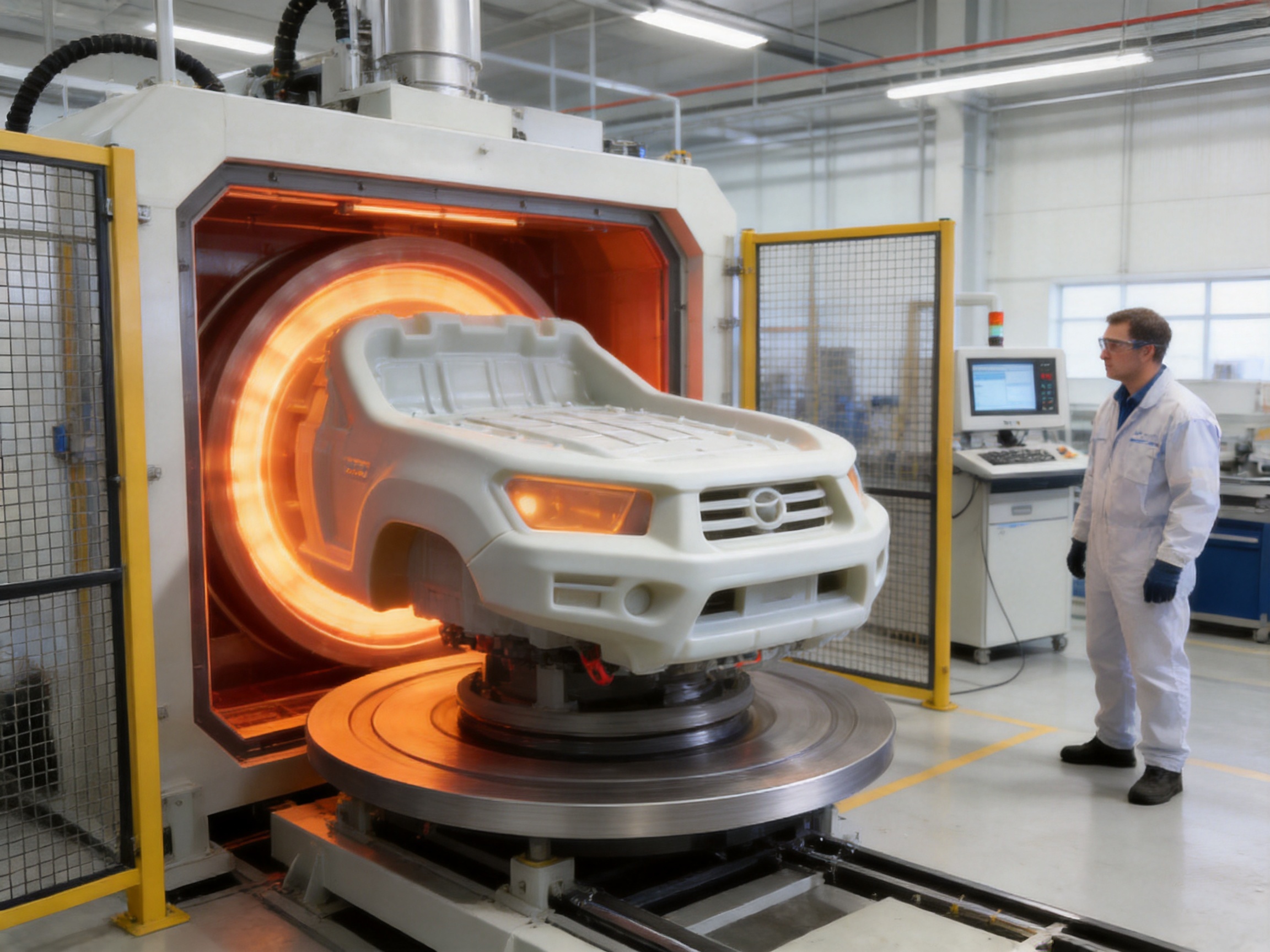
Rotational molding provides several benefits for the manufacture of large automotive components. The process begins with a measured quantity of polymer placed inside a mold. The closed mold is then heated and rotated along two or more axes. As the polymer melts, it gradually adheres to the mold surface and forms a hollow part. After the material has reached the required condition, the mold is cooled while rotation continues, helping the product maintain its shape before removal.
One of the main advantages of rotational molding is its suitability for large and extra-large parts. The process does not require the same high injection pressure associated with injection molding, which allows manufacturers to produce large components using comparatively simple tooling. This can reduce tooling complexity and provide greater flexibility for customized bumper designs.
Rotational molding also supports seamless construction. A bumper produced as one main molded body can avoid some of the weak points associated with multiple joined sections. Fewer assembly joints may improve appearance, simplify production, and reduce the risk of leakage or separation in areas exposed to vibration and impact.
Another important benefit is design flexibility. The mold can be developed for different bumper lengths, widths, shapes, mounting features, reinforcement zones, and styling profiles. This is valuable for off-road vehicle manufacturers, specialty vehicle builders, aftermarket product developers, and equipment manufacturers that require customized exterior parts rather than standard components.
The process is also compatible with a broad range of rotational molding polymers. Depending on the required combination of toughness, stiffness, chemical resistance, ultraviolet resistance, surface appearance, and operating temperature, the product material can be selected and processed to meet the intended application.
However, the benefits of rotational molding are realized only when the mold and process are correctly engineered. Material loading, mold temperature, rotation speed, heating time, cooling rate, wall thickness, and demolding procedures must be evaluated as an integrated system. The off-road bumper mold is therefore not simply a hollow tool; it is an essential part of the complete manufacturing solution.
<
One-Piece Molding for Durability and Appearance
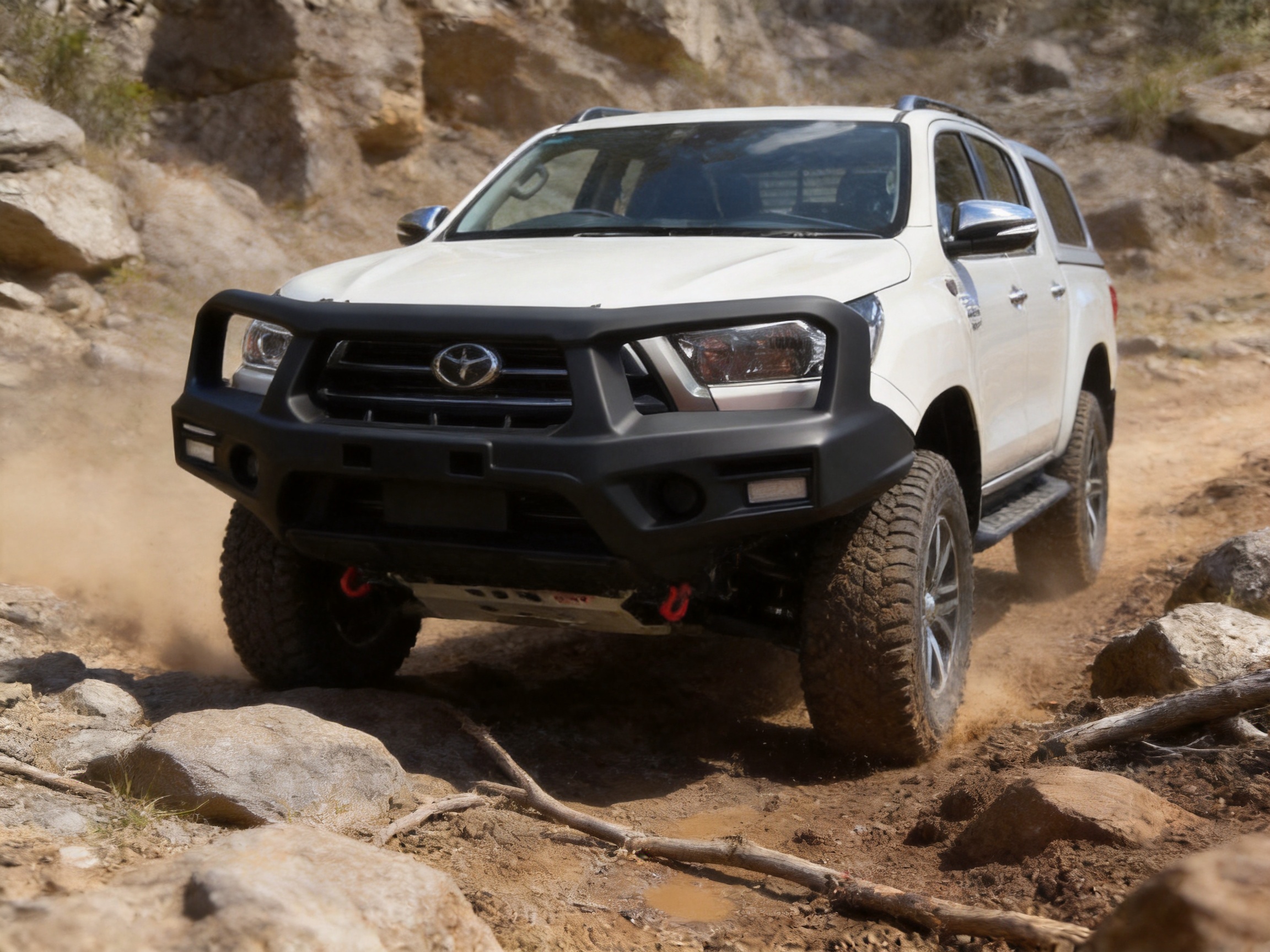
The one-piece molding approach is one of the most important features of this off-road bumper solution. By forming the main bumper body as a single molded structure, the process can produce a smooth and continuous exterior surface. This gives the finished product a clean appearance and reduces the visual interruptions associated with multiple assembled panels.
A one-piece structure can also support consistent performance. In an off-road environment, bumpers may be exposed to repeated contact with rocks, branches, uneven terrain, loading equipment, and other obstacles. A continuous molded body distributes forces across the product more effectively than a design that relies heavily on multiple joints or mechanically connected sections.
The one-piece concept does not eliminate the need for engineered mounting areas, inserts, brackets, or reinforcement features. Instead, it provides a strong foundation for integrating those elements into a carefully designed product. Areas that require additional stiffness or connection strength can be considered during product optimization and mold development.
Surface appearance is another important advantage. Rotational molding can produce large curved surfaces with a consistent finish when the mold surface, polymer, heating cycle, and cooling procedure are properly controlled. This is particularly valuable for automotive exterior components, where customers expect the bumper to support both functional protection and an attractive vehicle appearance.
For manufacturers developing customized off-road vehicles, the one-piece approach may also simplify product styling. Distinctive contours, recessed areas, raised sections, and integrated visual features can be incorporated into the mold design. This provides greater freedom than a basic flat or mechanically assembled bumper structure.
Key Advantages Compared with Alternative Tooling Approaches
The off-road bumper mold offers several practical advantages when compared with less specialized tooling or conventional approaches that are not optimized for large hollow automotive components.
Efficient Production of Large Parts
Large bumpers can be challenging to manufacture using processes that require high-pressure filling or extensive assembly. Rotational molding uses a relatively simple mold structure and gradual material distribution, making it suitable for wide, deep, and curved parts. This can reduce the number of individual sections required for the finished product.
Lower Tooling Complexity
Compared with complex high-pressure molds, rotational molding tools can have a comparatively straightforward structure. Lower tooling complexity may support more economical development, especially for customized products, prototypes, and medium-volume projects. It can also make design changes more practical during vehicle development.
Seamless Hollow Construction
The process forms the bumper body against the internal surface of the mold, allowing the production of hollow structures with a continuous main body. This approach can provide a useful balance of strength, weight, material efficiency, and impact tolerance.
Flexible Product Development
A rotational molding tool can be adapted to different product sizes and shapes. This is important for manufacturers serving multiple vehicle platforms or producing specialized bumper variants. Product optimization can be performed before final tooling so that the mold reflects actual production needs rather than only the original concept drawing.
Suitable for Impact-Resistant Polymers
Off-road bumpers require materials that can tolerate deformation and impact without cracking or losing their functional shape. Rotational molding supports the processing of suitable impact-resistant polymers, provided that the material, wall thickness, mold temperature, and cycle parameters are correctly selected.
Support for Attractive Exterior Finishes
Because the mold directly defines the bumper’s exterior surface, careful mold manufacturing can support smooth curves, clear styling details, and consistent visual quality. Surface treatment and finishing can also be considered according to the customer’s appearance requirements.
| Performance factor | Off-road bumper rotational molding solution | Production benefit |
| Part size | Suitable for large and extra-large hollow components | Supports full-size bumper designs with fewer assembled sections |
| Tooling structure | Relatively simple rotational molding construction | Practical for customized products and development programs |
| Product construction | One-piece seamless molded body | Improves appearance and supports continuous structural performance |
| Material flexibility | Compatible with selected impact-resistant polymers | Allows product performance to be matched to the operating environment |
| Design flexibility | Supports curved surfaces, mounting features, and styling details | Enables application-specific automotive exterior designs |
| Maintenance | Tooling can be inspected, cleaned, and supported throughout production | Helps improve long-term process stability |
Material Selection for the Off-Road Bumper Mold
Tooling material selection has a direct influence on thermal behavior, dimensional stability, mold weight, service life, and manufacturing cost. The most suitable material depends on the bumper’s size, geometry, production quantity, heating equipment, expected cycle frequency, and maintenance requirements.
Aluminum Tooling
Aluminum is one of the most practical materials for large rotational molding tools. It combines relatively low weight, good thermal conductivity, machinability, and useful tooling durability. These characteristics make it especially suitable for large bumper molds that must be handled during installation, inspection, modification, and maintenance.
Thermal conductivity is important because the polymer must be heated evenly across the mold surface. Large bumpers often include broad curved areas, deep contours, corners, recesses, and raised details. If these areas receive significantly different thermal conditions, the finished product may show variations in wall coverage or surface quality. Aluminum can help support a more consistent heat transfer pattern when the mold is properly designed and used with suitable process parameters.
Aluminum also works well with precision machining. CNC equipment can reproduce complex bumper geometries, mounting zones, styling features, and detailed contours with a high level of repeatability. This supports accurate prototype development and helps manufacturers make design changes during the product development stage.
Another advantage is handling convenience. A large steel mold can be considerably heavier than an aluminum equivalent, creating additional demands during installation and production changes. Lower tooling weight may simplify handling and reduce the physical burden on operators and equipment.
Aluminum is often a strong option for prototype programs, medium-volume production, and applications where heating efficiency, product appearance, and design flexibility are key priorities. It may also be appropriate for higher-volume production when the tooling design, alloy selection, surface treatment, and maintenance plan are properly established.
Steel Tooling
Steel tooling provides a different balance of characteristics. It is normally selected when mechanical rigidity, resistance to repeated handling, and long service life are more important than low weight. For long production programs, a robust steel structure may provide dependable performance over a large number of molding cycles.
Steel can be valuable when a large mold must withstand frequent installation, removal, transportation, or demanding operating procedures. Its rigidity may support stable geometry in applications where the tooling experiences substantial mechanical loads or repeated handling.
However, steel tooling is generally heavier and requires careful thermal planning. Its thermal behavior differs from that of aluminum, so heating and cooling conditions may need to be adjusted. The mold design should consider heat distribution, cycle time, equipment capacity, and the possibility of temperature differences across large or complex surfaces.
The decision between aluminum and steel should therefore be made according to the complete production program. Expected output, tooling life, product geometry, mold handling systems, thermal equipment, maintenance resources, and future design changes should all be considered.
Matching Tooling Material to Production Requirements
There is no universal mold material that is best for every off-road bumper project. Aluminum may provide advantages for a lightweight, flexible, and thermally efficient tool, while steel may be selected for a long-running program that prioritizes mechanical durability. A professional tooling manufacturer should evaluate the application rather than recommend a material based only on general preference.
Material selection should also consider the final bumper polymer. The thermal characteristics of the tooling and the processing window of the polymer must work together. A tool that is technically strong but difficult to heat uniformly may not deliver the required product quality. Similarly, a thermally efficient mold may not be the most practical choice if the production environment requires exceptional resistance to repeated mechanical handling.
Design Engineering for Large and Complex Bumpers
Successful off-road bumper production begins before the mold is manufactured. Product geometry must be reviewed to identify areas that may affect material distribution, demolding, wall thickness, structural behavior, and surface appearance.
The design team should examine the bumper’s overall dimensions, radius transitions, corners, mounting features, reinforcement zones, openings, recesses, and styling elements. Sharp transitions can create areas where polymer distribution becomes less predictable. Appropriate radii and smooth geometry can improve material coverage and reduce stress concentration in the finished product.
Wall thickness is another important consideration. The bumper must be thick enough to provide the required strength and impact tolerance, but excessive material can increase weight, cycle time, and production cost. A well-designed mold supports controlled and consistent wall coverage across the product.
Mounting areas require particular attention. A bumper may need to connect to a vehicle frame, support brackets, recovery equipment, lighting components, sensors, or other accessories. The mold and product design must provide sufficient space and strength for these functional requirements while preserving the advantages of a seamless molded body.
Three-dimensional modeling helps the engineering team visualize the product and identify potential problems before manufacturing begins. Digital design review can be used to evaluate mold split lines, access points, demolding direction, heating behavior, and the relationship between the bumper and its mounting hardware.
Product optimization is especially important for customized off-road components. A design created solely for visual appearance may not be suitable for rotational molding. The engineering process should balance styling requirements with material flow, tool construction, production access, and inspection needs.
<
Advanced Manufacturing Processes
Jiangsu Zhroto Mould Co., Ltd. supports the development of rotational molding tools through a structured manufacturing process. The objective is to convert a product concept into reliable tooling that can operate consistently in an industrial production environment.
Project Consultation and Requirement Review
The process begins with a review of the customer’s product requirements. Important information includes bumper dimensions, vehicle application, expected production quantity, selected polymer, target wall thickness, surface requirements, heating equipment, production cycle, and required service conditions.
This stage helps determine whether aluminum, steel, or another tooling approach is most appropriate. It also allows the engineering team to identify special requirements such as integrated mounting structures, complex styling details, removable sections, inserts, or compatibility with electric-heated equipment.
Product Optimization and Three-Dimensional Engineering
After the requirements are established, the product geometry can be reviewed and optimized for rotational molding. Three-dimensional engineering supports accurate development of the bumper shape and allows the team to study potential production concerns before the mold is built.
The engineering review may include draft and demolding considerations, corner radii, wall thickness distribution, reinforcement areas, tooling access, mold assembly, and the position of mold components. Early identification of these factors can reduce later modifications and improve the transition from design to production.
Precision Mold Manufacturing
Once the design is approved, the mold is manufactured using suitable machining and fabrication processes. CNC machining can be used to produce accurate surfaces and detailed geometry. The tool is then assembled, finished, inspected, and prepared for trial molding.
Manufacturing accuracy is essential because the mold directly determines the final bumper’s dimensions and appearance. Surface quality, edge condition, assembly fit, and dimensional consistency should all be evaluated during production. A mold that meets the drawing but performs poorly during actual molding is not a complete solution, so manufacturing and process validation must remain connected.
Trial Molding and Sample Validation
Trial molding provides an opportunity to evaluate the interaction between the mold, polymer, heating equipment, rotation pattern, and cooling procedure. Trial samples can be inspected for dimensions, surface finish, wall coverage, deformation, mounting accuracy, and overall appearance.
If adjustments are required, the tooling or process can be modified before mass production. This validation stage is particularly important for large bumpers because small differences in heating or material distribution can become more noticeable across a large surface area.
Inspection and Production Support
After validation, the customer can receive the mold together with technical information and production guidance. Ongoing support may include advice on operating conditions, maintenance, cleaning, inspection, and future product modifications.
Jiangsu Zhroto Mould Co., Ltd. provides one-stop services covering product design, mold manufacturing, finished product production, inspection, delivery, and technical support. This integrated approach can reduce communication gaps between separate suppliers and create a clearer responsibility path for the customer.
Gas-Heated and Electric-Heated Rotational Molding Solutions
Different production environments may require different heating systems. Conventional gas-heated rotational molding equipment is widely used for many applications and can provide practical heating capacity for large tools. Electric-heated systems offer another approach, with greater emphasis on controlled heating zones, thermal efficiency, and temperature management.
When developing a mold for electric-heated equipment, the design team must pay close attention to thermal conductivity, heat distribution, heating zones, sensor placement, and process control. These factors can influence cycle consistency, energy use, and product quality.
Electric heating may be particularly useful for manufacturers seeking precise thermal management across complex bumper geometries. A large bumper can contain areas that heat at different rates because of changes in curvature, mold thickness, or distance from the heat source. Zoned control may help manage these differences when properly engineered.
Gas-heated and electric-heated solutions should not be viewed as competing technologies in every situation. The appropriate choice depends on existing equipment, production scale, energy requirements, factory conditions, tooling design, and the customer’s process objectives. The mold must be developed to suit the selected equipment rather than treated as an independent component.
Impact-Resistant Materials for Off-Road Bumpers
The mold is responsible for shaping the product, but the final bumper material determines much of its impact performance. Off-road bumpers may encounter repeated contact with obstacles, vibration from uneven ground, ultraviolet exposure, moisture, mud, chemicals, and temperature changes. The selected polymer must therefore provide a suitable balance of toughness, stiffness, environmental resistance, surface quality, and processability.
Impact-resistant rotomolding materials are designed to absorb and distribute energy when the bumper is subjected to an external force. Rather than cracking immediately under a sudden impact, a suitable material may deform within an acceptable range and retain its structural integrity. This characteristic is especially important for off-road vehicles that operate in unpredictable environments.
Material selection should consider the intended use of the bumper. A recreational vehicle, utility vehicle, agricultural machine, industrial transport vehicle, and specialty off-road platform may each have different requirements. The expected impact level, operating temperature, ultraviolet exposure, chemical contact, loading conditions, and appearance expectations should be reviewed before the material is finalized.
Material distribution also influences performance. Even a high-quality polymer may fail to provide consistent results if the molding cycle produces thin areas, excessive buildup, voids, or weak transitions. For this reason, mold design and process control are essential parts of the material performance strategy.
The most effective approach is to evaluate the mold and polymer as one engineering system. Tool material, mold geometry, heating profile, rotation pattern, polymer grade, cooling procedure, and inspection method must work together to achieve a reliable bumper.
Quality Control for Reliable Bumper Production
Quality control should be applied throughout the project rather than only at the end of production. Early inspection of product data and mold design can prevent avoidable problems. During manufacturing, dimensional checks and surface inspections help confirm that the tool is being produced according to specification.
Trial samples should be examined for overall dimensions, mounting locations, wall consistency, surface finish, deformation, and visual defects. Depending on the customer’s requirements, additional tests may be used to evaluate impact behavior, environmental resistance, load performance, or long-term durability.
Process records can also improve consistency. Important production information may include material batch, material weight, heating temperature, heating time, rotation speed, cooling conditions, mold condition, and inspection results. Maintaining clear records helps the production team identify changes and respond to quality concerns.
Mold maintenance is equally important. The tool should be cleaned regularly, inspected for damage, and checked for wear in areas that experience repeated handling. Mold surfaces should be protected from unnecessary scratches, contamination, and impact. Bolts, hinges, inserts, clamps, and other mechanical components should be checked according to an established maintenance schedule.
Consistent quality depends on the entire production system. A high-quality mold cannot compensate for incorrect material loading or unstable heating, just as a carefully controlled process cannot fully correct a mold with inaccurate geometry. The best results come from coordinated design, manufacturing, processing, inspection, and maintenance.
<
Company Manufacturing Strengths
Jiangsu Zhroto Mould Co., Ltd. was founded in 2015 and specializes in rotational molding mold design, mold manufacturing, rotomolded product processing, and integrated technical solutions. The company moved to a modern facility in Jiangyan District, Taizhou City, in 2021.
The facility covers approximately 18,000 square meters, including more than 12,000 square meters of standardized production workshops. This manufacturing environment supports organized mold production, product processing, inspection, storage, and project coordination.
The company has an annual capacity of more than 800 mold sets and approximately 3,600 tons of plastic products. This capacity demonstrates experience in handling both tooling and finished product production. It also enables the company to provide a more integrated service than a supplier focused only on isolated mold machining.
Its products serve a range of fields, including automotive parts, hydrogen energy storage and transportation, industrial equipment, agricultural machinery, water treatment, outdoor facilities, and other applications. Experience across these industries can support the development of complex hollow products and large rotationally molded components.
The company has obtained ISO 9001:2015, ISO 14001:2015, and ISO 45001:2018 certifications. These certifications relate to quality management, environmental management, and occupational health and safety management. Together, they reflect a structured approach to production organization and business operations.
For off-road bumper projects, the company’s strength lies in the combination of engineering, tooling, processing, and technical support. Customers can obtain assistance with product optimization, mold design, production testing, inspection, and future maintenance rather than managing every stage through unrelated suppliers.
Applications for the Off-Road Bumper Mold
The mold can be used for a variety of large protective automotive components and specialized vehicle applications. Potential applications include recreational off-road vehicles, utility vehicles, agricultural vehicles, industrial transport equipment, emergency vehicles, specialty trailers, and customized aftermarket platforms.
It may also support manufacturers that need low-volume or medium-volume production for specialized vehicle programs. Rotational molding can be practical in these situations because the tooling investment and design flexibility may be more suitable than processes intended primarily for very high-volume standardized components.
For new vehicle development, the mold can support prototype production and design verification. A prototype bumper allows engineers to assess fit, appearance, clearance, mounting position, and interaction with adjacent components before final production decisions are made.
For established products, the tool can support repeatable production of replacement or aftermarket bumpers. The mold can be maintained and monitored to help preserve product consistency over time. Future modifications may also be possible depending on the design and tooling structure.
How to Select the Right Off-Road Bumper Mold
Selecting a bumper mold should begin with the product rather than the material name or tooling price. The following factors should be evaluated as part of a complete project review.
Finished Product Size and Geometry
The bumper’s length, width, depth, curvature, openings, mounting sections, and styling details influence the mold structure and manufacturing method. Large or complex designs may require additional engineering to maintain consistent heating and material distribution.
Expected Production Volume
Prototype, low-volume, medium-volume, and long-term production programs may justify different tooling choices. Production quantity should be evaluated together with expected service life, maintenance requirements, and the cost of downtime if the mold requires replacement.
Required Impact and Environmental Performance
The bumper must be matched to the operating environment. Repeated impacts, ultraviolet exposure, moisture, chemical contact, abrasion, and temperature variation may require specific polymer characteristics and process controls.
Heating Equipment
The mold should be compatible with the customer’s rotational molding machine and heating system. Gas-heated and electric-heated equipment may require different thermal design considerations, mold construction features, and process parameters.
Appearance and Surface Quality
Automotive exterior parts are judged by both function and appearance. Surface texture, color, smoothness, styling accuracy, and the consistency of visible areas should be defined before mold manufacturing begins.
Future Modification Requirements
Vehicle projects may change during development. If future design changes are likely, the tooling strategy should consider whether modifications can be performed efficiently. Early communication with the mold manufacturer can make later adjustments more practical.
Recommended Development Workflow
A structured development workflow reduces uncertainty and supports reliable production results.
Define the bumper application, dimensions, operating environment, and performance requirements.
Confirm the polymer type, target wall thickness, appearance requirements, and production volume.
Review the product design for rotational molding suitability and identify areas requiring optimization.
Select the mold material and heating approach according to thermal, mechanical, and production requirements.
Complete three-dimensional mold design and confirm the structure before manufacturing.
Manufacture the mold using suitable machining, fabrication, finishing, and inspection processes.
Perform trial molding and evaluate dimensions, wall coverage, surface quality, and product fit.
Make necessary adjustments to the mold or processing conditions before mass production.
Establish inspection, maintenance, and production support procedures for long-term operation.
This workflow helps ensure that the finished tool is not only accurate as a manufactured object but also practical for actual production. It connects product design, mold engineering, processing, and quality management in a single development path.
Frequently Asked Questions
What is the best material for an off-road bumper mold?
Aluminum is often a practical choice because it is relatively lightweight, thermally conductive, and suitable for CNC machining. It can be effective for large bumpers, prototypes, and medium-volume production. Steel may be more suitable when long service life, mechanical rigidity, and repeated heavy handling are the main priorities.
Why is rotational molding suitable for large off-road bumpers?
Rotational molding is suitable because it can produce large hollow components using comparatively simple tooling. The process distributes polymer gradually across the mold surface and can create a seamless main body with flexible geometry, controlled wall coverage, and an attractive exterior finish.
Can the bumper mold support customized designs?
Yes. The mold can be developed for different bumper lengths, curves, mounting features, recessed areas, reinforcement sections, and styling details. Product optimization should be completed before mold manufacturing to ensure that the customized design is suitable for rotational molding.
What makes an off-road bumper impact resistant?
Impact resistance depends on the polymer, wall thickness, product geometry, material distribution, and processing conditions. A suitable impact-resistant polymer must work together with a properly designed mold and a stable heating and cooling cycle.
How does aluminum tooling compare with steel tooling?
Aluminum generally offers lower weight, good thermal conductivity, and easy machinability. Steel generally offers greater rigidity and long-term mechanical durability but is heavier and may require more careful thermal management. The best selection depends on the product, volume, equipment, and expected tooling life.
Can the mold be used with electric-heated rotational molding equipment?
Yes. Electric-heated production can be supported when the mold is designed with appropriate attention to thermal conductivity, heating zones, temperature control, and process requirements. The tooling should be developed according to the specific equipment and production conditions.
What services are available for the bumper mold project?
Services may include project consultation, product optimization, three-dimensional modeling, mold design, CNC manufacturing, material recommendations, process recommendations, trial molding, quality inspection, delivery, production support, and mold maintenance advice.
How can mold service life be improved?
Mold service life can be improved through suitable material selection, accurate manufacturing, correct handling, regular cleaning, routine inspection, proper storage, and maintenance of mechanical components. Production parameters should also be controlled to avoid unnecessary thermal or mechanical stress.
What should be checked during trial molding?
Trial molding should evaluate overall dimensions, wall coverage, surface finish, deformation, mounting position, product fit, and visible defects. The results should be compared with the approved design and customer requirements before mass production begins.
Why choose an integrated mold and product manufacturer?
An integrated supplier can coordinate product design, mold engineering, processing, testing, and technical support. This may reduce communication problems, accelerate issue resolution, and provide a clearer path from initial concept to stable production.
<>Conclusion
A reliable off-road bumper mold must combine accurate geometry, efficient thermal performance, suitable tooling material, practical maintenance, and compatibility with impact-resistant polymers. The rotational molding process provides an effective way to manufacture large, hollow, seamless automotive components with flexible styling and controlled production requirements.
The one-piece molding concept offers advantages in appearance, structural continuity, customization, and production efficiency. Aluminum tooling can provide low weight and good heat transfer, while steel tooling can support long-term durability and demanding production environments. The final choice should be based on product geometry, production volume, heating equipment, expected service life, and maintenance requirements.
Jiangsu Zhroto Mould Co., Ltd. combines mold design, CNC manufacturing, rotational molding processing, trial validation, inspection, and technical support. Its modern facility, certified management systems, broad application experience, annual mold capacity, and integrated production capabilities support the development of customized off-road bumper solutions.
By evaluating the mold, polymer, heating system, product geometry, and quality process as one complete system, manufacturers can achieve durable, attractive, and consistent bumpers for demanding off-road environments. This integrated approach gives the product a practical advantage over less coordinated tooling solutions and creates a stronger foundation for long-term production success.
References
1. ASTM International. Standard practices and guidance related to rotational molding, polymer processing, and plastic product evaluation.
2. Plastics Engineering Reference Materials. Principles of rotational molding, mold design, polymer selection, heating, cooling, and product inspection.
3. Society of Plastics Engineers. Technical publications concerning rotational molding materials, processing conditions, and impact-resistant plastic components.
4. ISO 9001:2015. Quality management systems and requirements.
5. ISO 14001:2015. Environmental management systems and requirements with guidance for use.
6. ISO 45001:2018. Occupational health and safety management systems and requirements.
7. Automotive component design references covering exterior part geometry, impact performance, dimensional control, and production validation.
Product: Off-road bumper mold


We provide customers with one-stop services ranging from product design, mold manufacturing to finished product production.
-
 +86-18006248936
-
 ricky.t@zhroto.com
-
 No.9 Jiangyuan Road, Luotang Street, Jiangyan District, Taizhou City,Jiangsu Province, China
Copyright © Jiangsu Zhroto Mould Co., Ltd. Rights Reserved.Custom Rotational Plastic Molding Factory
