 en
 中文简体
 русский
 Español
 Deutsch
 Polskie
 REQUEST A QUOTE

 Home / Author / Yuting Mbatha — Technical Customer Support Specialist / Military Box Mold Manufacturing: Durable Rotational Tooling for Tactical, Waterproof, and Heavy-Duty Cases
Military Box Mold Manufacturing: Durable Rotational Tooling for Tactical, Waterproof, and Heavy-Duty Cases
Content
- 1 Why Military Box Mold Quality Matters
- 2 6061-T6 Forged Aluminum Alloy for Military Box Tooling
- 3 Engineering Design for Heavy-Duty Military Transport Cases
- 4 Tooling for Rugged Tactical Equipment Cases
- 5 Waterproof Equipment Case Production Molds
- 6 Precision CNC Manufacturing Process
- 7 Gas-Heated and Electric-Heated Rotomolding Compatibility
- 8 Manufacturing Strengths of Jiangsu Zhroto Mould Co., Ltd.
- 9 Advantages Over Lower-Quality or Less Integrated Tooling
- 10 Quality Control and Mold Acceptance
- 11 Maintenance and Long-Term Tooling Performance
- 12 Application Areas for Military Box Molds
- 13 How to Select a Military Box Mold Manufacturer
- 14 Recommended Development Workflow
- 15 Frequently Asked Questions
- 15.0.1 What is a military box mold?
- 15.0.2 Why is 6061-T6 forged aluminum alloy suitable for this tooling?
- 15.0.3 How does a military box mold differ from a general storage box mold?
- 15.0.4 Can one mold produce both the lid and the base?
- 15.0.5 Why is trial production important?
- 15.0.6 Can the tooling work with electric-heated rotational molding machines?
- 15.0.7 What should be considered when designing a waterproof case mold?
- 15.0.8 How can mold quality affect production cost?
- 15.0.9 Does the manufacturer support product design optimization?
- 15.0.10 What certifications does the company maintain?
- 15.0.11 What information should a customer provide when requesting a quotation?
- 16 Conclusion
- 17 References
- 18 Product: Military box mold
Military and industrial equipment cases must protect valuable contents through transportation, storage, field deployment, repeated handling, and exposure to demanding environmental conditions. Behind every reliable rotationally molded case is a mold engineered to deliver consistent geometry, stable wall distribution, accurate interfaces, and long-term production repeatability. For this reason, the military box mold is not simply a forming tool. It is the foundation of product quality, manufacturing efficiency, and service reliability.
A high-performance military box mold must combine material strength, machining precision, thermal compatibility, practical product design, and dependable quality control. The mold should reproduce reinforced corners, curved surfaces, handles, hinges, latches, sealing interfaces, ribs, mounting areas, and other functional features without creating unnecessary production difficulties. At the same time, it must withstand repeated heating and cooling cycles while maintaining dimensional stability throughout its working life.
Jiangsu Zhroto Mould Co., Ltd. develops and manufactures rotational molding molds for customized military cases, tactical equipment boxes, waterproof containers, industrial enclosures, and other hollow plastic products. The company provides integrated services covering product structure optimization, three-dimensional engineering, mold design, precision CNC machining, trial production, sample validation, inspection, delivery, and production support.
The use of 6061-T6 forged aluminum alloy, combined with advanced machining and carefully controlled finishing, provides a strong foundation for military box tooling. Compared with lower-grade materials or less precise manufacturing methods, this approach can offer improved surface quality, better structural reliability, easier customization, and more stable production performance.
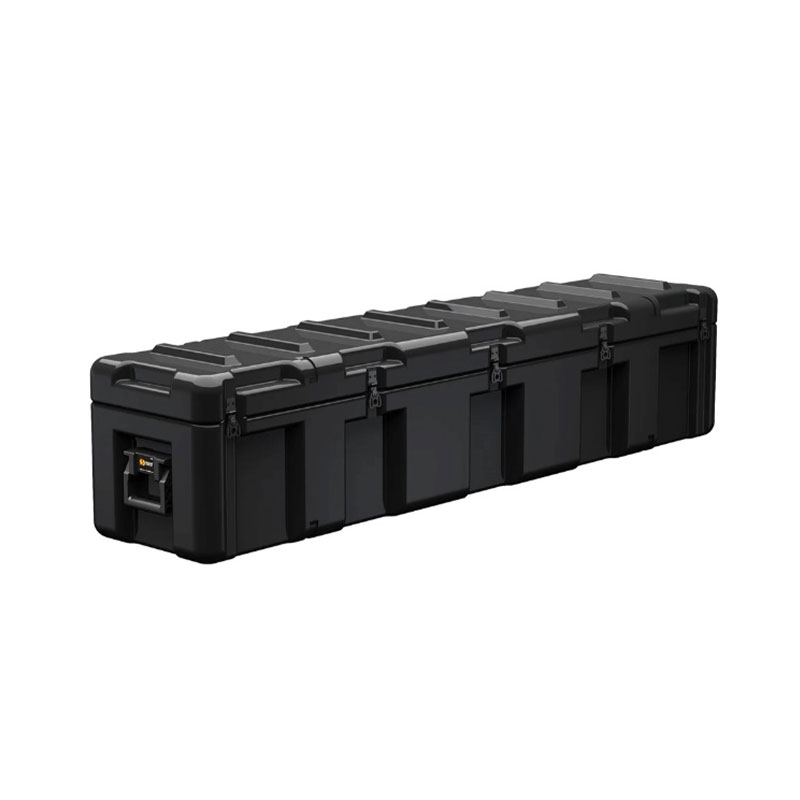
Military box mold
Why Military Box Mold Quality Matters
Military cases are commonly expected to protect equipment under conditions that are more severe than ordinary storage applications. They may be loaded into vehicles, carried across uneven terrain, stacked in warehouses, moved through supply chains, or opened and closed repeatedly during field operations. The finished case may need to resist impact, vibration, moisture, dust, temperature changes, and rough handling.
The mold directly influences how well the finished case performs. If the cavity contains dimensional inconsistencies, the molded product may have uneven walls, weak corners, poor lid alignment, or irregular mounting interfaces. If the surface is poorly finished, product release may become less predictable and the exterior appearance may suffer. If the mold is not compatible with the heating system, the production cycle may become unstable and different areas of the case may develop inconsistent material distribution.
These issues can create higher rejection rates, additional trimming, assembly problems, sealing failures, and increased maintenance costs. A properly engineered mold reduces these risks by considering the complete relationship between the finished product, the polymer material, the rotational molding machine, the heating method, the production cycle, and the intended service conditions.
Military box tooling must therefore be evaluated according to more than its purchase price. Important factors include the alloy and manufacturing method, the accuracy of the cavity, the quality of the surface finish, the repeatability of the tooling, the ability to accommodate customized features, the compatibility with gas-heated or electric-heated equipment, and the technical support available after delivery.
6061-T6 Forged Aluminum Alloy for Military Box Tooling
6061-T6 forged aluminum alloy is a preferred material for demanding rotational molding applications because it combines strength, durability, machinability, and favorable surface characteristics. For military box mold manufacturing, these properties are valuable because the tooling must remain stable through repeated production cycles while also supporting complex product configurations.
The forging process creates a dense internal structure that supports reliable mechanical performance. A dense structure can help reduce the risk of internal defects that may affect machining, thermal behavior, or long-term mold durability. The material is also suitable for precision cutting and finishing, allowing manufacturers to produce detailed cavity features and smooth surfaces.
The T6 temper provides a useful balance of strength and hardness for industrial tooling. Military case molds frequently include large flat areas, deep corners, curved sections, fastening features, and reinforced structures. These features require a mold material capable of maintaining its shape during machining, handling, heating, cooling, and repeated production use.
Another advantage is the alloy’s suitability for polishing. A well-polished cavity can support more consistent product release and help produce a cleaner external appearance. While surface finish alone cannot determine the overall quality of a case, it contributes to process stability, easier maintenance, and repeatable molded surfaces.
Compared with less suitable aluminum grades or poorly prepared materials, 6061-T6 forged aluminum alloy can provide a stronger foundation for customized military tooling. Its combination of internal density, surface quality, durability, and machinability supports both large transport cases and smaller tactical equipment boxes.
Material Advantages Compared with Conventional Alternatives
Some rotational molds are produced from materials or manufacturing methods selected primarily for low initial cost. Although these options may be acceptable for simple products or limited production runs, they may not provide the same level of dimensional stability, surface quality, or customization capability required for military applications.
6061-T6 forged aluminum alloy offers several practical advantages:
- Its strong and dense structure supports repeated production use.
- Its machinability allows complex product details to be manufactured accurately.
- Its surface quality supports polishing and controlled cavity finishing.
- Its durability helps the mold withstand repeated heating and cooling cycles.
- Its customization potential supports specialized military and industrial case designs.
- Its compatibility with rotational molding equipment allows flexible production planning.
The most suitable material still depends on product size, production volume, heating method, cavity design, and operating conditions. However, for customized military box molds, 6061-T6 forged aluminum alloy provides a well-balanced combination of performance and manufacturing practicality.
Engineering Design for Heavy-Duty Military Transport Cases
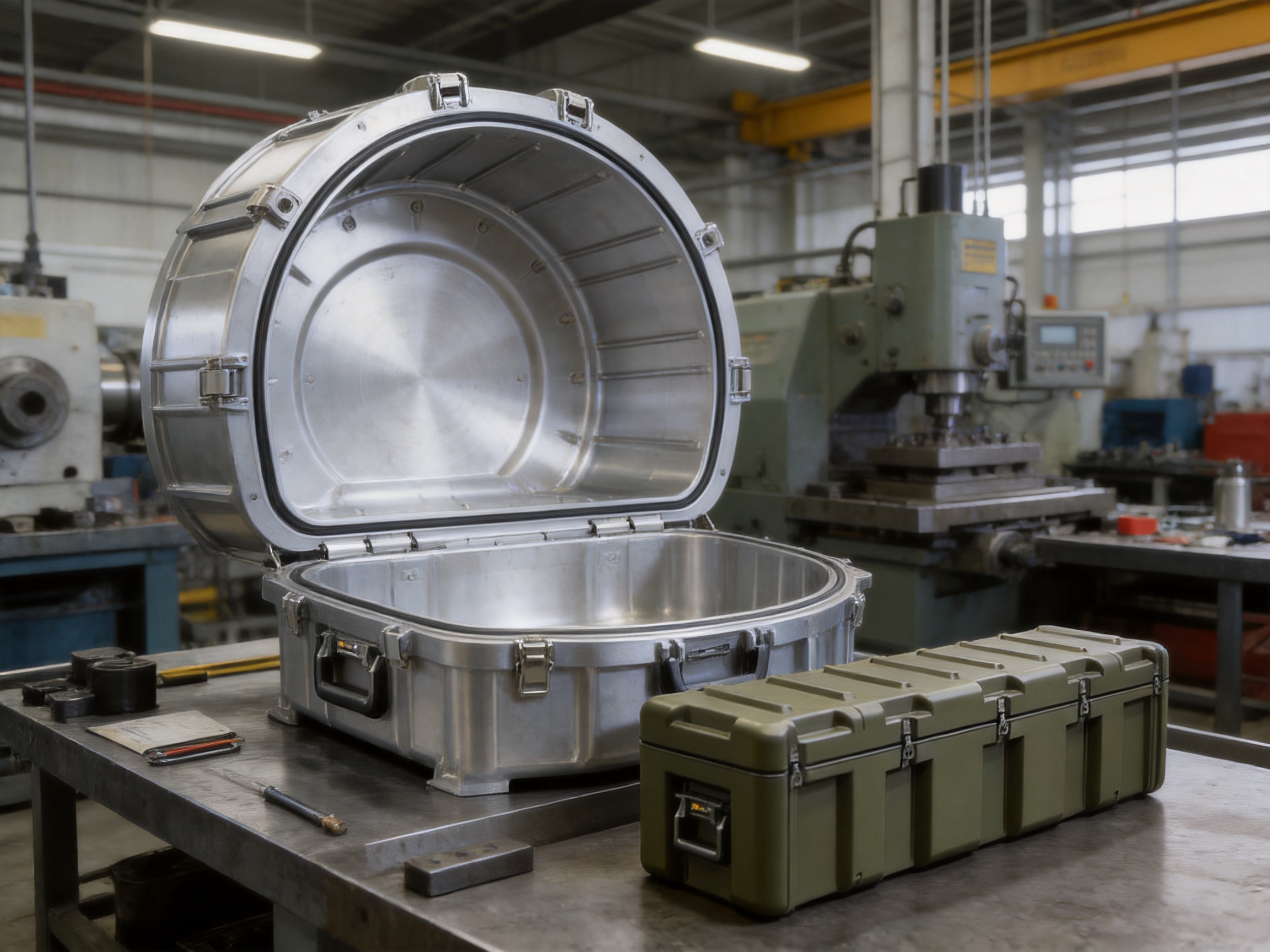
Heavy-duty military transport cases are designed to protect equipment during movement, loading, unloading, storage, and deployment. Their product structures often include reinforced corners, large curved panels, strong handles, mounting areas, lid interfaces, and fastening points. The mold must reproduce these features accurately while supporting consistent polymer distribution throughout the hollow cavity.
Rotational molding does not use high-pressure injection to force material into every area of the cavity. Instead, polymer powder is placed inside the mold, and the mold rotates through a controlled heating cycle. As the material melts, it coats the internal surfaces. This means the mold design must support natural material flow and avoid unnecessary areas where powder may collect or where the wall may become too thin.
Large military transport cases require careful control of wall distribution. Excessive material concentration can increase weight, cycle time, and material consumption. Insufficient material in a corner or load-bearing area may reduce impact resistance and structural reliability. The mold geometry must therefore balance product strength with efficient material use.
Corner design is particularly important. Rounded corners can improve material movement, reduce stress concentration, and support easier product release. Reinforced corners may be incorporated through carefully designed geometry, ribs, or additional structural features. These details must be optimized for rotational molding rather than copied directly from a design intended for another manufacturing process.
Large curved surfaces also require careful consideration. Excessive flatness may increase the risk of deformation, while abrupt transitions can affect wall thickness and product appearance. Three-dimensional engineering allows designers to evaluate these surfaces before machining begins and to identify potential problems at an early stage.
Structural Features for Transport-Oriented Cases
A heavy-duty military transport case may require a combination of the following features:
- Reinforced corners for improved impact resistance.
- Stable lid and base geometry for reliable assembly.
- Strong handle mounting areas for lifting and carrying.
- Accurate fastening interfaces for latches, locks, and hinges.
- Ribs or integrated reinforcement zones for structural support.
- Curved surfaces that promote balanced wall distribution.
- Drainage or protective features for outdoor and field use.
- Dimensional consistency across multiple production cycles.
Each feature influences the mold design. For example, a handle mounting area may require additional local strength but must not create a difficult undercut or a region that releases poorly. A hinge interface must be positioned accurately relative to the lid and base. A sealing surface must remain consistent around the entire perimeter. These requirements demonstrate why military box mold manufacturing should begin with the finished product and its operating conditions.
Tooling for Rugged Tactical Equipment Cases
Rugged tactical equipment cases are often more customized than general-purpose transport containers. They may be developed for communication devices, optical instruments, electronic systems, field tools, medical equipment, measurement instruments, or specialized military components. The case may need to accommodate internal protection, customized inserts, fastening systems, removable panels, cable passages, or equipment-specific interfaces.
The mold must reproduce these features without compromising structural integrity. A detailed product design can create challenges involving corners, transitions, release direction, wall distribution, and heating. For this reason, tooling development should include an early technical review of the complete product.
During the design stage, engineers should consider the equipment to be protected, the external dimensions, the anticipated loads, the handling method, the environmental exposure, the assembly requirements, and the selected rotational molding machine. A case intended for a large transport vehicle may require a different structure from a compact tactical case carried by one person.
The transition between flat and curved areas is one of the most important engineering considerations. An abrupt transition may affect the way polymer powder accumulates and melts. It may also create a stress concentration in the finished case. Smooth transitions and properly positioned radii can support more uniform wall distribution and improve the durability of the finished product.
Details such as hinges, latches, mounting points, handles, and protective interfaces should also be evaluated for manufacturability. If these details are too deep, too narrow, or poorly positioned, they may complicate product release or require additional finishing after molding. A well-designed mold integrates the required functionality while preserving a practical rotational molding process.
Advantages of Customized Tactical Tooling
Customized military box molds provide advantages over generic case tooling because the cavity is developed around the actual product requirements. This approach enables the manufacturer to optimize dimensions, structural features, interfaces, and external appearance for a specific application.
Customized tooling can help achieve:
- Better use of internal space for specialized equipment.
- More accurate mounting positions for hardware and accessories.
- Improved protection around sensitive components.
- More effective integration of handles, hinges, and fastening systems.
- Reduced dependence on secondary modifications after molding.
- Improved compatibility with the customer’s existing production equipment.
- Greater consistency between product design and final manufacturing requirements.
Jiangsu Zhroto Mould Co., Ltd. supports customized projects through product evaluation, CAD-based three-dimensional engineering, mold design confirmation, CNC machining, trial production, sample validation, and final inspection. This integrated workflow helps reduce communication gaps between product designers, mold manufacturers, and production teams.
Waterproof Equipment Case Production Molds
Waterproof equipment cases require accurate interfaces between the lid and base. The protective function of the finished product depends on the interaction of the molded shell, sealing components, hinges, latches, fasteners, and assembly process. Even a small dimensional variation around the mating area can affect fit and sealing performance.
For this reason, the mold must provide stable geometry around the perimeter of the case. The lid and base should be designed as a coordinated system rather than as unrelated components. Critical dimensions, corner radii, sealing channels, latch areas, and hinge positions should be reviewed together before the mold is manufactured.
A smooth cavity surface can support reliable product release and consistent external appearance. Accurate machining can help maintain the required dimensions around the sealing interface. The mold should also avoid unnecessary surface defects, sharp transitions, or irregularities that could create problems during production or assembly.
Waterproof equipment cases may be used outdoors, in transportation environments, near water treatment facilities, or in other applications where moisture protection is important. The mold therefore needs to support a product that is both structurally durable and dimensionally consistent.
Important features may include:
- Accurately aligned lid and base interfaces.
- Consistent sealing surfaces around the perimeter.
- Stable hinge and latch mounting positions.
- Protective ribs or raised features around vulnerable areas.
- Rounded corners that support reliable molding and impact resistance.
- External surfaces suitable for labels, coatings, or identification marks.
Precision CNC Manufacturing Process
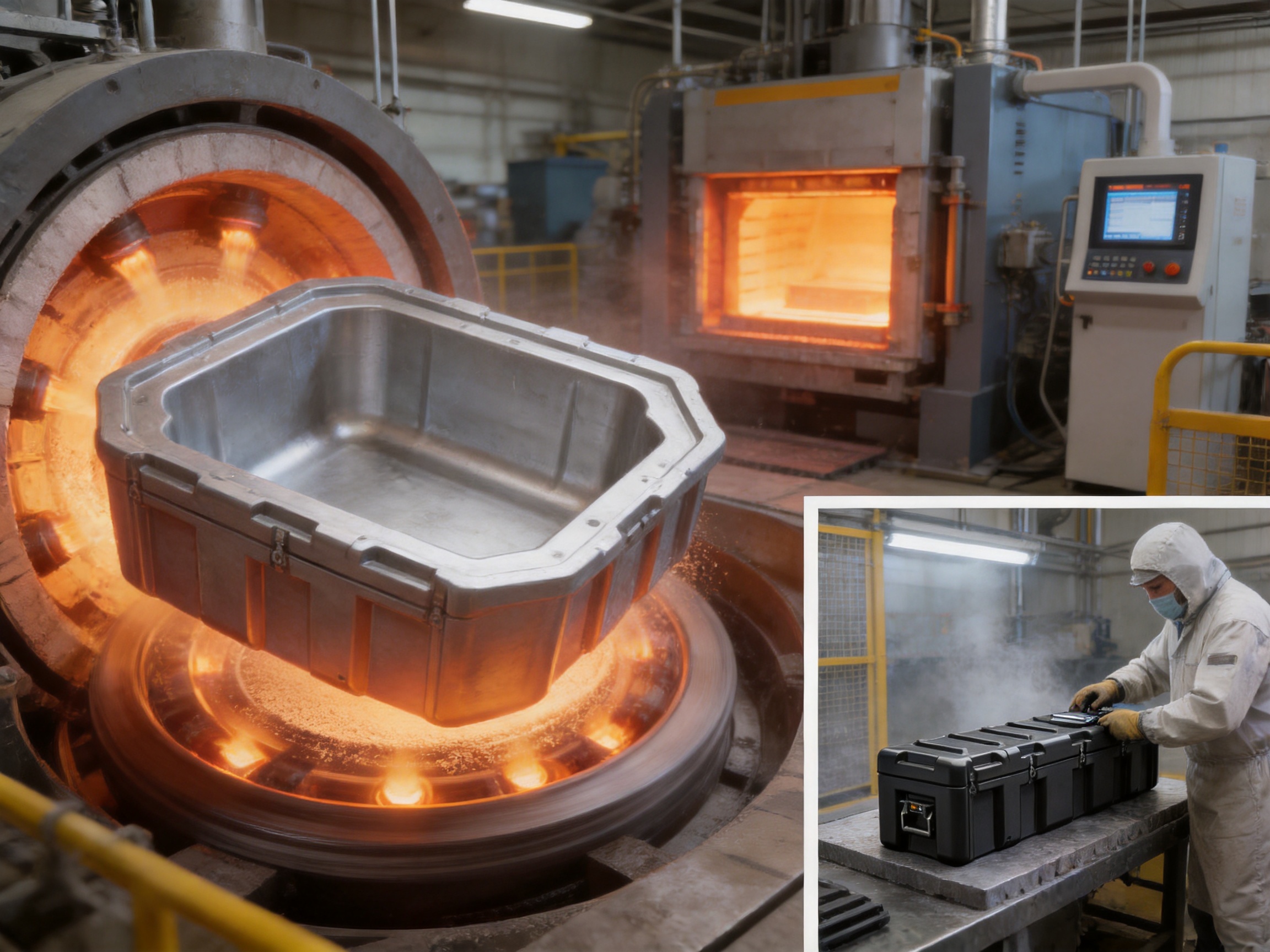
The quality of a military box mold depends on the complete manufacturing process rather than on material selection alone. Jiangsu Zhroto Mould Co., Ltd. combines product analysis, three-dimensional modeling, precision CNC machining, surface treatment, assembly, testing, and inspection to produce rotational tooling for customized cases.
Project Evaluation and Product Optimization
Each project should begin with a review of the product concept, drawing, sample, or existing case. Engineers evaluate the intended dimensions, wall requirements, structural features, production volume, polymer material, heating equipment, and service conditions. If the product design is not yet optimized for rotational molding, recommendations can be made before the mold is manufactured.
This early review can identify potential issues such as excessive flat areas, difficult release conditions, insufficient corner radii, overly complex interfaces, or inconsistent structural requirements. Solving these problems before machining can reduce later modifications and help shorten the path to production approval.
Three-Dimensional Mold Design
Three-dimensional engineering provides a visual and technical basis for mold confirmation. The model can be used to review cavity geometry, parting lines, flange areas, corner transitions, mounting positions, and other critical features. It also supports communication between the customer and the mold manufacturer.
Before production begins, the customer can confirm the appearance and major dimensions of the mold design. This is especially useful for military cases with customized interfaces or unusual external shapes. A confirmed three-dimensional model reduces uncertainty and establishes a reference for CNC programming and inspection.
CNC Machining
Precision CNC machining is used to create the cavity and other critical mold surfaces. Computer-controlled machining supports repeatable cutting paths, accurate curved surfaces, and detailed features. It is particularly valuable for large cases where manual finishing alone may not provide sufficient consistency.
The machining strategy depends on the product shape, mold size, cavity depth, corner geometry, and surface requirements. Rough machining removes excess material efficiently, while finishing operations refine the cavity surfaces and prepare them for polishing or other surface treatment.
Machining accuracy is important around hinge locations, latch interfaces, sealing areas, mounting zones, and mating surfaces. These regions may influence the performance of the finished case and should receive appropriate inspection during the manufacturing process.
Surface Finishing and Polishing
After machining, the mold surface may be polished or otherwise finished according to the product requirements. Surface treatment helps remove machining marks, improve appearance, and support reliable product release. The appropriate finish depends on the desired exterior texture, the polymer material, and the intended application.
For military cases, a controlled surface finish can contribute to a professional appearance and stable production performance. It may also simplify cleaning and maintenance of the tooling. Surface finishing must be performed carefully so that critical dimensions and functional interfaces are not unintentionally changed.
Assembly, Trial Production, and Validation
After the mold components are manufactured and assembled, trial production is carried out to evaluate the tooling under actual or representative rotational molding conditions. Trial samples provide practical information about wall distribution, product dimensions, release behavior, surface appearance, assembly fit, and structural details.
If adjustments are required, the mold can be refined before final acceptance. This validation stage is important because computer models and dimensional inspections cannot fully replace production testing. A mold may meet drawing requirements yet require process adjustments to achieve the intended product performance.
Gas-Heated and Electric-Heated Rotomolding Compatibility
Military box molds may be used with conventional gas-heated rotational molding machines or modern electric-heated systems. The heating method affects mold design, cycle control, energy use, and temperature distribution. Tooling should therefore be developed according to the equipment on which the customer intends to produce the case.
Gas-heated rotational molding remains widely used because it offers flexibility for large hollow products and compatibility with many existing production systems. The mold must be designed to withstand the thermal cycle and to support appropriate heat transfer across the entire cavity.
Electric-heated rotational molding systems provide more precise temperature management and may include independently controlled heating zones. These capabilities can improve process control, but they also place greater demands on thermal design, mold construction, and process monitoring.
Jiangsu Zhroto Mould Co., Ltd. supports both conventional gas-heated and electric-heated rotational molding applications. Since 2023, the company has invested in electric-heated rotational molding technology. Under suitable production conditions, electric systems may provide temperature control accuracy of approximately 1 to 2 degrees Celsius, thermal efficiency above 95 percent, and potential energy reductions of approximately 30 to 50 percent.
Actual results depend on product geometry, material, cycle time, machine configuration, operating conditions, and production management. Nevertheless, process-specific mold engineering can help manufacturers obtain greater control over heating, cooling, and material distribution.
Thermal Considerations for Military Box Molds
Thermal behavior affects both productivity and product quality. If one region of the mold heats faster than another, the case may develop uneven wall thickness or inconsistent surface appearance. If cooling is poorly controlled, deformation or dimensional variation may occur.
Important thermal considerations include:
- Mold thickness and heat transfer characteristics.
- Product size and cavity depth.
- Location of corners, ribs, and reinforced areas.
- Heating zone arrangement and machine configuration.
- Polymer type, powder characteristics, and required cycle time.
- Cooling conditions and demolding temperature.
- Expected production volume and repeatability requirements.
A mold designed for a gas-heated machine may not be optimized for an electric system with zoned temperature control. During the engineering stage, the manufacturer should review the customer’s equipment and process requirements so that the tooling can work effectively within the intended production environment.
Manufacturing Strengths of Jiangsu Zhroto Mould Co., Ltd.
Jiangsu Zhroto Mould Co., Ltd. is a professional manufacturer specializing in rotational molding mold design, mold production, rotomolded product processing, and integrated technical solutions. Founded in 2015, the company moved to a modern facility in Jiangyan District, Taizhou City, in 2021.
The facility covers approximately 18,000 square meters, including more than 12,000 square meters of standardized production workshops. The company has an annual mold output exceeding 800 sets and an annual plastic product capacity of approximately 3,600 tons. These resources support both individual customized projects and larger production programs.
Its manufacturing experience covers industrial equipment, automotive parts, agricultural machinery, hydrogen energy storage and transportation, water treatment, outdoor facilities, military-style cases, and other rotationally molded products. This cross-industry experience is valuable because many engineering principles used in one sector can contribute to improved tooling solutions in another.
The company provides one-stop services from product design and mold manufacturing to finished product production. This integrated model can reduce the need for customers to coordinate multiple suppliers for product development, tooling, trial production, and process support.
Jiangsu Zhroto Mould Co., Ltd. maintains ISO 9001:2015, ISO 14001:2015, and ISO 45001:2018 certifications. These systems provide a structured foundation for quality management, environmental responsibility, and occupational health and safety.
| Manufacturing capability | Customer benefit | Application to military box molds |
|---|---|---|
| Product structure optimization | Reduces design risks before tooling begins | Improves wall distribution, release behavior, and structural performance |
| Three-dimensional engineering | Supports clear design confirmation | Helps verify complex interfaces, corners, and mounting features |
| Precision CNC machining | Provides repeatable cavity geometry | Supports accurate dimensions and consistent molded surfaces |
| 6061-T6 forged aluminum alloy | Combines strength, machinability, and durability | Suitable for demanding production cycles and customized tooling |
| Trial production and sample validation | Confirms practical mold performance | Evaluates wall distribution, fit, appearance, and structural details |
| Gas-heated and electric-heated compatibility | Supports different production systems | Allows tooling to be matched to existing or new rotomolding equipment |
| Integrated technical support | Reduces coordination between suppliers | Supports development, acceptance, production, and maintenance |
Advantages Over Lower-Quality or Less Integrated Tooling
The competitive advantage of a military box mold should be evaluated over its entire service life. A lower initial price may not provide the best value if the mold produces inconsistent products, requires frequent modification, or creates avoidable production problems.
A high-quality mold can provide advantages in several areas:
Improved Dimensional Repeatability
Accurate machining and careful inspection help the mold produce cases with stable dimensions. This is important for lids, bases, sealing surfaces, hardware interfaces, and assemblies that must fit repeatedly.
Better Surface Quality
A smooth and carefully finished cavity can support more consistent product release and improved appearance. It may also reduce the amount of secondary finishing required after molding.
More Reliable Structural Performance
Optimized corners, transitions, ribs, and mounting areas can help create a case with more balanced strength. The mold is designed around the functional requirements of the finished product rather than around a generic shape.
Greater Customization
Precision CNC machining and three-dimensional engineering allow manufacturers to produce specialized interfaces, curved surfaces, equipment-specific cavities, and customized external features.
Reduced Development Risk
Design confirmation, trial production, sample validation, and inspection provide opportunities to identify and correct issues before production release. This can reduce the risk of expensive changes after the mold has entered regular use.
Better Long-Term Production Value
A durable mold that maintains consistent performance can support stable production over many cycles. Its value includes not only the initial tooling cost but also reduced rejection, less downtime, simpler maintenance, and more predictable product quality.
Quality Control and Mold Acceptance
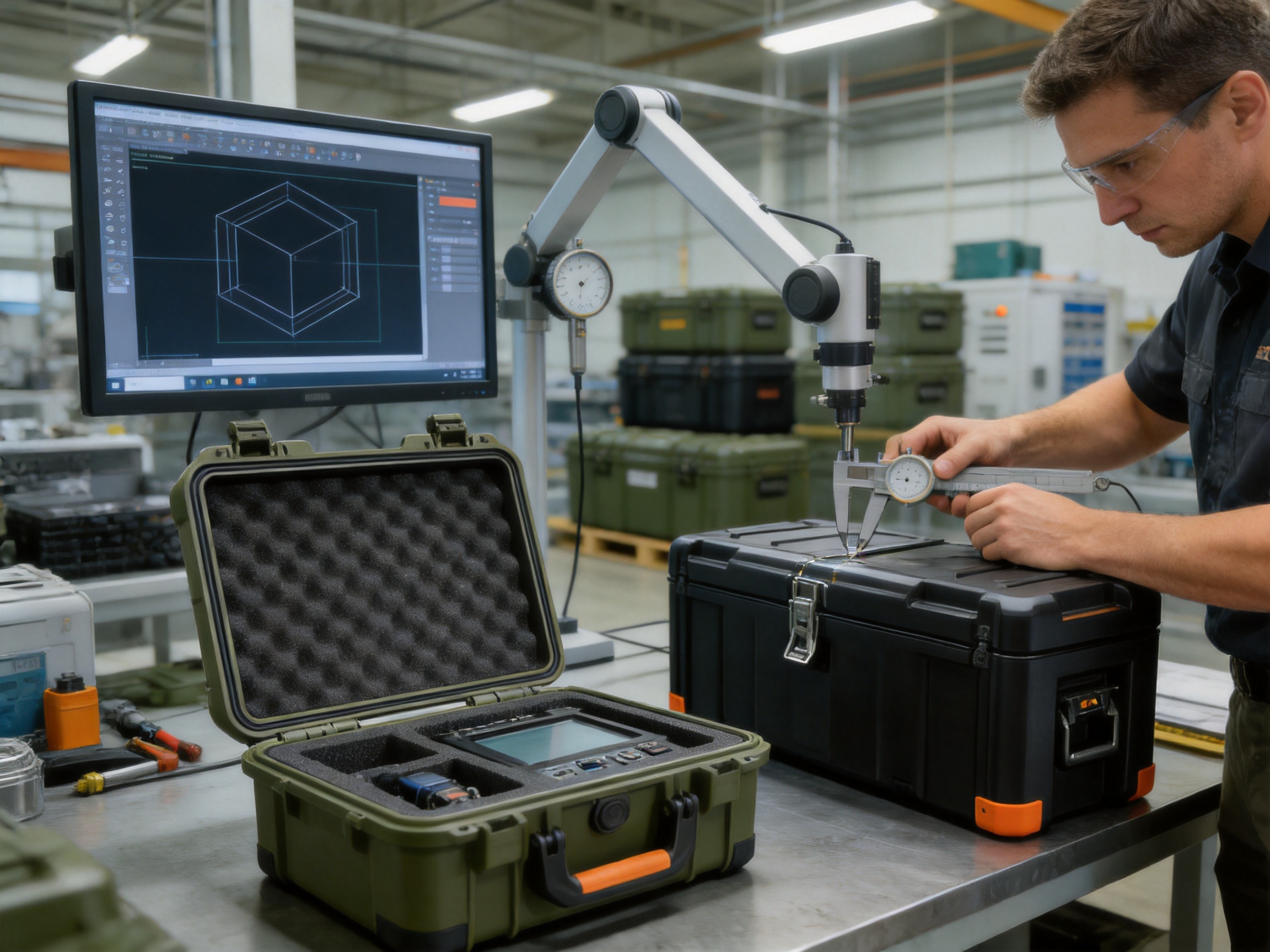
Mold acceptance should be based on measurable technical and production requirements. For military box tooling, inspection should cover dimensions, surface quality, structural details, parting areas, mating interfaces, and actual trial samples.
Dimensional inspection verifies that critical cavity features correspond to the approved design. This may include overall length, width, height, corner radii, flange dimensions, hinge locations, latch positions, sealing areas, and other customer-defined requirements.
Surface assessment checks for machining marks, dents, scratches, irregular polishing, and other conditions that could affect product release or appearance. The appropriate surface standard should be agreed before production so that acceptance criteria are clear.
Trial samples provide additional evidence of performance. They can be evaluated for wall distribution, deformation, external appearance, dimensional accuracy, assembly fit, and structural details. When required, samples may also be tested under representative handling or environmental conditions.
A complete acceptance process may include:
- Review of the approved product and mold drawings.
- Verification of critical mold dimensions.
- Inspection of cavity surfaces and functional interfaces.
- Confirmation of mold assembly and opening behavior.
- Trial production on the intended or representative machine.
- Evaluation of the molded sample.
- Completion of corrections or refinements if necessary.
- Final customer approval and production release.
This systematic process helps connect engineering quality with actual manufacturing performance.
Maintenance and Long-Term Tooling Performance
Even a well-manufactured military box mold requires appropriate maintenance. Regular cleaning, inspection, storage, and handling can extend service life and help preserve product consistency.
After production, the mold should be cleaned according to the material and process requirements. Residual polymer, dust, or contamination may affect surface quality and product release if allowed to accumulate. Particular attention should be given to parting lines, corners, vents, fastening areas, and sealing interfaces.
Operators should inspect the mold for scratches, dents, deformation, loose hardware, surface wear, and changes in the mating areas. Early detection allows minor issues to be corrected before they affect a large number of products.
Mold storage conditions also matter. The tooling should be protected from unnecessary moisture, impact, contamination, and improper stacking. Large mold sections should be supported in a way that minimizes stress and prevents accidental deformation.
Maintenance recommendations should consider production volume, cycle temperature, polymer type, mold construction, and machine operation. Jiangsu Zhroto Mould Co., Ltd. provides production support and maintenance advice to help customers maintain stable tooling performance after delivery.
Application Areas for Military Box Molds
Military box molds can be used for many types of protective and transport products. These may include equipment cases, field storage containers, tactical boxes, communication equipment housings, medical transport cases, instrument containers, maintenance tool cases, and specialized protective enclosures.
The same tooling principles also apply to non-military products that require durable hollow structures. Industrial transport cases, emergency response containers, outdoor equipment boxes, agricultural equipment enclosures, and specialized shipping cases may all benefit from similar mold engineering.
In each application, the design should reflect the actual operating conditions. A case used for indoor storage may require different reinforcement and sealing features from one used for outdoor deployment. A container for sensitive electronic equipment may require more customized interfaces than a general-purpose transport box.
The broad application experience of Jiangsu Zhroto Mould Co., Ltd. supports the development of tooling for different product categories. Knowledge gained from automotive parts, industrial equipment, outdoor products, water treatment components, and agricultural machinery can contribute to practical solutions for military and protective cases.
How to Select a Military Box Mold Manufacturer
Customers evaluating a mold supplier should consider more than the supplier’s ability to machine aluminum. A reliable partner should understand rotational molding, product design, thermal processing, trial production, quality inspection, and long-term manufacturing support.
Important evaluation questions include:
- Does the manufacturer understand rotational molding product design?
- Can the supplier recommend suitable mold materials and structures?
- Does the company provide three-dimensional engineering and design confirmation?
- What CNC machining and inspection capabilities are available?
- Can the mold be adapted to the customer’s heating equipment?
- Does the supplier perform trial production and sample validation?
- Can the company support changes or improvements during development?
- Are quality, environmental, and safety management systems established?
- Does the supplier offer technical support after mold delivery?
- Can the manufacturer provide both tooling and finished product processing?
A manufacturer that can support the complete development process may offer greater value than a supplier that only produces the physical mold. Integrated support helps maintain consistency between product requirements, tooling decisions, production conditions, and final acceptance.
Recommended Development Workflow
A practical military box mold project can follow the workflow below:
- The customer provides a product concept, drawing, sample, or development requirement.
- The manufacturer reviews the product application, dimensions, structure, and production conditions.
- Engineers recommend improvements for rotational molding where necessary.
- A three-dimensional product and mold model is prepared for confirmation.
- The suitable alloy, tooling structure, heating method, and machining plan are selected.
- 6061-T6 forged aluminum alloy is prepared for mold manufacturing when appropriate.
- CNC machining creates the cavity and critical functional surfaces.
- The mold is polished, finished, assembled, and inspected.
- Trial production is completed on suitable rotational molding equipment.
- Samples are evaluated for dimensions, appearance, wall distribution, fit, and structure.
- Required adjustments are completed before final acceptance.
- The mold is released for production with technical and maintenance recommendations.
This process creates clear checkpoints and reduces the risk of moving directly from an unverified design to mass production.
Frequently Asked Questions
What is a military box mold?
A military box mold is a rotational molding tool used to manufacture hollow protective cases for military, industrial, tactical, outdoor, or specialized equipment. The mold forms the external geometry of the case and may include features for lids, hinges, latches, handles, ribs, mounting points, and sealing interfaces.
Why is 6061-T6 forged aluminum alloy suitable for this tooling?
6061-T6 forged aluminum alloy provides a useful combination of strength, durability, dense internal structure, machinability, and surface quality. It can be precision machined and polished, making it suitable for customized cavities and repeated rotational molding cycles.
How does a military box mold differ from a general storage box mold?
A military box mold generally requires greater attention to structural durability, impact resistance, dimensional stability, sealing performance, reinforced corners, mounting areas, and environmental protection. The exact requirements depend on the intended product and service conditions.
Can one mold produce both the lid and the base?
In most cases, the lid and base are produced using separate mold sections or separate molds because they have different geometries and interfaces. The two components must nevertheless be designed together to ensure proper alignment, assembly, sealing, and hardware positioning.
Why is trial production important?
Trial production confirms how the mold performs under actual or representative rotational molding conditions. It allows the manufacturer and customer to evaluate wall distribution, product dimensions, surface quality, release behavior, assembly fit, and structural details before final production approval.
Can the tooling work with electric-heated rotational molding machines?
Yes. Military box molds can be developed for electric-heated systems as well as conventional gas-heated equipment. Electric systems may require closer attention to heating zones, temperature management, thermal efficiency, and the relationship between mold design and machine operation.
What should be considered when designing a waterproof case mold?
Important considerations include lid and base alignment, sealing surfaces, mating dimensions, corner geometry, hinge positions, latch areas, drainage features, and dimensional consistency. The mold should be engineered to support repeatable assembly and reliable protective performance.
How can mold quality affect production cost?
A high-quality mold can reduce rejection, secondary finishing, dimensional variation, downtime, and unplanned maintenance. Although precision tooling may have a higher initial cost than a basic alternative, its long-term production value can be better when consistent output and reliable service are considered.
Does the manufacturer support product design optimization?
Jiangsu Zhroto Mould Co., Ltd. provides project evaluation and product structure optimization before mold manufacturing. The engineering team can review the design for rotational molding suitability and recommend changes involving corners, transitions, wall distribution, interfaces, and production practicality.
What certifications does the company maintain?
The company maintains ISO 9001:2015, ISO 14001:2015, and ISO 45001:2018 certifications. These certifications support structured quality management, environmental management, and occupational health and safety practices.
What information should a customer provide when requesting a quotation?
Useful information includes product drawings or three-dimensional files, overall dimensions, expected material, production volume, heating machine type, desired surface finish, structural requirements, sealing expectations, hardware locations, and the intended application environment. A product sample or concept description can also help engineers evaluate the project.
Conclusion
A durable military box mold must be engineered as part of a complete manufacturing system. Material strength alone is not enough. Reliable tooling also requires accurate product design, suitable corner and transition geometry, controlled wall distribution, precision machining, appropriate surface finishing, thermal compatibility, trial validation, and long-term technical support.
6061-T6 forged aluminum alloy provides a strong foundation for customized rotational molds because of its dense internal structure, durability, machinability, and favorable polishing characteristics. When combined with three-dimensional engineering and precision CNC manufacturing, it can support heavy-duty transport cases, rugged tactical equipment cases, waterproof containers, and other specialized protective products.
Jiangsu Zhroto Mould Co., Ltd. offers integrated capabilities from product optimization and mold design to manufacturing, testing, sample validation, finished product processing, and production support. Its experience with both gas-heated and electric-heated rotational molding systems allows tooling to be matched to different equipment and process requirements.
For customers seeking dependable military box tooling, the most important objective is consistent long-term production performance. A carefully engineered mold can improve dimensional repeatability, structural reliability, surface quality, product customization, and manufacturing efficiency. By evaluating the entire process rather than the initial tooling cost alone, manufacturers can build a more stable and cost-effective foundation for demanding case production.
References
1. Aluminum Association. Aluminum Standards and Data: Alloy Designations, Temper Conditions, and General Material Characteristics.
2. ASTM International. Standards Related to Aluminum Alloys, Mechanical Properties, and Manufacturing Quality.
3. Plastics Industry Association. Rotational Molding Process Principles and Production Considerations.
4. ISO 9001:2015. Quality Management Systems: Requirements.
5. ISO 14001:2015. Environmental Management Systems: Requirements with Guidance for Use.
6. ISO 45001:2018. Occupational Health and Safety Management Systems: Requirements with Guidance for Use.
7. Rotational Molding Association. Guidelines for Mold Design, Heating, Cooling, and Product Development.
8. General engineering practice for rotational molding tool design, aluminum cavity machining, sample validation, and production process control.
Product: Military box mold


We provide customers with one-stop services ranging from product design, mold manufacturing to finished product production.
-
 +86-18006248936
-
 ricky.t@zhroto.com
-
 No.9 Jiangyuan Road, Luotang Street, Jiangyan District, Taizhou City,Jiangsu Province, China
Copyright © Jiangsu Zhroto Mould Co., Ltd. Rights Reserved.Custom Rotational Plastic Molding Factory
