 en
 中文简体
 русский
 Español
 Deutsch
 Polskie
 REQUEST A QUOTE

 Home / Author / Saskia Wen — Regional Sales Executive / Rotational Molding Furniture Molds: Design, Cost, Performance, and Manufacturing Advantages
Rotational Molding Furniture Molds: Design, Cost, Performance, and Manufacturing Advantages
Content
- 1 What Is a Rotational Molding Furniture Mold?
- 2 Why Rotational Molding Is Suitable for Plastic Furniture
- 3 Advantages Compared with Injection Molding and Blow Molding
- 4 Furniture Mold Design Considerations
- 5 Conventional Rotational Molding Furniture Molds
- 6 Electric-Heated Rotational Molding Furniture Molds
- 7 Aluminum Mold Construction and Machining
- 8 Manufacturing Process for a Furniture Rotational Mold
- 9 Factors Affecting Rotational Molding Furniture Mold Cost
- 10 How to Improve Furniture Mold Performance
- 11 Applications for Rotomolded Furniture
- 12 Manufacturing Strengths of Jiangsu Zhroto Mould Co., Ltd.
- 13 How to Select a Furniture Mold Supplier
- 14 Frequently Asked Questions
- 14.1 What is the main advantage of a rotational molding furniture mold?
- 14.2 Can rotational molding produce furniture with strong edges?
- 14.3 Are aluminum molds suitable for large furniture?
- 14.4 Is rotational molding less expensive than injection molding?
- 14.5 When should electric-heated tooling be selected?
- 14.6 What information should be supplied when requesting a quotation?
- 14.7 How long can a rotational molding furniture mold last?
- 14.8 Can one mold produce different furniture designs?
- 14.9 What post-processing is commonly required?
- 14.10 Why is supplier technical support important?
- 15 Conclusion
- 16 References
- 17 Product: Rotational molding furniture mold
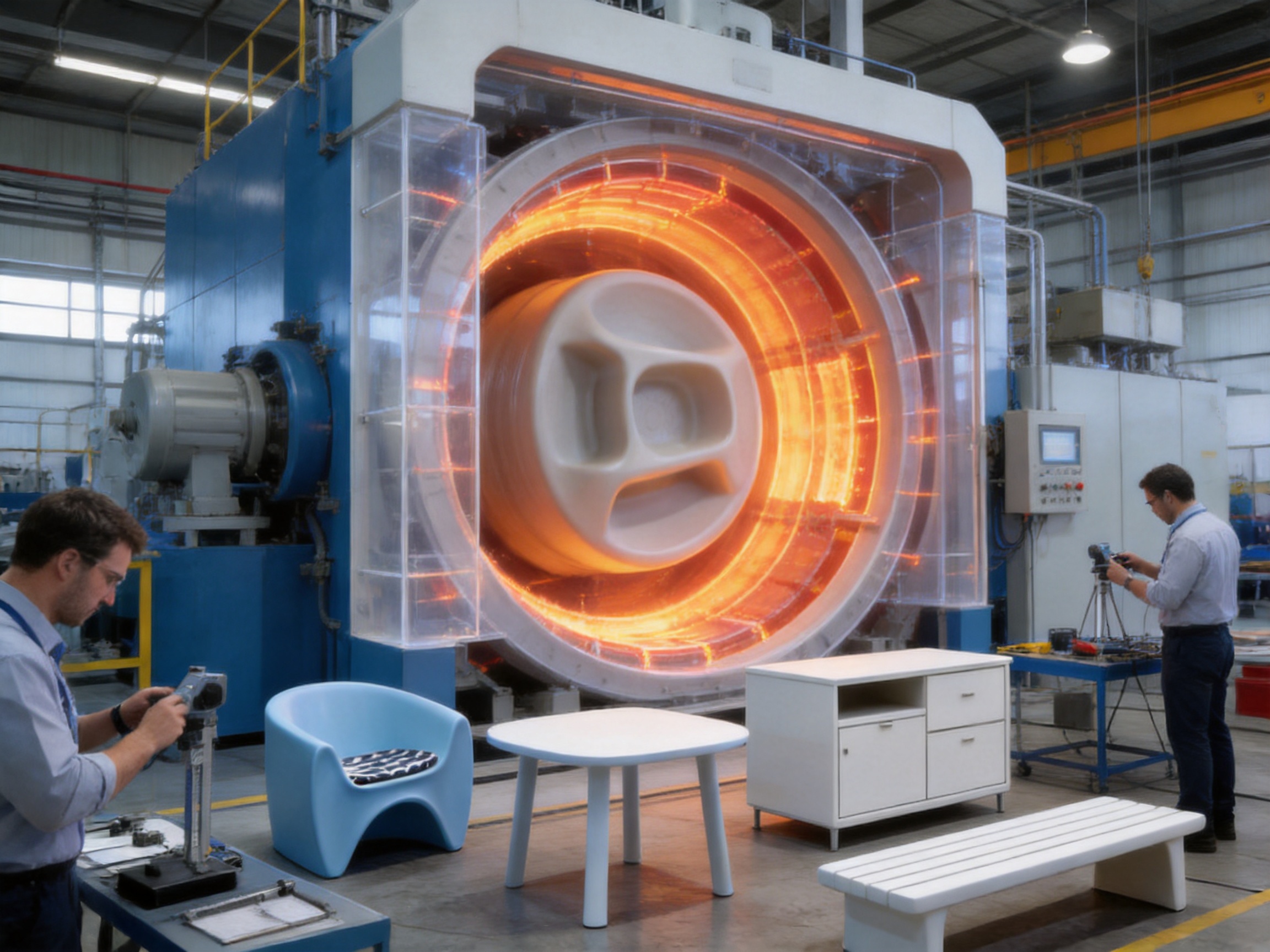
Rotational molding furniture molds are designed for the efficient production of large, hollow, seamless plastic furniture used in homes, commercial facilities, public spaces, hospitality environments, schools, gardens, and outdoor recreation areas. The process is particularly suitable for chairs, tables, cabinets, storage units, benches, planters, playground furniture, loungers, and other products that require durable one-piece construction.
Compared with injection molding and blow molding, rotational molding provides a practical combination of tooling economy, design flexibility, product size capability, and wall-thickness control. These advantages are especially important for furniture manufacturers because furniture products often have large dimensions, curved surfaces, hollow structures, ergonomic features, and edges that must withstand repeated impact or loading.
A well-engineered rotational molding furniture mold does more than reproduce the external shape of a product. It influences material distribution, edge strength, dimensional consistency, surface appearance, heating efficiency, cycle time, maintenance requirements, and the service life of the finished furniture. For this reason, mold design and manufacturing should be considered an essential part of the product development process rather than a separate step performed after the furniture design has been finalized.
Jiangsu Zhroto Mould Co., Ltd. provides rotational molding mold design, CNC manufacturing, mold testing, product processing, and technical support for customers developing large and complex plastic products. Its capabilities are applicable to furniture tooling requiring precise curves, controlled wall thickness, durable surfaces, efficient production, and compatibility with conventional or electric-heated rotational molding equipment.
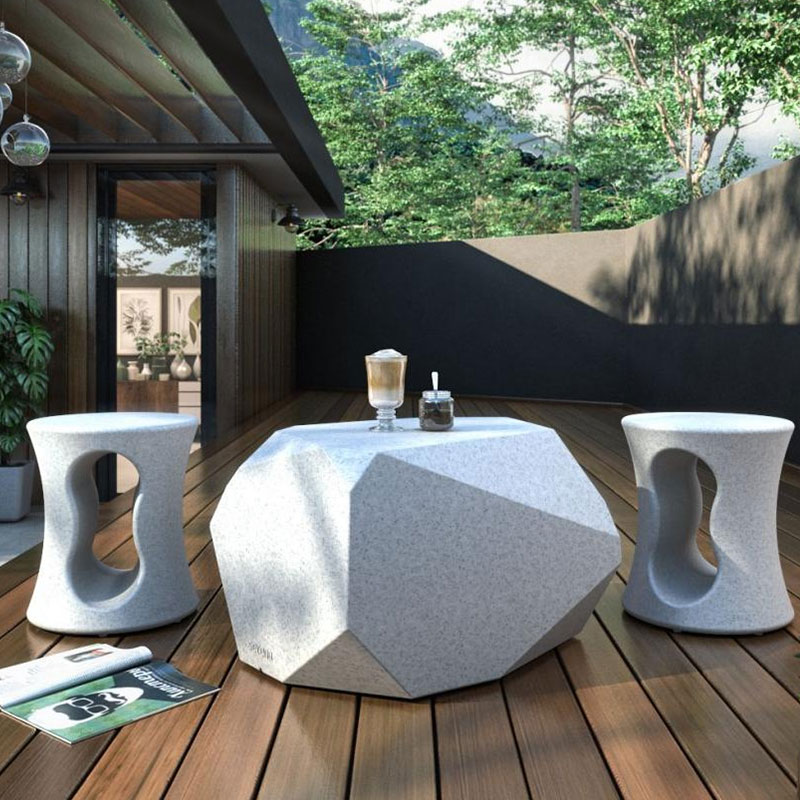
Rotational molding furniture mold
What Is a Rotational Molding Furniture Mold?
A rotational molding furniture mold is a hollow tool into which a measured quantity of plastic powder or resin is placed. The mold is then closed and rotated around two or more axes while being heated. As the material melts, it gradually coats the internal surface of the mold. After the required heating cycle, the mold is cooled while rotation continues, allowing the plastic to solidify into a hollow product that follows the mold cavity.
Once cooling is complete, the mold is opened and the furniture part is removed. Additional operations may include trimming, drilling, assembly, installation of hardware, surface finishing, or quality inspection. Because the plastic forms against the mold surface without requiring high injection pressure, the tooling structure can be comparatively simple, even when the final product is large.
The process is especially useful for furniture because it can produce seamless shells and integrated structures. A chair, cabinet, storage container, or table may be manufactured as a single piece with fewer joints and fewer potential weak points than a product assembled from multiple panels. The resulting structure can be resistant to moisture, corrosion, impact, and outdoor exposure when an appropriate polymer and formulation are selected.
Rotational molding also allows manufacturers to develop hollow products with controlled wall thickness. Although wall thickness is affected by powder loading, heating time, mold rotation, material behavior, and product geometry, proper engineering can create reinforced edges and functional areas without unnecessary material usage throughout the entire product.
Why Rotational Molding Is Suitable for Plastic Furniture
Furniture products often require a balance between appearance, strength, weight, manufacturability, and cost. Rotational molding supports this balance through a process that accommodates relatively large products and complex curved forms without the high-pressure tooling requirements associated with injection molding.
Large Product Capability
Rotational molding is well suited to large furniture because the process is not strongly restricted by injection pressure or the need to force molten polymer through narrow gates and runners. A large cabinet, outdoor bench, table, or storage unit can be developed as a hollow structure with comparatively moderate tooling complexity.
In injection molding, large furniture parts may require very large machines, substantial clamping force, extensive cooling systems, and complex mold structures. These requirements can increase tooling and production costs. Rotational molding avoids many of these limitations because the material is distributed inside a heated mold through rotation rather than injected under high pressure.
Seamless One-Piece Construction
One-piece construction is one of the most important advantages of rotomolded furniture. A seamless shell can reduce the number of joints, fasteners, welds, and assembly operations. This can improve appearance while also reducing areas where moisture, dirt, or bacteria may accumulate.
For outdoor furniture, seamless construction can reduce the risk of water entering through joints. For storage products, it can contribute to a more enclosed and durable structure. For public furniture, it can make cleaning easier and reduce the number of components that may loosen during long-term use.
Strong and Reinforced Edges
Furniture edges often experience greater stress than broad, flat surfaces. Chair edges may be struck or loaded repeatedly, table edges may receive impacts, and cabinet openings may be exposed to concentrated forces. Rotational molding provides useful control over material accumulation in selected areas when the product and mold are designed correctly.
For suitable furniture designs, edge thickness can exceed 5 millimeters. This characteristic can improve edge strength and reliability, particularly in outdoor seating, children's furniture, storage cabinets, tables, and products that are frequently moved or handled.
Resistance to Weather and Wear
Rotomolded furniture can be manufactured with polymers and additives selected for indoor or outdoor service. Depending on the material specification, finished products may provide resistance to moisture, sunlight, temperature variation, impact, abrasion, and common environmental contaminants.
Outdoor furniture must withstand repeated exposure to rain, humidity, ultraviolet radiation, dust, and temperature changes. A suitable material formulation, combined with a properly designed mold and stable production process, can help extend product service life and maintain a consistent appearance.
Design Flexibility
Rotational molding accommodates smooth curves, ergonomic contours, hollow interiors, integrated ribs, recessed areas, and complex external surfaces. Designers can create furniture with rounded corners, flowing forms, decorative textures, and functional recesses without relying on numerous separately assembled components.
This flexibility is valuable for both practical and aesthetic applications. A manufacturer may use the same general process for industrial storage furniture, modern outdoor seating, hospitality products, children's play furniture, or branded commercial installations.
Advantages Compared with Injection Molding and Blow Molding
Each plastic manufacturing process has appropriate applications. Injection molding is often highly efficient for small and medium-sized precision parts produced in very large volumes. Blow molding is effective for certain hollow containers and products with suitable shapes. Rotational molding, however, offers distinct advantages for large, hollow furniture and products requiring low-stress tooling, seamless construction, and broad design flexibility.
| Evaluation factor | Rotational molding | Injection molding | Blow molding |
| Large hollow furniture | Highly suitable | Often requires complex tooling and large equipment | Suitable only for certain shapes |
| Tooling pressure requirements | Low | High | Moderate to high |
| Typical mold cost for large products | Generally lower | Generally higher | Project dependent |
| Seamless one-piece construction | Excellent | Possible but may require assembly | Good for suitable hollow forms |
| Complex curved furniture surfaces | Highly flexible | Possible with more complex tooling | Limited by parison and shape requirements |
| Low-volume customization | Favorable | Less favorable because of tooling investment | Project dependent |
| Wall-thickness control | Controlled through design and processing | Generally precise but dependent on flow and cooling | Dependent on parison programming and geometry |
Lower Tooling Investment for Large Products
Rotational molding molds are generally less expensive than injection molds for large furniture products. The mold does not need to withstand high injection pressure, and its structure can be manufactured from aluminum or other suitable materials with a relatively straightforward construction.
Lower initial tooling cost can be important when a manufacturer is introducing a new furniture series, testing a product concept, or serving a market with moderate production quantities. The lower cost does not eliminate the need for accuracy or engineering quality, but it can make product development more accessible.
Reduced Assembly Requirements
Many injected or fabricated furniture products require multiple panels, fasteners, brackets, or welded components. Rotational molding can create an integrated shell, reducing the number of assembly operations. Fewer components may also simplify purchasing, inventory management, packaging, and quality control.
Greater Freedom for Large Hollow Structures
Rotational molding is particularly effective when the furniture is large and hollow. The process can create internal voids without requiring complex cores or extensive post-molding assembly. This can reduce product weight while preserving a strong external form.
For large products, weight reduction can improve transportation efficiency and make handling easier. The internal cavity can also be used to accommodate ballast, inserts, mounting components, insulation, or additional structural features where required by the application.
Furniture Mold Design Considerations
The best results begin with product design that is optimized for rotational molding. A furniture concept that looks attractive in a digital model may still require changes before it can be manufactured efficiently. Mold designers and product engineers should review wall distribution, draft, corner radii, openings, reinforcing features, parting lines, demolding, and post-processing requirements at the beginning of the project.
Product Geometry
Product geometry is one of the main factors affecting mold construction cost and production performance. Simple curved forms are generally easier to machine and finish than products with deep cavities, narrow recesses, abrupt transitions, sharp corners, or complex internal features.
Furniture should normally use rounded transitions rather than extremely sharp internal corners. Rounded geometry supports more uniform material distribution and can reduce stress concentration in the finished product. It can also improve powder movement and heat transfer during the rotational molding cycle.
Large flat areas may require additional design attention because they can be more vulnerable to warpage, sink effects, or inconsistent appearance. Ribs, supports, controlled curvature, or carefully positioned features may help improve rigidity without adding excessive material.
Draft and Demolding
Although rotational molding does not use the same ejection method as many injection molding processes, demolding must still be considered. The product should be removable from the mold without damaging its edges, recesses, surfaces, or integrated details.
Appropriate draft angles, split lines, removable inserts, and mold opening arrangements can simplify extraction. A product that is difficult to remove may require longer cycle times, additional labor, or frequent tooling adjustments. Early review of demolding conditions helps prevent these problems.
Wall Thickness
Wall thickness is influenced by the amount of material loaded into the mold, the product's orientation, the mold temperature, the heating cycle, the rotation pattern, and the shape of the cavity. Designers should identify areas requiring greater strength, such as seat supports, table edges, cabinet openings, mounting points, and load-bearing corners.
A uniform nominal wall thickness is often desirable, but furniture products may need localized reinforcement. The goal is not simply to make every region thicker. Excessive material can increase weight, cycle time, cost, and cooling requirements. A properly engineered mold should support material distribution that matches the actual load conditions of the furniture.
Edges and Corners
Edges should be designed with sufficient radius and material support to resist impact. Outdoor chairs, children's furniture, and storage cabinets often need especially durable edges because they are handled frequently or exposed to repeated contact.
Rotational molding can produce edges exceeding 5 millimeters in appropriate applications. However, the final result depends on the complete process rather than mold geometry alone. Powder quantity, material grade, heating time, rotation speed, and mold orientation must be validated through trials.
Surface Texture and Appearance
The internal surface of the mold determines the external finish of the furniture. Smooth, matte, textured, patterned, and decorative surfaces can be developed according to the product specification. Surface texture can also influence perceived quality, scratch visibility, grip, cleaning behavior, and resistance to minor surface defects.
Textured tooling generally requires additional engineering and finishing work. The texture must be consistent across the mold and suitable for material release. Decorative details should be deep enough to reproduce reliably but not so complicated that they create difficult cleaning or demolding conditions.
Parting Lines and Inserts
The mold parting line should be positioned where it causes minimal visual impact and does not interfere with furniture performance. Poorly positioned parting lines may create visible marks, extra trimming requirements, or weakened areas.
Some furniture products require threaded inserts, hinges, mounting points, drain features, handles, or other integrated details. These features should be evaluated for manufacturability, material flow, cleaning, and long-term durability. If an insert is required, the mold must provide reliable positioning and sufficient support during heating and rotation.
Conventional Rotational Molding Furniture Molds
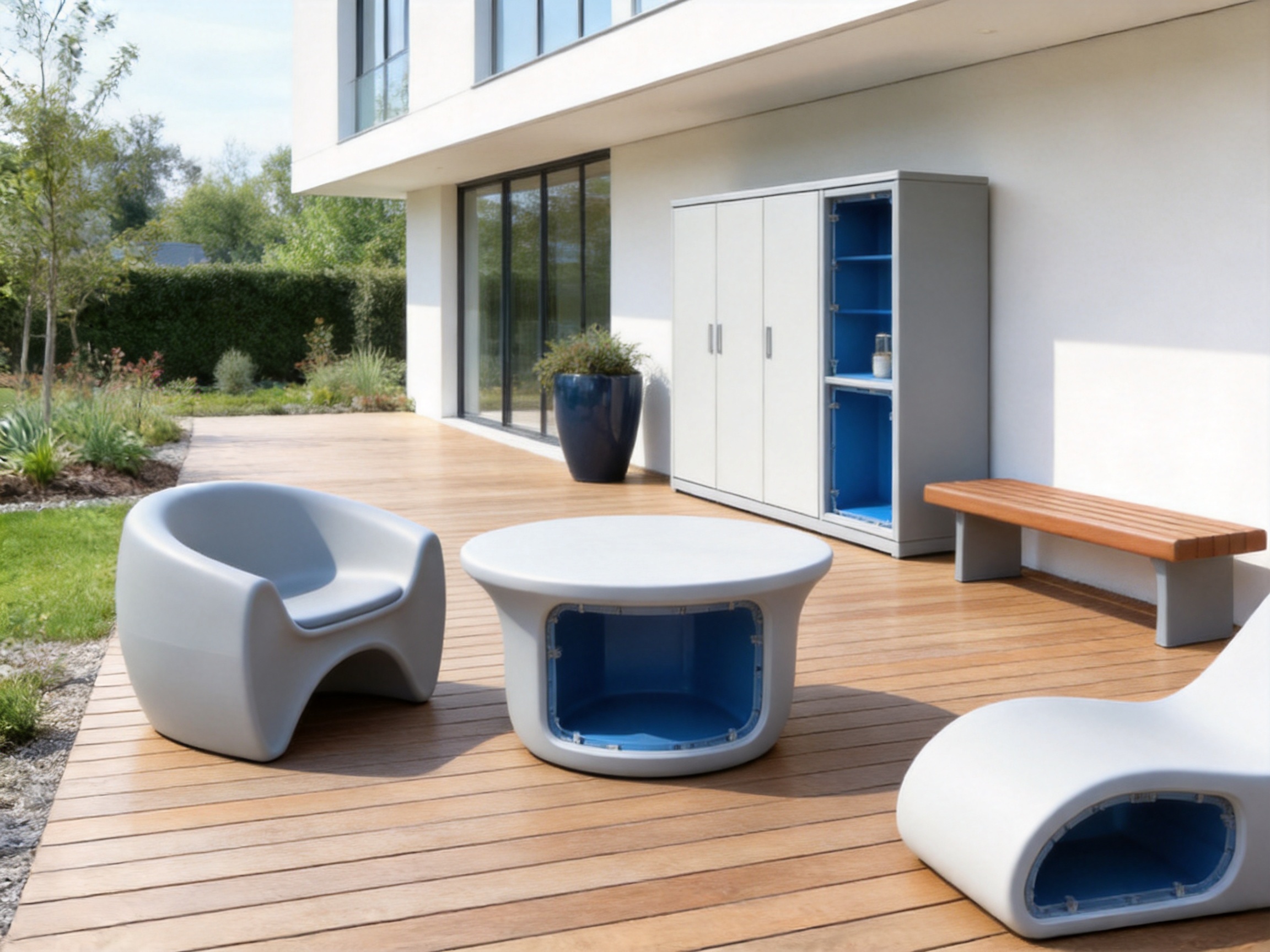
Conventional rotomolding molds are widely used for large hollow furniture and outdoor products. They are compatible with many gas-heated rotational molding machines and are often selected for projects where tooling simplicity, broad equipment compatibility, and economical development are important.
These molds can be designed for chairs, tables, cabinets, storage boxes, benches, containers, and recreational furniture. Their structure may be relatively simple compared with high-pressure tooling, but the mold still requires accurate modeling, suitable material thickness, reliable clamping, and careful surface finishing.
The size of the furniture mold affects material consumption, machining time, handling requirements, and finishing work. A large mold may need stronger frames, lifting points, reinforcement, and specialized transportation arrangements. The internal cavity must also be reviewed for accessibility, cleaning, insert installation, and inspection.
Benefits of Conventional Tooling
- Suitable for large hollow products.
- Compatible with a wide range of conventional rotational molding machines.
- Generally lower initial tooling cost.
- Relatively simple mold construction.
- Suitable for customized and moderate-volume furniture production.
- Flexible support for one-piece plastic structures.
Conventional tooling remains a practical choice when the production environment is stable and the customer is primarily seeking reliable furniture manufacturing with reasonable investment. It can also serve as an effective starting point for new product development and market testing.
Electric-Heated Rotational Molding Furniture Molds
Electric-heated rotational molding represents a more advanced direction in process control. Instead of relying solely on conventional gas heating, the equipment uses controlled electric heating systems that can support more precise temperature management and independent heating zones.
Electric-heated tooling requires closer coordination between the mold structure and the heating equipment. Engineers must consider thermal conductivity, heat transfer, mold thickness, heating-zone layout, insulation, electrical connections, control systems, and maintenance access.
Since 2023, Jiangsu Zhroto Mould Co., Ltd. has invested in electric-heated rotational molding technology and related manufacturing capabilities. The company's stated technical direction includes temperature control accuracy of approximately plus or minus 1 to 2 degrees Celsius, thermal efficiency above 95 percent, zoned heating, and potential energy savings of 30 to 50 percent, depending on the equipment configuration and production conditions.
These characteristics can be valuable for furniture products requiring stable appearance, repeatable wall thickness, controlled heating, or improved energy management. Zoned heating may allow different sections of a large furniture mold to receive adjusted thermal treatment according to geometry and material distribution requirements.
When Electric Heating May Be Appropriate
Electric-heated tooling may be appropriate when a manufacturer operates continuously, requires close process repeatability, wants to reduce energy consumption, or produces furniture with complex geometry and demanding surface requirements. It may also be considered where production management requires detailed monitoring of heating parameters.
The initial cost may be higher than conventional tooling because the mold, heating system, controls, and engineering design must work together. However, the total value should be evaluated across repeated production cycles. Better thermal control may reduce defects, stabilize quality, improve process documentation, and support more predictable production planning.
| Tooling solution | Primary characteristic | Typical furniture application | Investment tendency |
| Conventional rotomolding mold | Simple structure and broad machine compatibility | Large chairs, tables, cabinets, benches, and storage products | Generally lower |
| Electric-heated mold | Precise temperature control and zoned heating | Controlled production requiring improved thermal consistency | Generally higher |
| Complex custom tooling | Advanced curves, ribs, textures, inserts, or special details | Premium furniture and specialized structures | Dependent on project requirements |
Aluminum Mold Construction and Machining
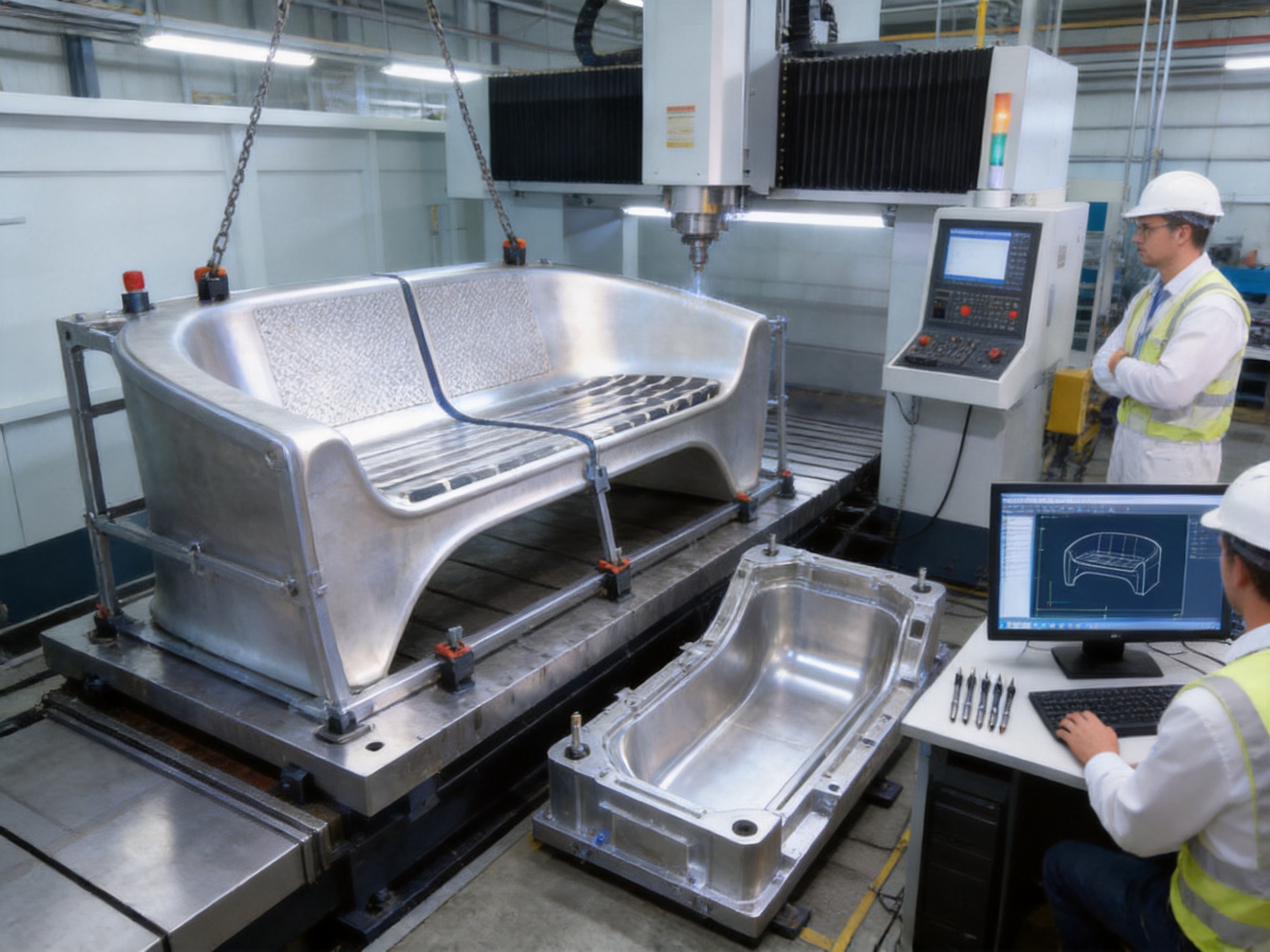
Aluminum is commonly selected for rotational molding because it offers useful thermal conductivity, machinability, and suitability for complex curved surfaces. Aluminum tooling can reproduce detailed furniture geometry while supporting relatively efficient heat transfer during the molding cycle.
The final cost of an aluminum furniture mold depends on more than the price of the raw material. Important factors include mold dimensions, aluminum volume, product complexity, CNC machining time, surface finishing, engineering requirements, reinforcement, trial work, and inspection.
For large furniture, the quantity of aluminum can be substantial. A larger mold requires greater material consumption and may require more powerful machining equipment. Deep cavities and complex ergonomic surfaces may also increase the number of machining operations and the time required to achieve the specified accuracy.
CNC Machining of Complex Curved Surfaces
Furniture frequently includes curved surfaces that must be comfortable, visually consistent, and dimensionally stable. CNC machining allows these forms to be produced according to a three-dimensional model. Accurate machining is especially important when several molds or mold sections must match one another.
Complex curves may be found in chair backs, seat pans, armrests, table corners, cabinet doors, decorative panels, and integrated supports. The quality of the machining affects not only visual appearance but also wall distribution, product assembly, contact surfaces, and the repeatability of subsequent production.
Surface Finishing
After machining, the mold surface may require polishing, texturing, deburring, blending, or other finishing operations. The selected finish must match the desired appearance of the furniture and the release behavior of the material.
Finishing is also important for reducing unwanted marks, protecting vulnerable areas, and ensuring that mold details are reproduced consistently. A poor surface finish may result in inconsistent gloss, visible machining lines, difficult demolding, or increased cleaning requirements.
Manufacturing Process for a Furniture Rotational Mold
A professional tooling project should follow a structured process from initial product review to final production support. The following stages help connect the furniture concept with practical manufacturing requirements.
1. Product Consultation and Application Review
The project begins with an assessment of the furniture's intended use. Engineers should understand whether the product will be used indoors or outdoors, whether it must support people or stored items, how often it will be handled, what environmental conditions it will experience, and what production volume is expected.
Application information affects material selection, wall thickness, edge design, surface finish, reinforcement, testing, and packaging. A storage cabinet for industrial use may require different features from a decorative garden planter or a children's chair.
2. Product Design Optimization
The product model is reviewed for rotational molding suitability. Designers evaluate draft, corner radii, wall transitions, openings, parting lines, ribs, mounting points, inserts, and demolding conditions.
This stage is an opportunity to eliminate unnecessary complexity before the mold is manufactured. Changes made during digital review are generally less expensive than modifications made after machining or trial production.
3. Three-Dimensional Engineering
A three-dimensional model is used to develop the mold cavity, parting structure, mold frame, clamping points, inserts, and other necessary components. The model also supports communication between the customer, tooling engineers, machining team, and production personnel.
Three-dimensional engineering can help identify interference, insufficient clearances, difficult internal areas, uneven transitions, and potential handling problems. It also provides a reference for inspection and future mold maintenance.
4. Material and Mold Structure Selection
Engineers select a suitable mold material and structure according to product size, geometry, production volume, heating system, surface requirements, and expected service life. Aluminum is commonly used, but the exact specification should be determined by the project requirements.
The tooling structure should be strong enough to maintain its shape during heating, cooling, handling, and repeated production. Large furniture molds may require reinforcement, frames, lifting points, and carefully designed clamping systems.
5. CNC Manufacturing
Precision CNC machining creates the main mold surfaces and complex details. Machining parameters are selected according to the material, geometry, required accuracy, and surface condition.
Large-scale machining capability is an important advantage for furniture tooling because small equipment may not accommodate the required mold dimensions. Integrated manufacturing resources can reduce the need to divide complex surfaces into unnecessary sections.
6. Manual Finishing and Assembly
Following CNC machining, the mold may require manual finishing, polishing, deburring, texture treatment, assembly, sealing, and installation of inserts or supporting components. Skilled finishing helps ensure that the mold surface is consistent and production-ready.
7. Mold Trial and Sample Validation
A mold trial allows the manufacturer to evaluate filling behavior, heating, cooling, release, wall distribution, surface appearance, dimensions, and cycle time. Sample furniture is inspected against the approved design and application requirements.
If adjustments are necessary, they should be documented and completed through a controlled modification process. Trial validation is particularly important for products with complex curves, deep cavities, special textures, or demanding edge strength.
8. Final Inspection and Delivery
Final inspection may include dimensional checks, surface inspection, parting-line review, opening and closing verification, insert inspection, and confirmation of lifting or clamping components. Documentation can include mold drawings, inspection records, trial results, operating guidance, and maintenance recommendations.
After delivery, production guidance may help the customer establish suitable material loading, heating, rotation, cooling, trimming, and inspection procedures.
Factors Affecting Rotational Molding Furniture Mold Cost
The price of a furniture mold depends on the complete project specification rather than mold size alone. A reliable quotation should identify the design scope, tooling material, machining requirements, finishing, trial work, inspection, modifications, delivery, and technical support.
Mold Size
Large molds require more material, machining capacity, handling equipment, finishing time, and storage space. Size can also affect transportation and installation requirements. However, size should be evaluated together with geometry because a compact but highly complex mold may require more work than a larger mold with simple surfaces.
Product Complexity
Curves, ribs, textures, recessed details, integrated supports, mounting points, internal partitions, and removable inserts can all increase engineering and manufacturing requirements. Complex furniture may need more trial cycles and greater attention to material flow.
Material Selection
Aluminum grade, mold wall construction, reinforcement, and surface treatment influence tooling cost. The material should be selected according to thermal behavior, machinability, product dimensions, production volume, and expected service life.
Surface Finish
A basic machined finish generally requires less work than a highly polished, textured, or decorative surface. If the furniture must have a specific gloss level, tactile texture, wood-like pattern, anti-slip finish, or decorative appearance, these requirements should be included in the initial quotation.
Heating Method
Conventional gas-heated tooling usually has a lower initial investment and broad equipment compatibility. Electric-heated tooling may require additional design and system integration but can provide more precise temperature control and potential energy advantages during long-term production.
Production Volume
For low-volume or market-testing projects, a manufacturer may prioritize affordable initial tooling. For continuous production, durability, cycle consistency, maintenance access, and process stability become more important. A slightly higher tooling investment may provide better total cost performance if it reduces defects and downtime.
Validation and Modification Requirements
Prototype samples, dimensional reports, material testing, performance testing, multiple trial rounds, and design modifications can affect the final cost. These services should be discussed before production begins so that both parties understand the development plan.
How to Improve Furniture Mold Performance
Tooling performance depends on the relationship between product design, mold construction, material selection, heating, rotation, cooling, and post-processing. The following practices can help improve results.
- Design smooth transitions and avoid unnecessary sharp internal corners.
- Identify load-bearing edges and reinforce them through geometry and material distribution.
- Use suitable draft and parting arrangements for reliable demolding.
- Consider wall thickness during product design rather than after mold manufacturing.
- Match surface texture to the required appearance and cleaning conditions.
- Review heating behavior for large flat areas and deep cavities.
- Provide suitable lifting, clamping, and maintenance features.
- Validate the mold through controlled trials before mass production.
- Record process parameters to improve repeatability between production batches.
- Inspect the mold regularly for wear, deformation, surface damage, and sealing problems.
It is also important to distinguish between a mold defect and a process defect. Inconsistent wall thickness, surface variation, or deformation may result from material loading, heating, rotation, cooling, or machine settings rather than from the mold itself. A supplier that provides process guidance can help identify the actual cause more efficiently.
Applications for Rotomolded Furniture
Outdoor Chairs and Tables
Outdoor chairs and tables benefit from seamless construction, weather resistance, rounded edges, and relatively low maintenance. Rotational molding can produce curved ergonomic forms and integrated supports suitable for gardens, terraces, resorts, restaurants, public spaces, and recreational facilities.
Storage Cabinets and Containers
Storage cabinets and containers require durable walls, strong openings, reliable doors or covers, and resistance to moisture and impact. Rotomolding can create enclosed hollow structures with reinforced edges and integrated mounting features.
Children's Furniture
Children's furniture often requires smooth surfaces, rounded corners, robust edges, and resistance to frequent handling. A seamless construction can reduce exposed fasteners and simplify cleaning. Product design and materials must still comply with the applicable safety requirements for the intended market.
Commercial and Hospitality Furniture
Hotels, restaurants, resorts, event venues, and commercial facilities often need furniture that is durable, easy to clean, visually consistent, and suitable for repeated use. Custom tooling can support distinctive forms, coordinated product families, and specialized branding details without requiring numerous assembled components.
Recreational and Public-Space Products
Benches, loungers, planters, play structures, and other public-space products may be exposed to heavy use, weather, transport, and occasional impact. Rotational molding can provide large, robust, hollow products with flexible appearance and practical maintenance characteristics.
Manufacturing Strengths of Jiangsu Zhroto Mould Co., Ltd.
Jiangsu Zhroto Mould Co., Ltd. was founded in 2015 and specializes in rotational molding mold design, mold manufacturing, rotomolded product processing, and integrated technical solutions. The company moved to a modern facility in Jiangyan District, Taizhou City, in 2021.
The facility covers approximately 18,000 square meters, including more than 12,000 square meters of standardized production workshops. Its annual production capacity exceeds 800 mold sets, while annual plastic product capacity exceeds 3,600 tons.
The company provides project support from initial consultation and product optimization through three-dimensional engineering, CNC manufacturing, mold trials, inspection, delivery, production guidance, and maintenance advice. This integrated workflow allows product design and tooling decisions to be evaluated together rather than handled by disconnected suppliers.
Its products and technical solutions serve hydrogen energy storage and transportation, automotive parts, industrial equipment, agricultural machinery, water treatment, outdoor facilities, and other sectors. Experience in these demanding applications can be valuable when developing furniture molds that require large dimensions, complex curves, reliable durability, and stable production.
The company has obtained ISO 9001:2015, ISO 14001:2015, and ISO 45001:2018 certifications. These certifications reflect structured approaches to quality management, environmental management, and occupational health and safety. For furniture buyers, an organized management system can support clearer documentation, more consistent inspection, and more reliable project communication.
Jiangsu Zhroto Mould Co., Ltd. supports tooling compatible with conventional gas-heated and electric-heated rotational molding machines. Customers can therefore select a solution according to existing equipment, planned production volume, desired thermal control, energy objectives, and product complexity.
How to Select a Furniture Mold Supplier
Choosing a supplier should involve more than comparing the lowest initial quotation. Buyers should evaluate the supplier's design capability, equipment, quality controls, trial procedures, communication, production support, and ability to handle future modifications.
Review Relevant Experience
Ask whether the supplier has manufactured large, hollow, curved, textured, or load-bearing products. Experience with industrial and outdoor products can be especially useful because these applications often require durability and process stability.
Confirm Engineering Capability
The supplier should be able to review product geometry and recommend practical improvements. A tooling manufacturer that only produces a mold from an unexamined model may overlook opportunities to improve wall distribution, demolding, maintenance, or production efficiency.
Evaluate Manufacturing Equipment
Large furniture molds require suitable machining capacity, handling equipment, finishing resources, and inspection tools. Buyers should confirm that the supplier can manufacture the required mold size without excessive segmentation or outsourcing.
Ask About Trial and Inspection Procedures
A clear trial plan should define what will be checked, including dimensions, surface quality, wall thickness, edge strength, demolding, cycle behavior, and product appearance. Inspection documents and sample approval procedures should be agreed upon in advance.
Consider Long-Term Support
Furniture products may require design revisions, replacement components, process adjustments, or maintenance after delivery. A supplier that provides production guidance and maintenance advice can help protect the tooling investment throughout its service life.
Frequently Asked Questions
What is the main advantage of a rotational molding furniture mold?
The main advantage is the ability to manufacture large, hollow, seamless furniture with comparatively economical tooling. The process also offers design flexibility, good suitability for curved surfaces, reduced assembly requirements, and useful control over wall thickness and edge strength.
Can rotational molding produce furniture with strong edges?
Yes. With suitable product geometry, material loading, heating, and process control, edge thickness can exceed 5 millimeters in appropriate furniture applications. This can improve durability for outdoor chairs, children's furniture, tables, storage cabinets, and other products exposed to repeated impact or loading.
Are aluminum molds suitable for large furniture?
Yes. Aluminum is widely used for rotational molding because it offers favorable thermal conductivity and can be machined into complex curved surfaces. The final mold cost depends on size, aluminum consumption, geometry, CNC machining, finishing, reinforcement, and inspection requirements.
Is rotational molding less expensive than injection molding?
For many large products, rotational molding tooling is generally less expensive than injection molding tooling because it does not need to withstand high injection pressure. However, the most suitable process depends on production volume, product size, dimensional requirements, cycle time, and material selection.
When should electric-heated tooling be selected?
Electric-heated tooling may be appropriate when the manufacturer requires precise thermal control, independent heating zones, improved process repeatability, or potential energy savings. It may be especially valuable for complex furniture or continuous production. The higher initial investment should be evaluated against expected long-term benefits.
What information should be supplied when requesting a quotation?
Customers should provide product drawings or three-dimensional models, dimensions, material requirements, expected production quantity, application conditions, surface finish, color, insert details, heating equipment information, inspection standards, and delivery expectations. More complete information allows the supplier to prepare a more accurate and useful quotation.
How long can a rotational molding furniture mold last?
Service life depends on mold material, construction, production frequency, heating and cooling conditions, handling, maintenance, product geometry, and process control. Properly designed and maintained tooling can support many production cycles, but the exact service life should be evaluated according to the project conditions.
Can one mold produce different furniture designs?
A mold is normally developed for a specific product geometry. However, interchangeable inserts, modular tooling, or carefully planned mold sections may support selected variations. These options should be considered during the initial design stage because they can affect cost, sealing, alignment, and production efficiency.
What post-processing is commonly required?
Post-processing may include trimming the parting line, drilling holes, installing hardware, adding inserts, fitting doors or covers, cleaning surfaces, and completing final inspection. The amount of post-processing depends on product design and the level of integration built into the mold.
Why is supplier technical support important?
Rotational molding performance depends on both tooling and process parameters. Technical support can help customers optimize material loading, heating time, rotation, cooling, demolding, trimming, and inspection. This reduces the risk of treating process problems as mold defects and supports more stable production.
Conclusion
Rotational molding furniture molds provide an effective solution for manufacturers producing large, hollow, seamless plastic furniture. Compared with injection molding and blow molding, rotational molding can offer lower tooling costs for large products, broad design freedom, reduced assembly requirements, and excellent suitability for durable indoor and outdoor applications.
The performance of the finished furniture depends on much more than the mold's external dimensions. Product geometry, wall-thickness planning, edge design, surface finish, aluminum construction, heating method, machining accuracy, mold trials, and production support all contribute to the final result.
Conventional tooling remains an economical and flexible option for many furniture projects, while electric-heated tooling may provide improved thermal control and energy management for demanding or continuous production. Aluminum molds, precision CNC machining, three-dimensional engineering, controlled validation, and professional finishing can further improve product consistency and tooling value.
Jiangsu Zhroto Mould Co., Ltd. combines rotational molding expertise, large-scale manufacturing resources, product processing capabilities, quality management systems, and technical support from concept to production. Its experience in furniture-related and industrial applications enables customers to develop custom tooling that balances appearance, durability, cost, production efficiency, and long-term reliability.
For companies planning new plastic furniture products, the most effective approach is to involve the tooling supplier early. Early cooperation makes it easier to optimize geometry, control cost, select the right heating method, improve wall distribution, and create a mold that performs reliably throughout the intended production cycle.
References
1. Rotational Molding Association, Fundamentals of Rotational Molding Technology.
2. Crawford, R. J., Rotational Molding of Plastics.
3. International Organization for Standardization, ISO 9001:2015 Quality Management Systems.
4. International Organization for Standardization, ISO 14001:2015 Environmental Management Systems.
5. International Organization for Standardization, ISO 45001:2018 Occupational Health and Safety Management Systems.
6. Association of Rotational Molders, Design Guidelines for Rotationally Molded Products.
7. Jiangsu Zhroto Mould Co., Ltd., Rotational Molding Mold Design, Manufacturing, and Technical Capability Information.
Product: Rotational molding furniture mold


We provide customers with one-stop services ranging from product design, mold manufacturing to finished product production.
-
 +86-18006248936
-
 ricky.t@zhroto.com
-
 No.9 Jiangyuan Road, Luotang Street, Jiangyan District, Taizhou City,Jiangsu Province, China
Copyright © Jiangsu Zhroto Mould Co., Ltd. Rights Reserved.Custom Rotational Plastic Molding Factory
