 en
 中文简体
 русский
 Español
 Deutsch
 Polskie
 REQUEST A QUOTE

 Home / Author / Saskia Wen — Regional Sales Executive / Automobile Fuel Tank Mold: Precision Rotational Tooling for Safer, Lighter, and More Efficient Vehicle Fuel Systems
Automobile Fuel Tank Mold: Precision Rotational Tooling for Safer, Lighter, and More Efficient Vehicle Fuel Systems
Content
- 1 1. The Role of an Automobile Fuel Tank Mold
- 2 2. Why Rotational Molding Is Suitable for Automotive Fuel Tanks
- 3 3. Product Advantages Compared with Conventional Tooling Solutions
- 4 4. Mold Design Features That Influence Fuel Tank Quality
- 5 5. Standard Rotational Fuel Tank Molds
- 6 6. High-Barrier Fuel Tank Tooling
- 7 7. Electric-Heated Precision Fuel Tank Molds
- 8 8. Manufacturing Process for an Automobile Fuel Tank Mold
- 9 9. Quality Control and Certification Readiness
- 10 10. How the Supplier’s Manufacturing Strength Creates Value
- 11 11. Practical Selection Criteria for Buyers
- 12 12. Maintenance and Service Life
- 13 13. Environmental and Economic Considerations
- 14 14. Recommended Development Workflow
- 15 15. Frequently Asked Questions
- 15.1 Q1: Does the automobile fuel tank mold itself require automotive safety certification?
- 15.2 Q2: What is the main advantage of rotational molding for fuel tanks?
- 15.3 Q3: Can one mold produce different fuel tank designs?
- 15.4 Q4: Why is wall-thickness control important?
- 15.5 Q5: What is high-barrier rotomolding?
- 15.6 Q6: When should electric-heated tooling be considered?
- 15.7 Q7: What inspection should be performed after trial molding?
- 15.8 Q8: Can plastic fuel tanks be safer than metal tanks?
- 15.9 Q9: How does the mold supplier support production after delivery?
- 15.10 Q10: What information should a buyer provide before requesting a quotation?
- 16 Conclusion
- 17 References
- 18 Product: Automobile fuel tank mold
Automotive fuel tanks must combine safety, dimensional accuracy, chemical resistance, structural durability, and reliable long-term performance. Although the finished tank receives most of the attention during vehicle development, the mold used to manufacture it has a direct influence on nearly every critical characteristic of the final component. A well-engineered automobile fuel tank mold supports uniform wall thickness, accurate mounting points, dependable sealing surfaces, smooth demolding, and repeatable production quality.
Rotational molding is particularly suitable for producing large, hollow, and geometrically complex automotive fuel tanks. Unlike many conventional forming methods, the process can create seamless plastic structures with integrated contours and relatively few joining operations. This makes it possible to design a fuel tank that uses restricted chassis space efficiently while reducing unnecessary weight and minimizing potential leak paths.
Jiangsu Zhroto Mould Co., Ltd. specializes in rotational molding mold design, precision manufacturing, rotomolded product processing, and integrated technical support. The company develops tooling for conventional gas-heated systems and advanced electric-heated rotational molding equipment. Its experience in automotive components, industrial products, water tanks, agricultural equipment, and other large hollow products allows it to approach fuel tank tooling as a complete engineering project rather than as a simple machined cavity.
This article explains the construction, advantages, design considerations, manufacturing process, quality controls, and application value of an automobile fuel tank mold. It also examines how high-barrier materials, electric heating, CAD engineering, CNC machining, trial molding, and production support can help manufacturers achieve more stable and competitive fuel tank production.

Automobile fuel tank mold
1. The Role of an Automobile Fuel Tank Mold
An automobile fuel tank mold is a precision tool used to form the outer geometry of a plastic fuel storage component during the rotational molding process. The mold may be manufactured in several sections, depending on the tank shape, access requirements, inserts, parting-line arrangement, and production equipment. During molding, a measured quantity of polymer powder is placed inside the mold. The closed mold is then heated and rotated around multiple axes so that the material gradually coats the internal surface.
As the polymer melts, it forms a hollow layer against the mold wall. Continued heating and rotation help distribute the material over curved surfaces, corners, ribs, recesses, and other features. After the required material distribution has been achieved, the mold is cooled while rotation continues. The solidified part is then removed from the mold and transferred to subsequent inspection, trimming, fitting, and assembly operations.
The mold determines the basic shape and many of the functional details of the finished tank. It influences the location of mounting areas, filler-neck interfaces, pump openings, vent connections, sensor bosses, reinforcement sections, drain features, and protective contours. It also affects how material moves during heating and how the finished tank contracts during cooling.
For this reason, a mold cannot be evaluated only by its external appearance or basic dimensional conformity. It must also perform consistently under repeated thermal cycles. It should heat and cool in a predictable manner, resist distortion, maintain the intended parting-line accuracy, and allow the molded tank to be removed without damaging delicate features.
A suitable automobile fuel tank mold therefore serves several functions at the same time:
- It reproduces the required three-dimensional tank geometry.
- It supports consistent plastic distribution throughout the tank body.
- It accommodates integrated bosses, ribs, mounting structures, and connection points.
- It helps control the position and quality of parting lines.
- It provides reliable venting and demolding performance.
- It withstands repeated heating, cooling, handling, and production cycles.
- It supports the validation requirements of the finished fuel tank.
In a competitive automotive market, these capabilities can influence development time, material consumption, production yield, service life, and total manufacturing cost.
2. Why Rotational Molding Is Suitable for Automotive Fuel Tanks
Rotational molding offers several advantages for large hollow automotive components. The process does not generally require high injection pressure, and it can produce a seamless body in a single primary molding operation. This is valuable for fuel tanks because every unnecessary joint, welded seam, or connection can become a potential area of weakness or leakage if not properly designed and controlled.
The process also supports unusual and highly contoured shapes. A fuel tank does not need to be a simple rectangular or cylindrical container. It may have to fit around exhaust components, suspension members, chassis cross-members, battery housings, drive systems, spare-wheel wells, or other restricted areas. Rotational molding allows designers to develop a tank that follows the available installation space more closely.
Better use of available chassis space can provide several benefits. A tank may achieve a greater usable capacity without increasing its maximum external dimensions. The vehicle designer may obtain more clearance around other systems. The tank may also be positioned lower or closer to the center of the vehicle, depending on the vehicle architecture and safety strategy.
Plastic fuel tanks can also contribute to vehicle weight reduction. The relative density of common plastics is much lower than that of many metals. When the design, wall thickness, fittings, reinforcement strategy, and regulatory requirements are properly considered, a plastic tank may be significantly lighter than a comparable metal tank. Lower component weight can contribute to improved fuel economy, reduced transport energy, and lower vehicle operating costs.
Another advantage is that plastic is generally less likely than metal to create sparks when subjected to certain collision or friction conditions. This characteristic does not eliminate the need for complete vehicle safety engineering, fire protection, electrical control, and crash validation. However, it can be an important factor when selecting the tank material and manufacturing method.
Rotational molding also enables the integration of complex contours and structural features into the mold itself. Features that would require multiple forming or joining operations in another process may be incorporated into a rotationally molded design. This can reduce assembly complexity and improve the overall continuity of the tank structure.
| Design requirement | Rotational molding contribution | Potential product benefit |
| Large hollow volume | Seamless or near-seamless molded body | Reduced dependence on joined panels |
| Restricted chassis space | Complex three-dimensional mold geometry | Improved space utilization |
| Low vehicle weight | Use of lightweight polymer systems | Lower component mass |
| Integrated mounting areas | Bosses, ribs, and contours incorporated into tooling | Fewer secondary operations |
| Production repeatability | Controlled mold geometry and thermal behavior | More consistent tank dimensions |
3. Product Advantages Compared with Conventional Tooling Solutions
The performance of an automobile fuel tank depends on the complete system, including the polymer, fittings, processing parameters, inspection plan, and installation environment. Nevertheless, mold quality remains a major differentiator between a stable production program and one that experiences repeated variation.
3.1 Complex geometry without excessive assembly
A major advantage of a rotational fuel tank mold is the ability to produce complex hollow forms in one primary process. Traditional metal tank construction may involve multiple stamped panels, welding operations, surface treatments, and sealing steps. Other plastic processes may require separate components or additional joining operations for very large or irregular shapes.
Rotational molding can simplify the structure by forming a large body around the required contours. The mold can include curved transitions, recessed areas, mounting platforms, protective zones, and other features that follow the vehicle layout. Fewer major joints may help simplify assembly and reduce the number of operations requiring separate process controls.
3.2 Efficient use of restricted vehicle space
Automotive packaging is becoming increasingly complex. Conventional internal combustion vehicles must accommodate exhaust systems, emissions equipment, suspension components, structural members, and thermal shields. Hybrid and alternative-fuel platforms may introduce additional batteries, motors, electronics, or energy storage components. In this environment, a standard rectangular tank may not provide the required capacity or installation flexibility.
A custom automobile fuel tank mold can be developed around the available space. The tank may be extended into suitable cavities or shaped around obstacles, provided that the final design satisfies safety clearances, service requirements, material distribution limits, and vehicle validation criteria. This packaging flexibility can help designers increase fuel capacity without simply enlarging the overall tank envelope.
3.3 Reduced weight potential
Weight reduction is one of the most important goals in modern vehicle development. A lighter fuel tank can support improvements in fuel economy and handling efficiency. The actual weight advantage depends on the resin, wall thickness, reinforcement, fittings, barrier layers, mounting system, and required performance. Even so, the low density of suitable plastic materials gives rotationally molded tanks a strong starting point compared with many metal alternatives.
The mold contributes to weight reduction by allowing designers to place material where it provides the greatest functional value. Properly designed ribs, curved surfaces, transitions, and reinforcement zones may provide stiffness without requiring excessive uniform thickness throughout the entire tank. Controlled tooling and trial molding are necessary to ensure that these features are filled consistently and that no weak areas develop.
3.4 Seamless construction and leakage control
Fuel containment requires strict control of leakage and permeation. A rotationally molded tank can be formed as a single hollow body, which may reduce the number of primary seams compared with an assembled multi-panel structure. A seamless body does not automatically guarantee compliance, but it can provide a favorable foundation for containment performance when combined with compatible materials, correct processing, reliable fittings, and appropriate validation.
The mold must be designed to minimize defects near parting lines, inserts, corners, bosses, and connection areas. Parting-line alignment, clamp pressure, venting, surface condition, and mold closure all influence the quality of these regions. A precision mold can make the production process more stable and improve the repeatability of leak testing.
3.5 Better design freedom for product development
Rotational molding is compatible with a wide range of shapes and sizes. It is suitable for both relatively straightforward tanks and highly specialized automotive designs. Product engineers can revise the tank geometry through digital modeling before the mold is manufactured. This creates an opportunity to evaluate installation, capacity, clearances, fitting positions, and structural features at an early stage.
When the mold supplier participates in the design review, potential manufacturing problems can be addressed before they become expensive tooling changes. Areas that may require review include sharp internal corners, deep undercuts, narrow openings, sudden wall transitions, difficult demolding directions, unsupported inserts, and regions with uneven heating exposure.
3.6 Compatibility with different heating systems
Standard molds can be used with conventional gas-heated rotational molding machines when the tooling design is matched to the equipment and process conditions. For more demanding applications, electric-heated rotational molding systems can provide improved thermal precision and independent control of heating zones.
The availability of both conventional and electric-heated tooling solutions allows manufacturers to select a process according to production volume, geometry, resin system, energy strategy, and quality requirements. This flexibility is a practical advantage over suppliers that provide only one type of tooling or one standard manufacturing approach.
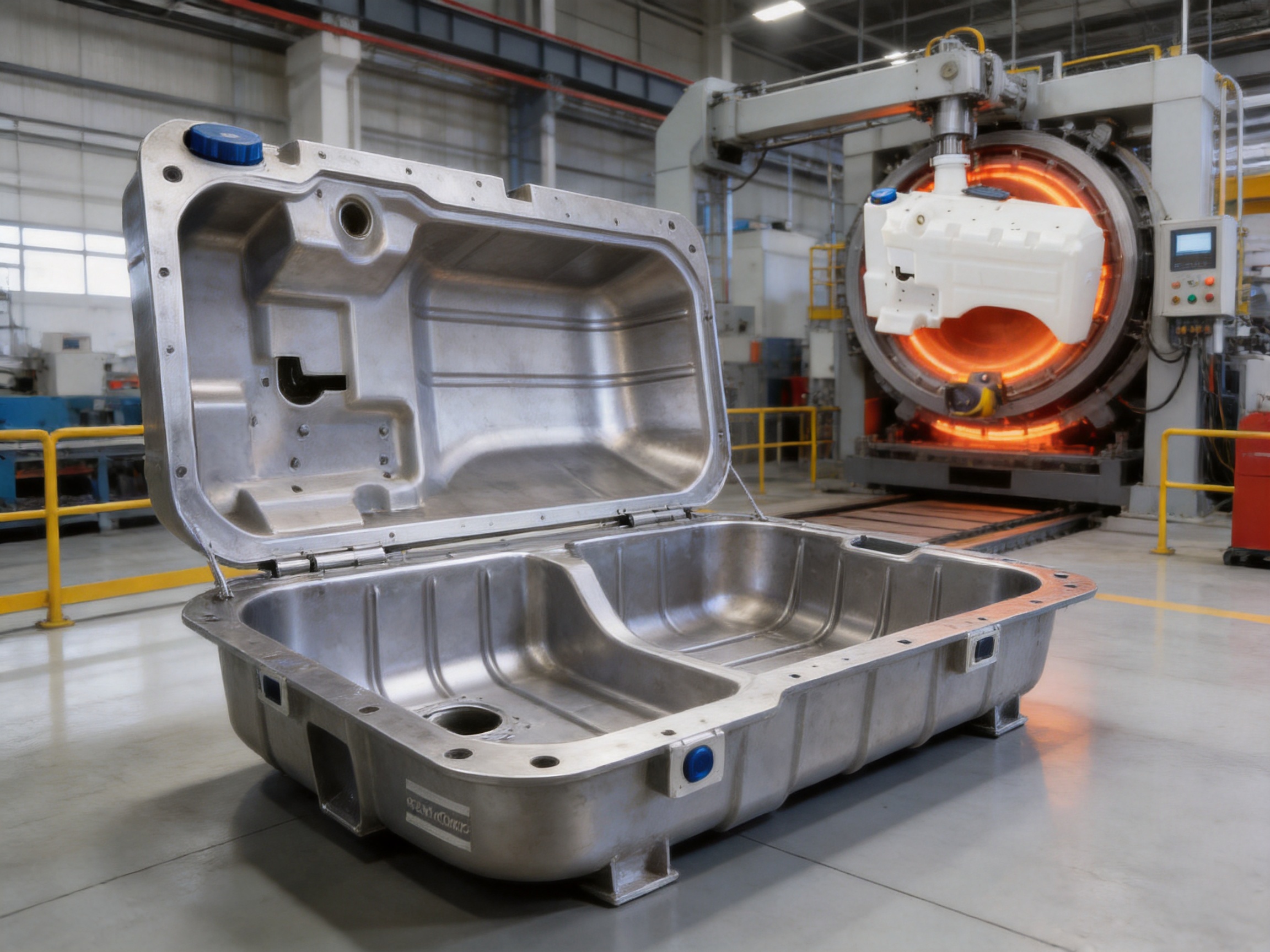
4. Mold Design Features That Influence Fuel Tank Quality
The design of the mold is one of the most important stages in the development of an automotive fluid tank manufacturing program. A tank may appear acceptable in a computer model but still produce difficulties during molding if the tool does not account for powder movement, thermal gradients, shrinkage, venting, insert placement, or demolding access.
4.1 Parting-line strategy
The parting line determines where the mold sections meet and where the molded component will show a division or flash-removal area. Its position should be selected according to the tank geometry, tooling access, appearance expectations, sealing surfaces, structural loads, and trimming requirements.
An unsuitable parting line can create unnecessary flash, difficult trimming, poor dimensional control, or a weak area near a highly stressed feature. A carefully planned parting line can simplify mold opening, support reliable closure, and place the finishing operation in a region where it will not interfere with vehicle installation or sealing.
4.2 Wall-thickness distribution
Rotational molding does not distribute material in exactly the same way as injection molding or blow molding. The powder melts and builds a layer on the mold surface while the tool rotates. Geometry, heating rate, rotation speed, mold orientation, material characteristics, and local thermal exposure all affect the final wall distribution.
Fuel tank tooling should therefore avoid unnecessary abrupt transitions and should be reviewed for areas where material may accumulate or remain insufficient. Corners, deep recesses, tall bosses, narrow channels, and shielded zones require special attention. Trial molding and section measurement are valuable methods for confirming whether the actual wall structure matches the design intent.
4.3 Integrated bosses and mounting features
Automotive fuel tanks normally require numerous connection and support features. These may include mounting brackets, pump openings, sensor interfaces, filler connections, vent ports, rollover valve locations, protective ribs, and assembly references. Each feature affects the mold design and may require a removable insert, fixed cavity structure, or post-molding operation.
The tooling must allow these features to be formed accurately without causing excessive local material variation. The design should also consider how the feature will be inspected and how mating components will be installed. Incorrect positioning of a boss or connection point can lead to assembly interference, sealing problems, or costly rework during vehicle integration.
4.4 Venting
Venting allows air and process gases to move appropriately during heating and cooling. Poor venting can contribute to incomplete formation, trapped air, surface defects, dimensional instability, or difficulty during demolding. The location and design of vents must be considered together with the tank geometry, material, heating cycle, and equipment.
Fuel tank applications require special care because contamination, blocked vents, or poorly controlled vent structures may affect both molding quality and the functional performance of the final part. Vent components should be selected and maintained according to the process requirements and inspection plan.
4.5 Surface quality
The internal surface of the mold is transferred to the external surface of the molded tank. Surface quality affects appearance, cleaning, release behavior, and local stress concentration. A suitable finish can support easier demolding and reduce the likelihood of material sticking to the cavity.
Surface treatment and finishing should be selected according to the mold material, production temperature, resin system, expected cycle count, and required visual standard. Excessive roughness can interfere with release, while inappropriate polishing or coating may not withstand repeated thermal cycles.
4.6 Cooling and thermal balance
Cooling is not merely the final step after heating. It influences shrinkage, warpage, dimensional stability, and residual stress. Uneven cooling can cause distortion, especially in large tanks with different wall thicknesses or highly asymmetric shapes.
A well-designed mold should be evaluated for thermal balance throughout the complete cycle. The mold construction, wall thickness, material, venting, heating method, cooling method, and rotation pattern must work together. Electric-heated equipment can provide additional control, but the mold itself must still be designed to respond predictably to the selected process.
5. Standard Rotational Fuel Tank Molds
Standard rotational fuel tank molds are intended for reliable production using established rotational molding equipment. They are suitable for applications in which the primary objectives are consistent geometry, efficient production, dependable release, and broad equipment compatibility.
These molds can be designed for conventional gas-heated machines and may be manufactured with a construction that balances strength, heat transfer, fabrication efficiency, and maintenance requirements. The tooling can support large tank bodies, integrated contours, chassis-fitting shapes, and selected structural features.
The phrase “standard” does not mean basic or unsophisticated. A standard fuel tank mold still requires detailed engineering review. The designer must understand the tank’s service environment, target capacity, connection points, operating temperature, material system, installation method, and validation requirements. A standard mold is successful only when it repeatedly produces parts within the customer’s specifications.
Typical advantages include the following:
- Compatibility with widely used rotational molding equipment.
- Practical construction for regular production cycles.
- Support for large hollow automotive components.
- Relatively straightforward maintenance and repair procedures.
- Flexible application across different tank sizes and geometries.
- Efficient transition from prototype samples to production tooling.
Standard tooling can be especially appropriate when the production program has stable geometry, moderate process complexity, and established heating procedures. The design can still include detailed features, removable inserts, reinforced sections, and carefully controlled parting lines.
6. High-Barrier Fuel Tank Tooling
High-barrier fuel tank tooling is intended for applications where fuel permeation, chemical resistance, containment, and long-term performance receive particular attention. Fuel vapor control is a significant consideration in vehicle development, and the complete tank system must be designed to limit unacceptable permeation under the required operating conditions.
The mold alone does not create barrier performance. The polymer structure, additives, barrier layers, fittings, closures, processing temperatures, wall distribution, and final assembly all contribute to the result. However, the mold must provide a stable foundation for the selected material system. If the tooling produces inconsistent wall thickness or local defects, the barrier strategy may not perform as intended.
High-barrier rotomolding requires close coordination between product engineering, polymer suppliers, mold manufacturers, and validation teams. The mold design should be evaluated for:
- Material compatibility with the selected fuel and additives.
- Uniform formation of the required polymer structure.
- Controlled thermal exposure during heating.
- Potential degradation caused by excessive temperature or residence time.
- Accuracy of connection points and closures.
- Resistance to distortion during cooling.
- Repeatability during production-scale molding.
Testing may include fuel permeation evaluation, leakage testing, pressure or vacuum checks, dimensional inspection, thermal cycling, impact testing, vibration testing, and long-term durability assessment. The exact test program depends on the vehicle type, fuel system architecture, geographical market, applicable legislation, and customer specifications.
A high-barrier mold may require more detailed thermal analysis and process development than a conventional tank mold. Small differences in mold temperature or material distribution can affect the performance of a barrier structure. For this reason, digital design, controlled trial molding, sample sectioning, and documented process optimization are valuable parts of the development program.
7. Electric-Heated Precision Fuel Tank Molds
Electric-heated rotational molding provides enhanced control over the temperature applied to different areas of the mold. Instead of relying only on a general heat source, the system may use multiple heating zones, sensors, and control circuits to manage complex geometries more accurately.
This approach can be valuable when a fuel tank contains deep contours, large flat areas, thick structural features, or regions that receive different levels of heat during a conventional cycle. Independent zones may help reduce thermal imbalance and improve the consistency of material formation.
Under suitable operating conditions, electric-heated systems may achieve temperature control accuracy within approximately one to two degrees Celsius and thermal efficiency above 95 percent. Actual performance depends on equipment design, mold construction, insulation, sensor placement, control software, ambient conditions, and process settings. These figures should therefore be verified within the customer’s specific production environment.
The benefits of electric-heated tooling may include:
- More precise temperature management.
- Independent control of selected mold zones.
- Improved response to complex tank geometries.
- Reduced thermal variation between different regions.
- Better process documentation and repeatability.
- Potentially improved energy efficiency.
- More predictable development of high-barrier material structures.
Electric-heated tooling requires careful engineering. Heating elements, sensors, wiring routes, insulation, protective structures, and maintenance access must be integrated into the mold without interfering with production or demolding. The mold must also withstand repeated thermal cycling without unacceptable deformation or electrical damage.
Since 2023, Jiangsu Zhroto Mould Co., Ltd. has expanded its capabilities in electric-heated rotational molding technology. Its technical approach includes mold design, CNC machining, trial production, thermal process support, and production guidance. This provides customers with an option beyond conventional gas-heated tooling when process precision is a primary objective.
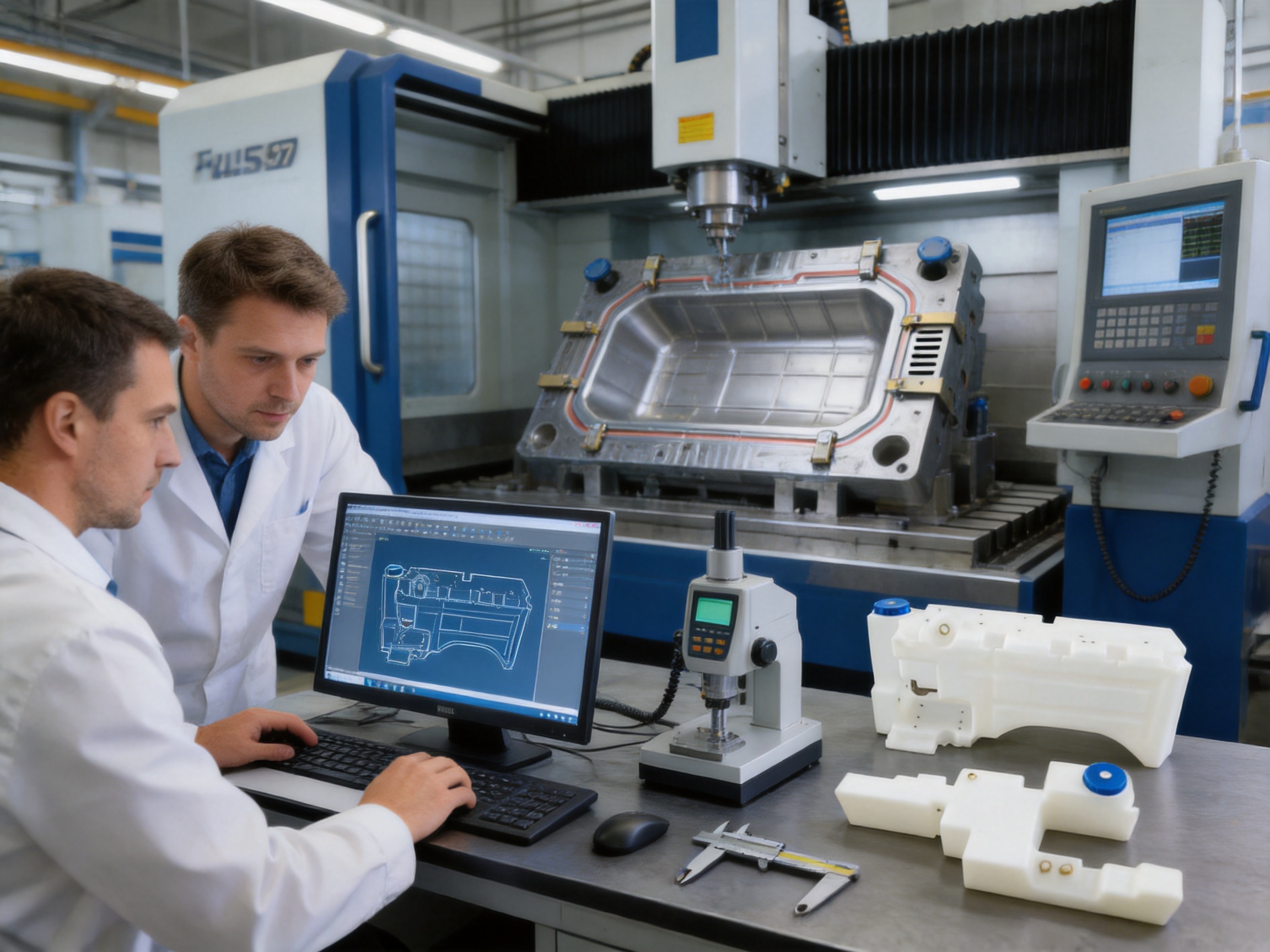
8. Manufacturing Process for an Automobile Fuel Tank Mold
A reliable fuel tank mold is produced through a controlled sequence of engineering, machining, fitting, trial molding, inspection, and acceptance. Each stage contributes to the final performance of the tooling.
8.1 Project consultation and requirement review
The project begins with a review of the tank design and intended operating conditions. Important information includes the overall dimensions, capacity, polymer type, fuel compatibility, mounting method, connection locations, target production volume, equipment type, heating method, surface requirements, tolerance expectations, and target market.
The supplier should also understand whether the tank is intended for a passenger vehicle, commercial vehicle, agricultural machine, special-purpose vehicle, or another application. Different applications may require different levels of impact resistance, chemical durability, pressure performance, temperature resistance, and environmental protection.
8.2 Product structure optimization
Before detailed mold design begins, the tank structure should be reviewed for manufacturability. Engineers examine wall transitions, corners, ribs, bosses, inserts, parting lines, vent positions, demolding directions, and possible areas of material accumulation or shortage.
This review may identify features that are difficult to produce consistently or that could increase tooling cost without providing proportional functional value. It may also reveal opportunities to improve installation, reduce weight, simplify assembly, or increase usable capacity.
8.3 Three-dimensional modeling
Three-dimensional CAD modeling is used to develop the tank geometry and mold structure. The model allows engineers to examine the relationship between the tank and the vehicle chassis, verify clearances, position fittings, and evaluate the opening direction of the mold.
Digital modeling also supports communication between the mold supplier, tank manufacturer, vehicle engineering team, and material supplier. Changes can be reviewed before machining begins, helping reduce the risk of expensive revisions after the mold has been fabricated.
8.4 Mold construction and material selection
The mold material and construction method are selected according to the tank size, design complexity, production volume, heating system, thermal requirements, and maintenance expectations. The construction must provide sufficient strength and stability while supporting predictable heat transfer.
For complex tooling, individual mold sections may be manufactured separately and then assembled with carefully controlled alignment. Reinforcement structures can be added where needed to reduce distortion during heating and cooling. Special attention is given to hinges, clamps, locks, inserts, vents, and access points.
8.5 CNC machining
Precision CNC machining creates the mold cavity, mounting surfaces, connection features, and other critical geometry. Computer-controlled machining helps improve repeatability and allows complex three-dimensional surfaces to be produced with consistent accuracy.
Machining strategy is selected according to the mold material and geometry. Large surfaces may require roughing and finishing operations, while small bosses, recesses, and connection areas require more detailed toolpaths. After machining, critical dimensions are checked against the approved CAD model and technical drawings.
8.6 Fitting, finishing, and assembly
After machining, the mold sections are fitted together and inspected for alignment. Parting surfaces, clamps, hinges, vents, inserts, and other components are installed and adjusted. Surface finishing is completed according to the required production standard.
The assembled tooling should open and close smoothly. The mold must maintain appropriate contact along the parting line without excessive gaps or interference. If the tooling includes electric heating, wiring, sensors, heating zones, protective components, and control interfaces are also checked at this stage.
8.7 Trial molding
Trial molding is used to verify that the mold can produce a tank with the intended shape and process behavior. Trial conditions should be documented, including material batch, powder quantity, heating profile, rotation pattern, cooling method, cycle time, and demolding procedure.
The trial part is inspected for overall dimensions, wall thickness, surface quality, flash, warpage, incomplete formation, voids, insert position, and connection accuracy. If necessary, the mold design or process parameters are adjusted before final acceptance.
8.8 Inspection and acceptance
Final acceptance may include mold dimensional inspection, surface inspection, trial sample review, functional checks, and confirmation of production documentation. Depending on the customer’s requirements, the supplier may also provide inspection reports, material information, maintenance recommendations, and process guidance.
A mold should not be considered complete simply because it has been machined. It should demonstrate that it can repeatedly support the required manufacturing process. This distinction is particularly important for safety-related automotive components.
9. Quality Control and Certification Readiness
Automobile fuel tank molds are not generally certified in the same way as a finished vehicle fuel system. In most cases, regulatory approval and safety validation focus on the completed fuel tank, its fittings, its installation, and the vehicle system. Nevertheless, the mold must support the production of parts that satisfy all applicable requirements.
Certification readiness should be considered from the beginning of development. The manufacturer should identify the intended vehicle market and determine which fuel-system regulations, emissions requirements, material standards, and customer validation procedures apply. The mold supplier can then design and manufacture the tooling to support those requirements.
Relevant validation areas may include:
- Leakage resistance.
- Fuel permeation control.
- Material compatibility.
- Dimensional accuracy.
- Wall-thickness consistency.
- Impact and durability performance.
- Thermal cycling stability.
- Vibration and fatigue resistance.
- Connection and sealing reliability.
- Production traceability and repeatability.
Quality management systems can help organize the design and manufacturing process. Jiangsu Zhroto Mould Co., Ltd. operates with ISO 9001:2015 Quality Management System Certification, ISO 14001:2015 Environmental Management System Certification, and ISO 45001:2015 Occupational Health and Safety Management System Certification. These certifications do not replace product-specific automotive approval, but they indicate structured management practices for quality, environmental control, and occupational safety.
For fuel tank tooling, documentation should ideally cover design review records, approved drawings, material information, machining inspection, mold assembly checks, trial molding results, dimensional reports, corrective actions, and maintenance recommendations. Traceable records make it easier to investigate production variation and support customer audits.
10. How the Supplier’s Manufacturing Strength Creates Value
The value of a fuel tank mold supplier is determined not only by the finished tool but also by its ability to manage the complete development process. Jiangsu Zhroto Mould Co., Ltd. was founded in 2015 and specializes in rotational molding mold design, mold manufacturing, rotomolded product processing, and integrated technical solutions.
The company operates a modern facility in Jiangyan District, Taizhou City. The site covers approximately 18,000 square meters, including more than 12,000 square meters of standardized production workshops. This production environment supports mold fabrication, machining, assembly, trial production, inspection, and related technical services.
With an annual capacity of more than 800 mold sets and approximately 3,600 tons of plastic product production, the company can support both tooling projects and downstream rotomolded product development. This broader capability is useful because mold performance is best evaluated in relation to the actual molding process and finished product.
The company’s application experience includes vehicle fuel tanks, automotive parts, industrial equipment, agricultural machinery, water treatment products, outdoor facilities, hydrogen energy storage and transportation products, and other large hollow components. Experience across these sectors can contribute to better understanding of large-part design, complex geometry, thermal processing, and production durability.
Its one-stop service model may include project consultation, product design optimization, three-dimensional engineering, mold design confirmation, precision CNC manufacturing, trial molding, sample inspection, acceptance support, production guidance, and maintenance advice. This integrated structure can reduce communication gaps between separate suppliers and help shorten the path from concept to stable production.
11. Practical Selection Criteria for Buyers
When selecting an automobile fuel tank mold supplier, buyers should evaluate more than the initial quotation. A lower tooling price may not represent lower total cost if the mold requires extensive correction, produces inconsistent parts, or creates long-term maintenance problems.
Important selection criteria include the supplier’s experience with large hollow automotive components, ability to interpret CAD data, understanding of rotational molding behavior, machining capability, trial production resources, quality documentation, and after-sales technical support.
Buyers should also ask whether the supplier can support both standard and advanced heating systems. A supplier with experience in electric-heated rotational molding may be better positioned to manage projects requiring tight thermal control or high-barrier material systems.
The following questions are useful during supplier evaluation:
- Can the supplier review the product design for rotational manufacturability?
- Does the supplier understand fuel compatibility and barrier requirements?
- Can the supplier provide accurate three-dimensional mold design?
- What machining and dimensional inspection equipment is available?
- How are parting lines, vents, inserts, and mounting features controlled?
- Can the supplier perform trial molding before delivery?
- How are wall thickness and sample dimensions evaluated?
- Can the supplier support gas-heated and electric-heated systems?
- Are maintenance instructions and production recommendations provided?
- How are engineering changes and corrective actions documented?
Production volume should also influence the tooling decision. A prototype or low-volume program may prioritize flexibility and rapid modification, while a high-volume automotive program may require maximum repeatability, robust construction, automated process control, and detailed preventive maintenance planning.
12. Maintenance and Service Life
Even a precisely manufactured mold requires regular care. Repeated heating and cooling can gradually affect parting surfaces, hinges, clamps, vents, inserts, electrical components, and surface finishes. Preventive maintenance helps preserve dimensional accuracy and reduces unexpected production interruptions.
After each production cycle, operators should inspect the mold for residual material, flash, damage, blocked vents, loose fasteners, abnormal wear, and signs of distortion. Cleaning methods should be compatible with the mold material and surface treatment. Aggressive tools or unsuitable chemicals may damage the cavity surface.
Parting surfaces should remain clean and properly aligned. Excessive flash may indicate a closure problem, wear, contamination, or incorrect clamping. It should not be treated only as a trimming issue because persistent flash can signal a deeper tooling or process problem.
Heating systems require additional attention. Gas-heated equipment should be checked for burner performance, temperature uniformity, and safe operation. Electric-heated systems require inspection of heating elements, sensors, wiring, connectors, insulation, and control functions. Calibration and replacement intervals should be established according to the production environment.
Maintenance records should include cycle counts, repair history, dimensional checks, surface treatment, vent cleaning, insert replacement, and major process changes. These records help predict future service needs and support consistent production quality.
13. Environmental and Economic Considerations
The choice of a plastic fuel tank and its mold can influence both product economics and environmental performance. Lightweight components may reduce vehicle energy consumption during operation. Rotational molding can also consolidate multiple features into a single part, potentially reducing assembly steps, fasteners, and secondary joining processes.
Energy efficiency during molding depends on the equipment, heating method, cycle settings, insulation, mold construction, and production management. Electric-heated systems may offer more targeted heating and improved thermal efficiency when properly designed and controlled. However, the total environmental impact should be evaluated across the complete process, including electricity sources, material selection, scrap management, transportation, and product service life.
Durable tooling can reduce the environmental burden associated with repeated mold replacement. A mold designed for repairability, accessible maintenance, and stable thermal performance may deliver more production cycles over its service life. Proper mold design can also reduce trial waste by identifying manufacturing issues before large-scale production begins.
Material efficiency is equally important. The objective is not simply to use less plastic, but to place the correct amount of material in the correct locations while maintaining all required performance characteristics. Accurate mold design, controlled rotation, stable heating, and wall-thickness inspection help support this balance.
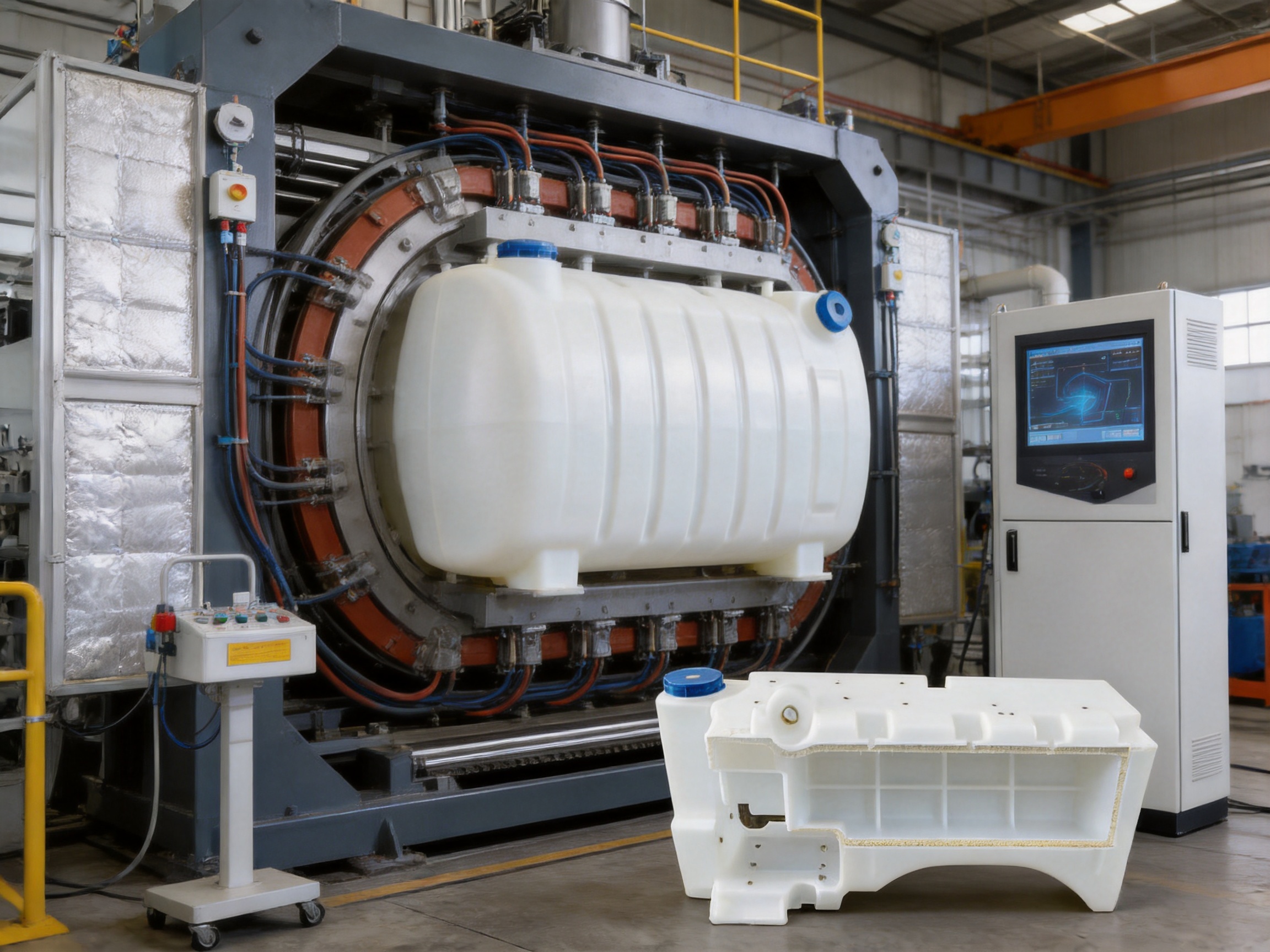
14. Recommended Development Workflow
A disciplined development workflow helps reduce technical risk and supports a faster transition to production. The following sequence is suitable for many automobile fuel tank mold projects.
- Define the vehicle application, fuel type, installation environment, target capacity, and market.
- Confirm applicable safety, emissions, material, and validation requirements.
- Review the tank structure for rotational manufacturability.
- Evaluate wall-thickness transitions, corners, bosses, inserts, and parting lines.
- Select the polymer system and determine whether high-barrier performance is required.
- Choose conventional gas heating or electric heating according to geometry and process needs.
- Complete three-dimensional mold design and customer approval.
- Manufacture the mold through controlled machining, fitting, and finishing.
- Perform trial molding using documented process parameters.
- Inspect the trial tank for dimensions, wall thickness, surface quality, and feature position.
- Conduct leakage, permeation, durability, and other product-specific validation tests.
- Release the mold for production after corrective actions and acceptance are complete.
- Maintain the mold through regular inspection, cleaning, calibration, and repair.
This workflow recognizes that tooling is part of a larger engineering system. The goal is not simply to produce a mold that matches a drawing, but to create a repeatable manufacturing foundation for a compliant and durable fuel tank.
15. Frequently Asked Questions
Q1: Does the automobile fuel tank mold itself require automotive safety certification?
In most cases, the primary certification and regulatory approval apply to the finished fuel tank, its fittings, the vehicle fuel system, and the complete installation rather than to the mold as an independent certified product. However, the mold must be capable of consistently producing parts that pass the required leakage, permeation, durability, dimensional, and other validation tests.
Q2: What is the main advantage of rotational molding for fuel tanks?
The main advantage is the ability to produce large, hollow, and complex shapes with a seamless or near-seamless structure. This allows the tank to use restricted chassis space efficiently, integrate selected features, reduce assembly requirements, and potentially achieve lower weight than an equivalent metal design.
Q3: Can one mold produce different fuel tank designs?
A mold is normally developed for a specific tank geometry. Some inserts or modular features may be replaceable, but major changes in the tank shape, capacity, mounting layout, or connection locations generally require substantial modification or a new mold. Early CAD review is therefore important before production tooling begins.
Q4: Why is wall-thickness control important?
Wall-thickness variation can affect strength, impact resistance, dimensional stability, leakage performance, permeation, weight, and long-term durability. The mold geometry, material quantity, rotation pattern, heating cycle, and cooling process must work together to achieve an appropriate and repeatable wall structure.
Q5: What is high-barrier rotomolding?
High-barrier rotomolding refers to the use of suitable materials and controlled rotational molding processes to reduce fuel permeation and improve containment performance. Barrier performance depends on the complete system, including the resin, additives, processing conditions, tank fittings, closures, and final assembly. Mold design is an important foundation but cannot guarantee compliance by itself.
Q6: When should electric-heated tooling be considered?
Electric-heated tooling may be considered when a tank has complex contours, difficult thermal zones, high-barrier material requirements, demanding dimensional tolerances, or a need for more precise process control. It can provide zoned heating and improved temperature management, although the equipment and mold must be engineered as a complete system.
Q7: What inspection should be performed after trial molding?
Trial inspection may include overall dimensions, wall thickness, feature position, parting-line quality, flash, surface condition, warpage, insert placement, connection accuracy, leakage, and other application-specific tests. The exact inspection plan should be established according to the customer’s product specifications and applicable regulations.
Q8: Can plastic fuel tanks be safer than metal tanks?
Safety depends on the complete design, material, vehicle installation, fittings, crash behavior, fire performance, and compliance testing. Plastic tanks may offer lower weight, greater shape flexibility, and reduced spark generation in certain collision or friction conditions. These advantages must be confirmed through product-specific validation rather than assumed solely from the material choice.
Q9: How does the mold supplier support production after delivery?
Support may include production guidance, trial parameter recommendations, mold maintenance advice, troubleshooting, dimensional review, repair suggestions, and assistance with process changes. Jiangsu Zhroto Mould Co., Ltd. provides integrated support from product design and tooling development through trial molding, inspection, acceptance, and production guidance.
Q10: What information should a buyer provide before requesting a quotation?
The buyer should provide the latest tank drawings or three-dimensional data, target capacity, dimensions, material specification, fuel type, expected production volume, heating equipment, connection locations, tolerance requirements, surface expectations, target market, and validation plan. Complete information improves quotation accuracy and reduces the risk of later design changes.
Conclusion
An automobile fuel tank mold is a critical manufacturing asset for producing safe, lightweight, accurate, and durable plastic fuel storage components. Its value extends far beyond the shape of the cavity. Mold design influences material distribution, wall thickness, leakage control, thermal behavior, demolding, mounting accuracy, production repeatability, and the ability of the finished tank to pass product-specific validation.
Rotational molding provides strong advantages for automotive fuel tank production because it supports large hollow structures, complex chassis-fitting geometry, integrated features, lightweight construction, and reduced dependence on joined panels. Standard rotational molds offer broad equipment compatibility and practical production performance, while high-barrier tooling and electric-heated precision molds provide additional capabilities for demanding containment and process-control requirements.
The strongest results come from a complete engineering approach that includes product structure optimization, three-dimensional modeling, accurate CNC machining, controlled mold assembly, trial molding, dimensional inspection, material compatibility review, and documented production support. A supplier with experience in both conventional and advanced rotational molding systems can help manufacturers reduce development risk and build a more stable path toward production approval.
With its specialized rotational molding capabilities, standardized manufacturing facility, annual mold production capacity, technical certifications, and integrated service model, Jiangsu Zhroto Mould Co., Ltd. provides tooling solutions for automotive fuel tanks and other large hollow plastic products. By combining precision manufacturing with process engineering and practical after-sales support, the company helps customers develop fuel tank molds that are designed not only to meet current production needs but also to support long-term quality and competitiveness.
References
1. Rotational Molding Process Engineering Principles, technical reference literature for hollow polymer product manufacturing.
2. Automotive Fuel System Design and Validation Practices, industry guidance for containment, leakage, durability, and material compatibility.
3. Polymer Materials for Automotive Fluid Storage Applications, reference materials covering chemical resistance, barrier performance, and thermal behavior.
4. Quality Management Systems for Manufacturing Organizations, ISO 9001:2015 principles and implementation guidance.
5. Environmental Management Systems, ISO 14001:2015 principles for controlled manufacturing operations.
6. Occupational Health and Safety Management Systems, ISO 45001 principles for production facilities.
7. Rotational Molding Equipment and Thermal Process Control, engineering references for gas-heated and electric-heated molding systems.
8. Automotive Component Dimensional Inspection and Process Validation, technical guidance for production tooling and finished-part verification.
Product: Automobile fuel tank mold


We provide customers with one-stop services ranging from product design, mold manufacturing to finished product production.
-
 +86-18006248936
-
 ricky.t@zhroto.com
-
 No.9 Jiangyuan Road, Luotang Street, Jiangyan District, Taizhou City,Jiangsu Province, China
Copyright © Jiangsu Zhroto Mould Co., Ltd. Rights Reserved.Custom Rotational Plastic Molding Factory
