 en
 中文简体
 русский
 Español
 Deutsch
 Polskie
 REQUEST A QUOTE

 Home / Author / Mei-Rong Alvarado — Product After-Sales Service Manager / Advanced Rotational Molding Solutions for Safe and Durable Children’s Playgrounds
Advanced Rotational Molding Solutions for Safe and Durable Children’s Playgrounds
Content
- 1 Understanding Children’s Playground Molds
- 2 How Rotational Molding Produces Playground Components
- 3 Key Advantages of Children’s Playground Molds
- 4 Comparison with Alternative Manufacturing Methods
- 5 Design Features That Improve Playground Mold Performance
- 6 Safety Considerations for Children’s Playground Products
- 7 Company Manufacturing Capabilities
- 8 Material and Surface Considerations
- 9 Production Quality Control
- 10 Why Mold Quality Influences Total Project Cost
- 11 Applications for Different Playground Environments
- 12 Project Workflow from Concept to Production
- 13 Maintenance of Children’s Playground Molds
- 14 How to Select a Reliable Mold Supplier
- 15 Frequently Asked Questions
- 15.1 What is a children’s playground mold?
- 15.2 Why is rotational molding suitable for playground equipment?
- 15.3 Can playground molds be customized?
- 15.4 What materials are commonly considered for rotomolded playground products?
- 15.5 How does the mold affect the final surface?
- 15.6 Are rotationally molded playground products lightweight?
- 15.7 Can one mold produce different product sizes?
- 15.8 What should be checked during sample approval?
- 15.9 How long can a playground mold remain in service?
- 15.10 Can the supplier manufacture the finished playground product as well as the mold?
- 15.11 Why should customers review the mold design before manufacturing begins?
- 15.12 Is a smooth playground surface enough to guarantee safety?
- 16 Conclusion
- 17 References
- 18 Product: Children's playground mold
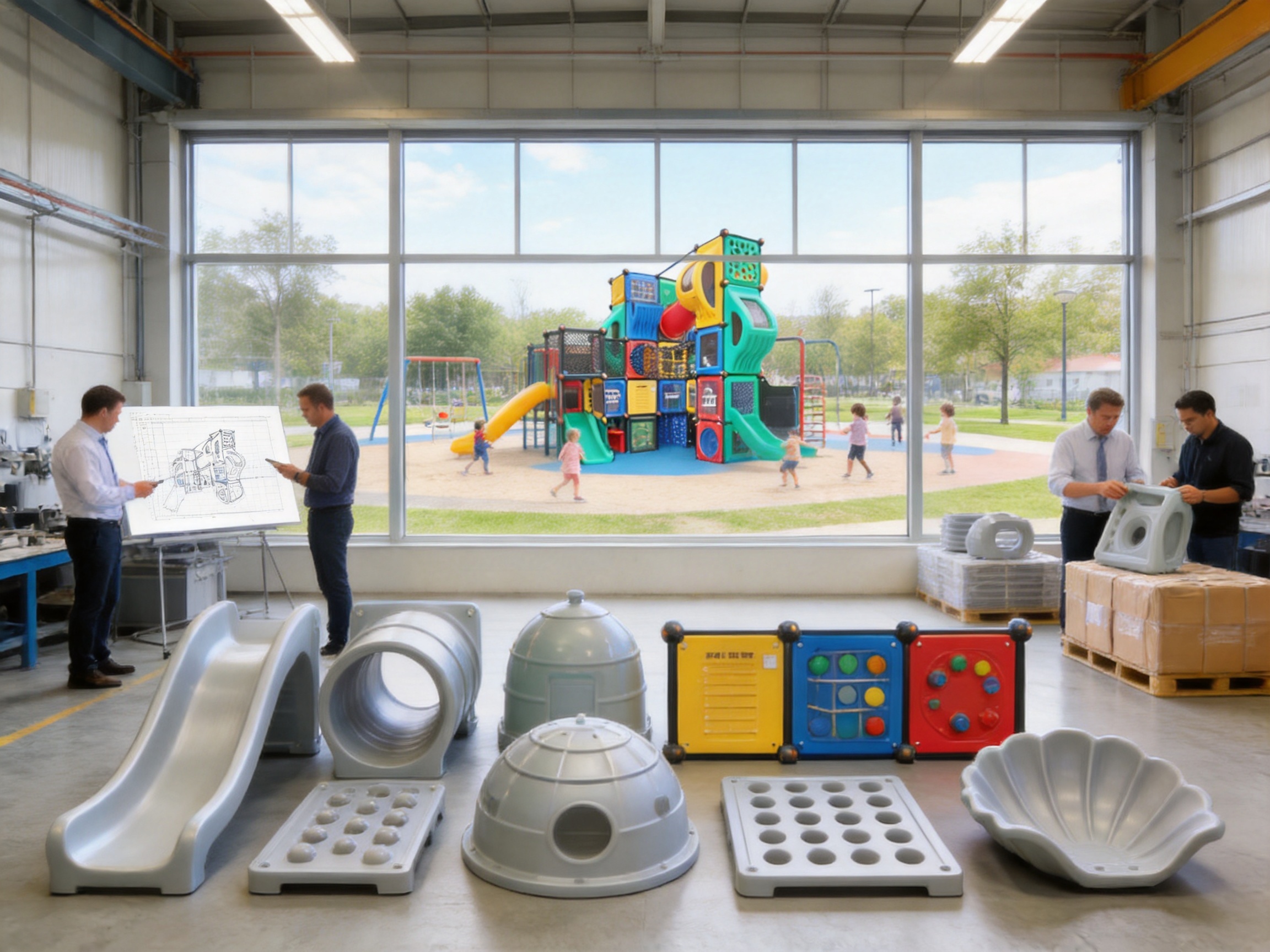
Children’s playgrounds are designed to encourage movement, imagination, social interaction, and healthy physical development. However, every playground component must also satisfy demanding requirements for structural stability, surface quality, durability, weather resistance, and child safety. Slides, climbing modules, tunnels, activity panels, seats, and other recreational components must withstand repeated impact, changing temperatures, ultraviolet exposure, moisture, and daily use by children of different ages. Behind many of these products is a carefully engineered mold that determines the final shape, performance, and appearance of the playground equipment.
Children’s playground molds are specialized tooling systems used to manufacture playground products efficiently and consistently. When combined with rotational molding technology, these molds can produce hollow, strong, and lightweight plastic components with smooth surfaces and complex three-dimensional forms. The process is particularly suitable for playground equipment because it supports seamless construction, rounded edges, integrated shapes, and dependable wall distribution without requiring multiple assembled parts.
Jiangsu Zhroto Mould Co., Ltd. specializes in the design and manufacturing of rotational molding molds and the production of rotomolded plastic products. Its children’s playground mold solutions are developed for customers that require reliable tooling, repeatable production, attractive product appearance, and practical long-term performance. The company provides services ranging from product design and mold manufacturing to finished product production, enabling customers to manage multiple stages of development through one experienced manufacturing partner.
This article explains how children’s playground molds work, what advantages they offer compared with alternative manufacturing approaches, and why mold design and manufacturing quality are essential to the success of playground products. It also examines the company’s production capabilities, quality systems, technical strengths, and the considerations that buyers should evaluate before selecting a mold supplier.
Understanding Children’s Playground Molds
A children’s playground mold is a precision tool used to form plastic material into the desired shape of a playground component. Depending on the product concept, the mold may be designed for a slide, tunnel, climbing shell, playhouse, seating element, roof, enclosure, storage unit, or other recreational structure. The mold contains the negative geometry of the product, including its external contours, openings, reinforcing features, mounting points, and decorative details.
Unlike simple flat or two-dimensional tooling, playground molds often include large curved surfaces and irregular geometries. These shapes must be designed carefully so that plastic powder can reach all areas during rotation and heating. At the same time, the mold must allow the finished product to be removed without damaging edges, corners, openings, or surface details.
The mold is normally manufactured from metal with sufficient strength and thermal conductivity for repeated heating and cooling cycles. Its construction must remain dimensionally stable during production. Even small inaccuracies in the mold can influence the wall thickness, fit between components, drainage performance, assembly alignment, or visual quality of the final playground product.
For this reason, a children’s playground mold is more than a basic forming tool. It is the foundation of the complete product manufacturing process. Good mold engineering contributes to consistent dimensions, smooth surfaces, efficient demolding, stable production cycles, and reduced maintenance requirements.
How Rotational Molding Produces Playground Components
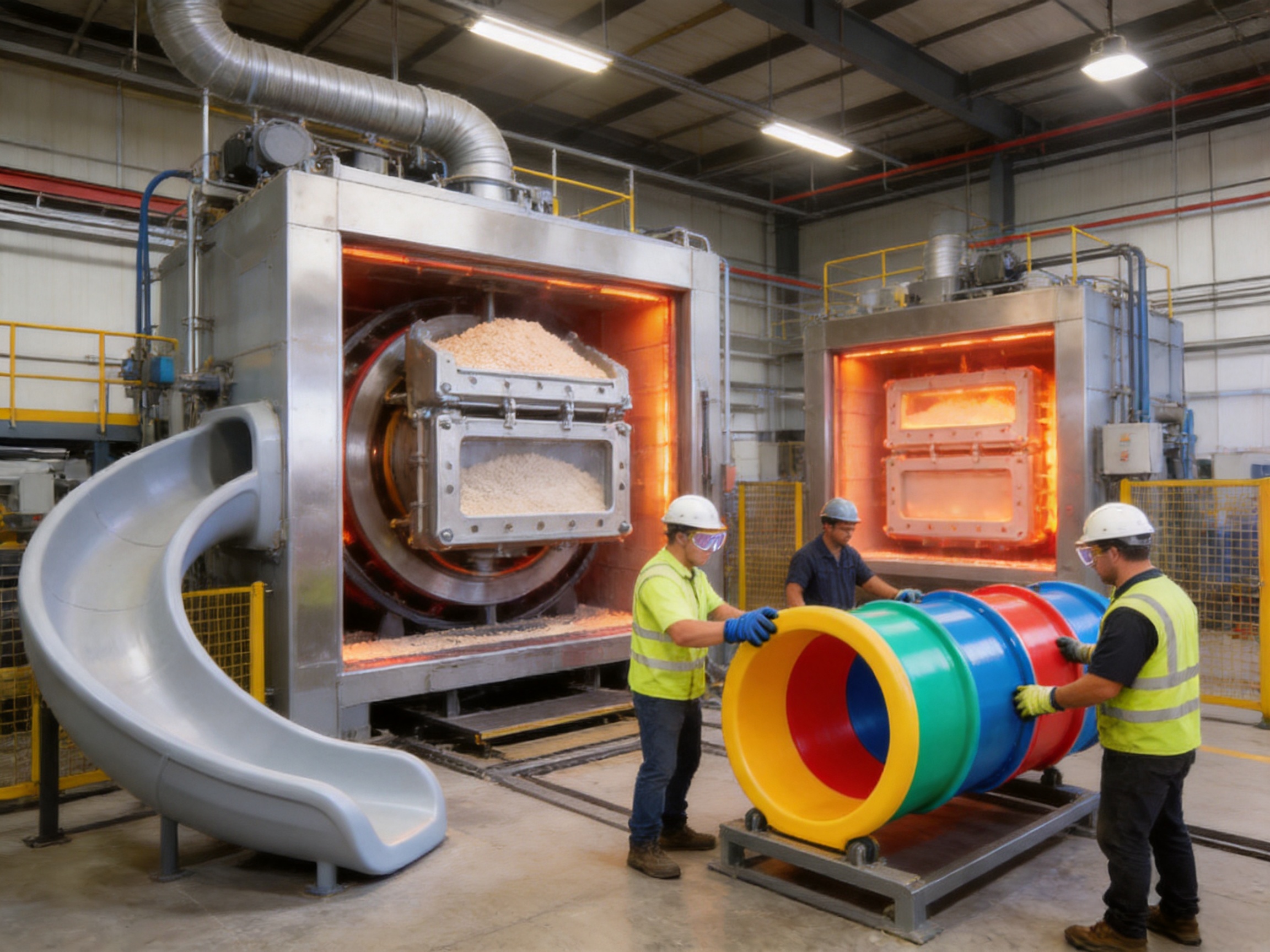
Rotational molding, also called rotomolding, is a plastic manufacturing process used to create hollow products. A measured quantity of polymer powder is placed inside a mold. The mold is then closed and heated while rotating around two or more axes. As the material melts, it gradually coats the internal surface of the mold. After sufficient heating, the mold is cooled while continuing to rotate. Once the plastic has solidified, the finished product is removed from the mold.
This process is highly suitable for large playground components because it can produce one-piece hollow structures without a traditional injection-molding gate system or extensive assembly. The result can be lightweight while still providing useful stiffness and impact resistance. The design may incorporate rounded transitions, broad curves, internal ribs, mounting features, and other details that would be difficult or expensive to create through conventional fabrication.
The rotational molding cycle generally includes several important stages:
Product and Mold Design
The process begins with an evaluation of the intended playground product. Designers consider the overall dimensions, user age range, expected loads, installation method, openings, surface requirements, drainage, material behavior, and production volume. The product model is then developed with suitable draft angles, radii, wall-thickness targets, and connection details.
At this stage, the mold supplier must also assess whether the proposed geometry can be filled evenly during rotation. Deep recesses, narrow passages, sharp internal corners, and inaccessible areas may cause incomplete material coverage or uneven thickness. Early design review helps prevent these problems before tooling begins.
Mold Manufacturing
After the product design is approved, the mold is manufactured according to the final geometry. Manufacturing may involve cutting, forming, welding, machining, surface finishing, and inspection. The method selected depends on the size, complexity, material, and expected service life of the mold.
Large playground molds require careful control of panel alignment, seams, flanges, hinges, clamps, vents, and access points. The mold must be sufficiently rigid to retain its shape during repeated thermal cycles. Its internal surface should be prepared to support reliable release and a consistent external finish on the finished product.
Material Loading
A controlled amount of plastic powder is placed inside the mold before it is closed. The quantity of material influences the final wall thickness and product weight. Accurate loading is therefore important for achieving consistent production results.
For playground products, material selection may be based on impact performance, weather resistance, color stability, flexibility, chemical resistance, and service temperature. The mold supplier and product manufacturer must coordinate closely so that the mold design and process conditions are compatible with the selected polymer.
Heating and Rotation
The closed mold is heated in a rotational molding oven while rotating along multiple axes. The movement allows the softened polymer to flow across the inside of the mold and gradually form a continuous layer. Heating must be controlled carefully. Insufficient heating can lead to incomplete fusion, weak areas, or poor surface appearance. Excessive heating may cause material degradation, discoloration, brittleness, or unnecessary cycle time.
Cooling and Demolding
After the plastic has fused, the mold enters the cooling stage. Controlled cooling helps reduce distortion and internal stress. The mold continues rotating so that the product remains evenly supported as it solidifies.
Once the product has cooled enough to maintain its shape, the mold is opened and the component is removed. Proper draft, parting-line design, and access planning make demolding more efficient and reduce the possibility of damage. The product may then receive trimming, drilling, edge finishing, hardware installation, or other post-processing.
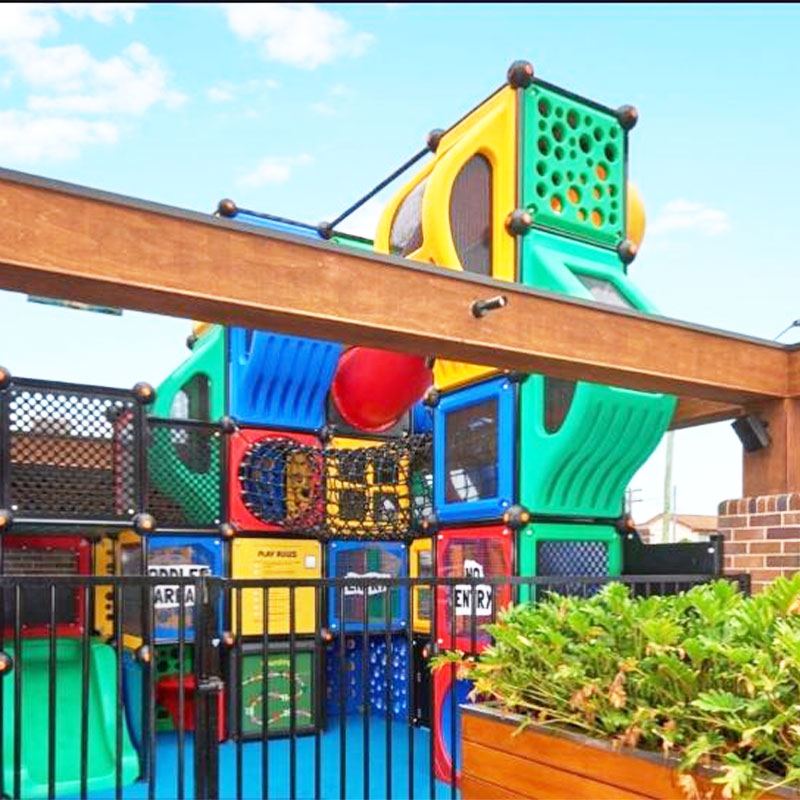
Children's playground mold
Key Advantages of Children’s Playground Molds
Stable One-Piece Construction
One of the most important advantages of rotationally molded playground components is the ability to create large hollow structures in one continuous piece. Fewer joints and seams can reduce potential weak points and simplify assembly. A one-piece slide body, tunnel, or play shell can provide a consistent load path and a cleaner appearance than a product assembled from numerous smaller panels.
Reduced assembly can also lower installation time and minimize the number of fasteners exposed to children. Although many playground products still require connecting hardware, the primary molded body can remain continuous, rounded, and structurally stable.
Impact Resistance
Playground products are exposed to repeated impacts from children climbing, sliding, jumping, and moving across different surfaces. Rotationally molded plastic can provide a useful combination of toughness and flexibility when the material and wall thickness are correctly selected.
Unlike brittle materials that may crack suddenly, suitable plastic products can absorb and distribute impact energy. The final performance depends on polymer grade, processing temperature, wall distribution, product geometry, installation, and maintenance. A well-designed mold helps create the geometry needed for reliable performance under normal playground use.
Smooth and Child-Friendly Surfaces
The surface of the mold directly influences the surface of the finished product. A carefully finished mold can produce smooth and attractive playground components with rounded transitions and fewer surface irregularities. Smooth slide surfaces help reduce friction and improve the user experience. Rounded edges and carefully controlled openings can also reduce the possibility of scratches, snags, or other avoidable hazards.
Surface quality is not only a visual issue. It affects cleaning, water drainage, resistance to dirt accumulation, and long-term maintenance. A smooth molded surface is generally easier to wash and inspect than a rough or heavily jointed surface.
Design Freedom
Children’s playgrounds often require imaginative forms that attract attention and encourage creative play. Rotational molding supports a wide range of shapes, including curved roofs, animal-inspired forms, tunnels, domes, organic climbing surfaces, and integrated play structures.
The process is well suited to products with large dimensions and complex contours. Designers can develop different styles and sizes for small community playgrounds, schools, residential developments, public parks, resorts, indoor play centers, and commercial recreation areas.
Lightweight but Functional Structures
Hollow plastic construction can reduce the weight of large components compared with solid materials. Lower weight makes transportation, handling, installation, and repositioning more manageable. At the same time, the shape of the component can provide useful rigidity and load-bearing performance.
Weight reduction should not be confused with reduced safety. The finished product must still be designed and tested for the intended loads, support conditions, and installation environment. The advantage of rotational molding is that it can achieve an effective balance between material usage, structural performance, and practical handling.
Color and Appearance Options
Color can be incorporated into the molding material, creating a consistent appearance throughout the product surface. Bright colors and distinctive forms are valuable for playground design because they attract children’s attention and help create a recognizable theme.
When color is integrated into the plastic rather than applied only as a surface coating, normal wear may be less visually disruptive. The final color performance still depends on pigment quality, material selection, ultraviolet exposure, cleaning practices, and environmental conditions.
Efficient Production for Different Volumes
Rotational molding is often advantageous for medium-volume and customized products because the tooling can be more economical and adaptable than some high-pressure molding alternatives. It enables manufacturers to produce large components without investing in extremely complex high-tonnage equipment.
The same basic technology can support customized shapes, product variations, color changes, and different sizes. This is useful for playground equipment manufacturers that offer multiple product families or need to develop new designs for different markets.
Comparison with Alternative Manufacturing Methods
Choosing a production method depends on the product’s dimensions, geometry, material, quantity, quality requirements, and target cost. Children’s playground molds used for rotational molding have several competitive advantages, particularly for large hollow products.
| Manufacturing approach | Typical strengths | Considerations for playground products |
|---|---|---|
| Rotational molding | Large hollow parts, smooth curves, low assembly needs, design flexibility, suitable for customized production | Cycle time must be controlled, and wall distribution depends on mold design and process conditions |
| Injection molding | High repeatability, fast cycles for suitable parts, detailed features | Large products may require expensive equipment, complex tooling, and substantial investment |
| Fiberglass fabrication | Flexible prototyping and complex surface forms | May require more manual labor, surface finishing, and maintenance of coatings or layers |
| Metal fabrication | High stiffness and strong structural frames | Can be heavier, may require additional surface protection, and may create more joints or hard edges |
| Thermoforming | Efficient for certain thin-walled shapes and panels | May require secondary assembly and additional reinforcement for large or deeply formed structures |
Compared with injection molding, rotational molding is especially attractive when the playground component is large, hollow, and relatively low to medium in production volume. Injection molding can be highly efficient for smaller components, but the equipment and tooling investment may increase significantly for large parts.
Compared with fiberglass fabrication, rotational molding offers a more repeatable industrial production process and can reduce dependence on manual lay-up work. Compared with metal, molded plastic can offer lower weight, smoother integrated surfaces, and improved freedom for rounded designs. The best method depends on the specific application, but rotational molding provides a strong balance for many playground component designs.
Design Features That Improve Playground Mold Performance
Rounded Corners and Generous Radii
Sharp corners can create stress concentrations in both the mold and the finished plastic product. They may also interfere with material flow and cleaning. Rounded corners support smoother powder movement, more uniform coverage, and a safer product surface.
Generous radii are particularly helpful in areas that children may touch, slide against, or climb over. They also make the mold easier to manufacture and maintain.
Appropriate Draft Angles
Draft angles allow the molded product to be removed from the tool without excessive force. Without sufficient draft, the component may stick to the mold, become distorted, or suffer damage during demolding.
Draft requirements must be considered together with surface texture, openings, parting lines, and the flexibility of the selected material. Early planning can prevent difficult modifications after the mold has been completed.
Controlled Wall Thickness
Consistent wall thickness is essential for predictable strength, weight, cooling, and dimensional stability. Playground components with uneven wall distribution may develop weak areas, distortion, sink-like surface effects, or inconsistent impact performance.
Rotational molding does not distribute material in exactly the same way as pressure-driven processes. The geometry of the mold, the amount of powder, the rotational speed, the heating cycle, and the material’s flow behavior all influence the final result. Experienced mold designers account for these factors during development.
Ventilation and Air Management
Proper venting helps manage air and gases inside the mold during heating and cooling. A suitable venting arrangement can support more stable processing and reduce the risk of undesirable internal pressure or surface defects.
Vent design must be carefully placed so that it supports the molding process without damaging the appearance or creating difficult finishing requirements. Large playground molds may need special attention because of their volume and complex internal geometry.
Parting Lines and Access Points
The position of the parting line affects product appearance, demolding, trimming, and assembly. A well-planned parting line can be located in a less visible area while still allowing the mold to open efficiently.
Access points should also be designed for cleaning, inspection, material loading, hardware installation, and maintenance. Poor access planning may increase production time and make routine service more difficult.
Integrated Mounting and Reinforcement Features
Playground components often need to connect to posts, platforms, ladders, support frames, or other modules. Mounting locations should be incorporated into the product design and accurately represented in the mold.
Where necessary, the product may include thicker sections, molded-in bosses, internal supports, or areas prepared for inserts. These features must be engineered carefully so that they do not cause excessive material accumulation or cooling problems.
Safety Considerations for Children’s Playground Products
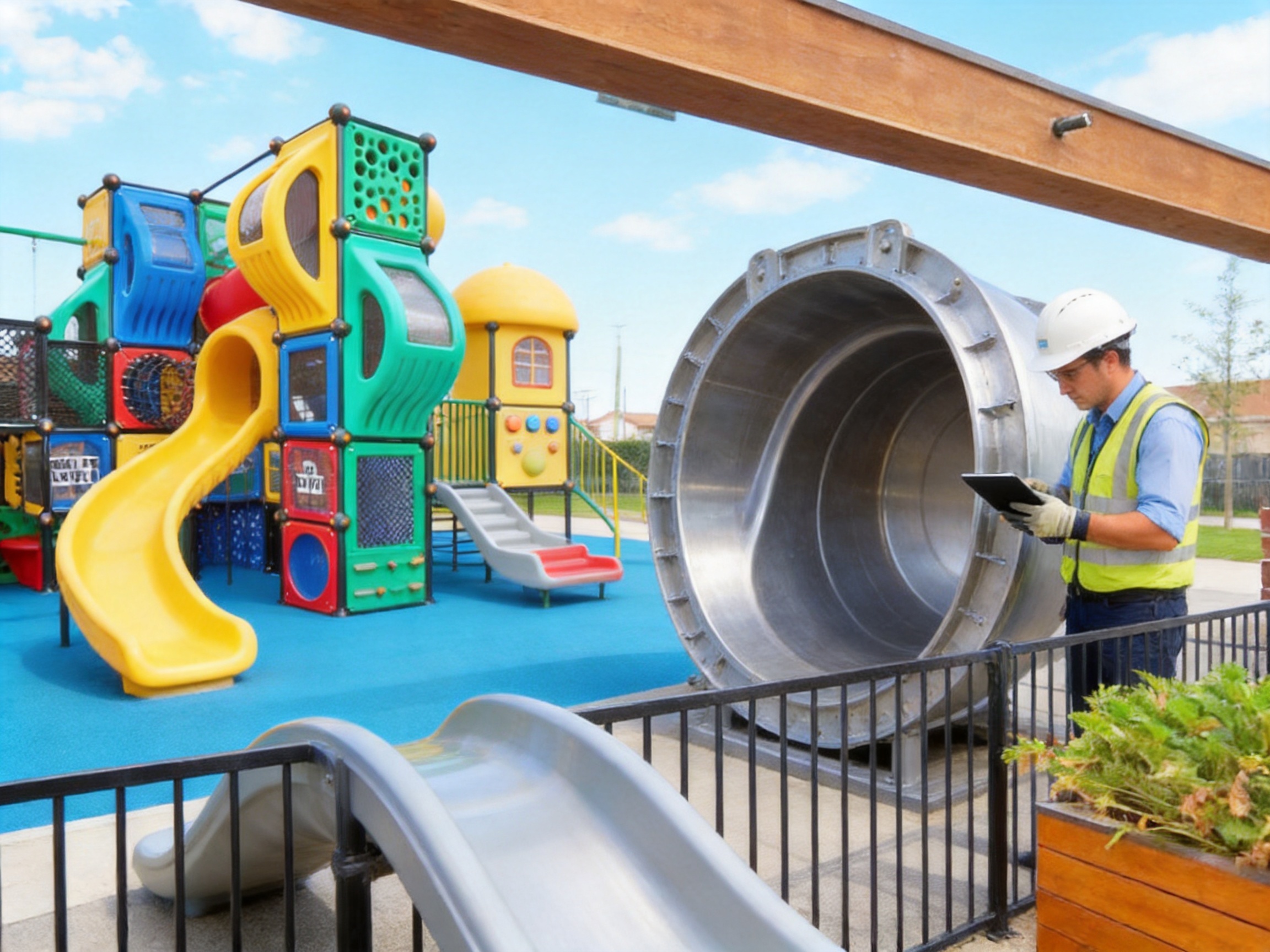
Safety is the central consideration in playground product development. A mold cannot replace proper engineering, testing, installation, supervision, or maintenance, but it can provide the foundation for producing consistent and well-formed components.
The mold and product design should consider foreseeable use by children, including climbing, sliding, hanging, sitting, leaning, jumping, and repeated contact. The product should be evaluated for sharp edges, pinch points, entrapment risks, unexpected openings, excessive deflection, weak attachment areas, and surface defects.
The final playground equipment must be assessed according to the requirements applicable in its intended market. These requirements may address impact areas, fall zones, access openings, guardrails, platform heights, structural loads, surface temperature, flammability, material safety, and installation conditions.
A stable mold helps create repeatable dimensions across production batches. This consistency is important because even small variations in openings, connection points, or support geometry may affect how components fit together. Reliable tooling also supports better quality control by reducing unnecessary variation.
Surface quality deserves special attention. Products should be checked for burrs, sharp projections, incomplete fusion, exposed hardware, rough trimming, and other defects. A smooth molded surface is beneficial, but it must be supported by proper post-processing and final inspection.
Company Manufacturing Capabilities
Jiangsu Zhroto Mould Co., Ltd. was founded in 2015 and specializes in rotational molding molds, rotomolded product processing, and integrated technical solutions. The company’s experience covers the development and production of tooling for multiple industries, including hydrogen energy storage and transportation, automotive parts, industrial equipment, agricultural machinery, water treatment, and outdoor facilities.
This broad industrial experience is relevant to children’s playground mold manufacturing because many of the underlying technical requirements are shared across sectors. Large molded products require careful attention to dimensional stability, thermal cycling, material behavior, surface finish, structural performance, and production repeatability. Experience with different applications can strengthen the company’s ability to adapt tooling solutions to specific customer requirements.
In 2021, the company moved to a modern facility in Jiangyan District, Taizhou City, Jiangsu Province. The facility covers approximately 18,000 square meters, including more than 12,000 square meters of standardized production workshops. This scale provides space for mold manufacturing, product processing, assembly, inspection, storage, and related production activities.
The company reports an annual capacity of more than 800 mold sets and 3,600 tons of plastic products. Such capacity supports both tooling projects and subsequent product manufacturing. Customers that need more than a standalone mold can request an integrated service covering design, mold construction, trial production, and finished product output.
Integrated Product Development
An integrated supplier can participate earlier in the project and identify manufacturing challenges before they become expensive tooling changes. Product geometry, mold construction, plastic material, cycle parameters, post-processing, and installation requirements can be reviewed as one connected system.
For playground equipment manufacturers, this approach may reduce communication gaps between separate design, mold, and production companies. It can also shorten the path from concept to sample and from sample to stable production.
Engineering and Customization
Children’s playground products are often customized according to the available space, target age group, theme, brand identity, or installation method. Standard catalog tooling may not satisfy every requirement. A capable mold manufacturer should therefore be able to interpret drawings, three-dimensional data, samples, or early-stage product concepts.
Customization may involve changes to dimensions, surface details, openings, mounting positions, textures, color plans, or product combinations. The technical team must determine which changes can be made without compromising mold strength, product release, or rotational molding performance.
Quality Management Systems
The company has obtained ISO 9001:2015, ISO 14001:2015, and ISO 45001:2018 certifications. These certifications represent structured approaches to quality management, environmental management, and occupational health and safety.
For customers, a formal management system can provide greater confidence that processes are documented, responsibilities are defined, nonconformities are addressed, and continuous improvement is considered. Certification alone does not guarantee that every product will meet every requirement, but it supports a disciplined manufacturing environment.
Production Experience Across Industries
Applications such as water treatment, outdoor facilities, agricultural machinery, and industrial equipment often require robust products that operate in demanding environments. This experience may contribute to stronger understanding of outdoor exposure, moisture, impact, handling, and long-term service requirements.
For playground products, that knowledge can help inform decisions about material selection, wall thickness, drainage, mounting, UV exposure, cleaning, and maintenance. Each playground project still requires its own evaluation, but cross-industry expertise can be a practical advantage.
Material and Surface Considerations
The choice of plastic material affects the performance of the final playground component. Common considerations include impact resistance, stiffness, flexibility, ultraviolet stability, color retention, chemical resistance, low-temperature behavior, and processability in rotational molding.
Material selection should be based on the product’s environment and expected use. Outdoor playgrounds may experience intense sunlight, rain, snow, temperature changes, dust, cleaning chemicals, and repeated mechanical contact. Indoor playgrounds may have different requirements but can still experience heavy use and frequent cleaning.
The mold surface and the material formulation work together to determine the appearance of the product. A properly prepared mold can help achieve a smooth, uniform surface. However, surface results also depend on powder quality, particle size, heating conditions, cooling rate, pigment dispersion, and handling after demolding.
Color planning should consider visibility, theme coordination, heat absorption, and long-term appearance. Darker surfaces may become warmer under direct sunlight, while lighter surfaces may show dirt differently. These factors should be considered by the product designer and playground operator.
Where a textured surface is required for grip or visual effect, the texture should be designed intentionally and evaluated for cleanability, comfort, and safety. Excessive roughness may cause abrasion or collect dirt, while insufficient texture may not provide the desired functional benefit.
Production Quality Control
Quality control begins before the mold is manufactured. Product drawings, three-dimensional models, material specifications, tolerances, and inspection criteria should be reviewed and approved. Any unclear dimensions or functional requirements should be resolved before cutting or forming begins.
During mold manufacturing, attention should be given to dimensional accuracy, weld quality, surface preparation, parting-line fit, hardware installation, vent placement, and overall rigidity. Inspection may include visual checks, dimensional measurement, alignment verification, and trial assembly.
During trial production, the team can evaluate powder loading, heating behavior, product release, wall distribution, shrinkage, surface finish, trimming requirements, and dimensional conformity. Trial results may lead to process adjustments or minor mold modifications.
For production approval, the finished product should be checked against the agreed requirements. Depending on the project, this may include:
Dimensional inspection of overall length, width, height, openings, mounting points, and critical interfaces.
Visual inspection for surface uniformity, color consistency, incomplete fusion, contamination, deformation, scratches, burrs, and trimming quality.
Functional inspection of fit, assembly, movement, drainage, access, and interaction with related components.
Structural evaluation based on the intended load conditions and installation configuration.
Documentation of material batches, production parameters, inspection results, and corrective actions where required.
Consistent records help support traceability and make it easier to identify the cause of any future production issue. They also help customers maintain repeatable quality when ordering replacement or additional components.
Why Mold Quality Influences Total Project Cost
The initial mold price is only one part of the total cost of a playground product. A low-cost mold that produces inconsistent parts, requires frequent repair, or causes excessive trimming may create higher expenses over its service life.
Well-designed tooling can reduce material waste by supporting more predictable loading and wall distribution. It can shorten production time by simplifying demolding and minimizing rework. It can also reduce rejected parts caused by distortion, incomplete fusion, dimensional errors, or surface defects.
Maintenance is another important factor. Strong mold construction, reliable hinges and clamps, accessible inspection points, and suitable surface treatment can help reduce downtime. A mold that is easier to clean, repair, and adjust may deliver better value even if its initial cost is not the lowest available.
Product consistency can also reduce downstream expenses. When components fit together correctly, installation is faster and fewer modifications are required on site. Consistent color and appearance can support a more professional result across an entire playground project.
Customers should therefore evaluate mold suppliers according to total value rather than purchase price alone. Design support, sample development, production assistance, quality documentation, delivery reliability, and after-sales technical communication are all relevant factors.
Applications for Different Playground Environments
Public Parks
Public parks require playground equipment that can withstand frequent use and exposure to changing weather. Molded slides, tunnels, climbing shells, roofs, and activity elements can be designed for durability, easy cleaning, and practical replacement.
Schools and Kindergartens
Schools and kindergartens often need equipment suitable for specific age groups and available spaces. Customized mold dimensions can help create compact layouts, low-height activities, or themed structures that support supervised play.
Residential Communities
Residential playgrounds may have limited space and require attractive equipment that integrates with landscaping and surrounding buildings. Rotational molding supports colorful, rounded, and relatively lightweight components that can be adapted to different site plans.
Indoor Play Centers
Indoor facilities may use molded tunnels, panels, small slides, and interactive elements as part of larger play systems. Smooth surfaces and easy-to-clean construction are valuable in environments where hygiene and frequent maintenance are important.
Hotels, Resorts, and Commercial Recreation Areas
Hotels and resorts often seek distinctive themed equipment that supports their identity and attracts families. Custom molds allow designers to develop special shapes, colors, and integrated features that are not available from standard products.
Project Workflow from Concept to Production
A successful children’s playground mold project benefits from a clear workflow. The first step is requirement collection. The customer should provide the intended product use, dimensions, drawings or models, target age group, material preferences, estimated annual quantity, installation method, surface requirements, and applicable standards.
The supplier then reviews the concept for manufacturability. This review should identify draft requirements, parting lines, wall-thickness risks, mounting areas, venting, demolding access, and possible areas of distortion. Any proposed changes should be discussed before final approval.
After the design is confirmed, the mold is manufactured and inspected. A trial mold may be used to produce samples for evaluation. The customer can review shape, appearance, fit, dimensions, color, and functional characteristics.
Once the sample is approved, the process parameters are stabilized. These may include material quantity, heating time, oven temperature, rotational speed, cooling conditions, and trimming procedures. A stable process supports repeatable production over time.
For large projects, it is useful to establish a documentation package containing approved drawings, sample photographs, material information, inspection criteria, packaging instructions, and maintenance recommendations. This documentation improves communication between the mold supplier, product manufacturer, installer, and operator.
Maintenance of Children’s Playground Molds
Regular mold maintenance protects product quality and extends tooling life. After each production cycle, the mold should be checked for residual plastic, contamination, damage, loose hardware, and changes at the parting line.
Hinges, clamps, handles, vents, and other moving or functional components should be inspected according to the manufacturer’s maintenance plan. Any sign of wear, deformation, or cracking should be recorded and addressed before it affects production.
The mold should be stored in a clean and dry environment when not in use. Improper storage can expose the tooling to moisture, impact, contamination, or unnecessary stress. Large molds should be supported in a way that avoids deformation.
Maintenance practices should avoid damaging the mold surface. Harsh tools or unsuitable chemicals may create scratches or alter the surface finish. A controlled cleaning procedure is preferable to aggressive treatment.
How to Select a Reliable Mold Supplier
Buyers should begin by reviewing the supplier’s experience with rotational molding and large hollow products. Experience with unrelated tooling may not be sufficient for complex playground components. Ask whether the supplier can provide product design support, mold manufacturing, trial production, and finished product processing.
Production capacity is also important. The supplier should have adequate workshop space, equipment, personnel, and scheduling ability to manage the project. A company with both mold and plastic product production capabilities may provide more coordinated service.
Quality certifications and documented procedures can indicate a structured operation. However, customers should also review actual inspection methods, sample approval processes, corrective-action procedures, and communication practices.
Technical communication should be clear from the beginning. The supplier should be willing to discuss wall thickness, material behavior, draft, parting lines, venting, mounting features, tolerances, and expected production conditions. A supplier that only quotes a price without reviewing the design may not identify important manufacturing risks.
Finally, customers should evaluate after-sales support. Mold projects may require adjustments after trial production, and long-term product programs may need replacement parts, tooling maintenance, or design revisions. Reliable technical support can protect the customer’s investment.
Frequently Asked Questions
What is a children’s playground mold?
A children’s playground mold is a specialized tool used to form plastic playground components such as slides, tunnels, climbing shells, roofs, panels, and activity structures. It defines the product’s shape, openings, surface details, mounting points, and other features.
Why is rotational molding suitable for playground equipment?
Rotational molding is suitable because it can produce large, hollow, seamless, and curved plastic parts. It supports lightweight construction, smooth surfaces, attractive colors, and customized product shapes. It is especially useful for medium-volume production and products that would require expensive tooling if made by other methods.
Can playground molds be customized?
Yes. Molds can be customized according to product dimensions, shape, theme, color plan, mounting arrangement, surface finish, and installation requirements. The proposed design must still be reviewed for material flow, demolding, wall distribution, structural performance, and production feasibility.
What materials are commonly considered for rotomolded playground products?
Material selection depends on the required impact resistance, flexibility, stiffness, weather exposure, color stability, chemical resistance, temperature range, and processing behavior. The material should be selected for the intended environment and applicable safety requirements.
How does the mold affect the final surface?
The mold’s internal surface finish, geometry, parting line, and cleanliness influence the appearance of the finished product. A properly prepared mold can support smooth surfaces and consistent details, while damage or contamination may be transferred to the product.
Are rotationally molded playground products lightweight?
They can be relatively lightweight because the process creates hollow structures rather than solid components. The final weight depends on product dimensions, wall thickness, material density, reinforcement, and design requirements. Lightweight construction can simplify transportation and installation while still providing useful structural performance.
Can one mold produce different product sizes?
A single mold normally produces one defined product geometry. Product variations may require interchangeable sections, modifications, or separate molds. The most appropriate approach depends on the design, expected production volume, and required level of commonality between sizes.
What should be checked during sample approval?
Customers should review dimensions, wall distribution where applicable, surface finish, color, trimming, openings, mounting points, fit with other components, drainage, appearance, and functional performance. The sample should be compared with approved drawings and project requirements.
How long can a playground mold remain in service?
Service life depends on mold construction, material, heating and cooling cycles, maintenance, handling, storage, and production volume. Properly designed and maintained tooling can support repeated production, but regular inspection is necessary to identify wear or damage.
Can the supplier manufacture the finished playground product as well as the mold?
Yes. Jiangsu Zhroto Mould Co., Ltd. provides both rotational molding mold manufacturing and rotomolded product processing. This integrated capability can help customers move from product design and tooling to sample production and finished component manufacturing through one supply chain.
Why should customers review the mold design before manufacturing begins?
Early review can identify problems involving draft, parting lines, wall distribution, vents, mounting features, sharp corners, and demolding. Correcting these issues during design is generally faster and less expensive than modifying completed tooling or repairing rejected products.
Is a smooth playground surface enough to guarantee safety?
No. A smooth surface is beneficial, but safety also depends on the complete product design, material, dimensions, structural strength, installation, fall zones, hardware, inspection, maintenance, and compliance with applicable standards. The mold supports manufacturing quality but is only one part of the overall safety system.
Conclusion
Children’s playground molds play a decisive role in the quality, appearance, performance, and production efficiency of modern playground equipment. Through rotational molding, manufacturers can create large hollow components with smooth surfaces, rounded forms, stable construction, attractive colors, and flexible customized designs. These characteristics make the process highly competitive for slides, tunnels, climbing modules, playhouses, panels, roofs, and other recreational structures.
The strongest results come from treating mold development as an engineering project rather than a simple tooling purchase. Product geometry, material selection, wall distribution, demolding, ventilation, mounting, surface finish, safety, and maintenance must be considered together. A reliable mold can reduce assembly requirements, improve production consistency, lower waste, and support long-term product value.
Jiangsu Zhroto Mould Co., Ltd. combines rotational mold manufacturing, plastic product processing, industrial production experience, standardized workshop facilities, and integrated technical services. Founded in 2015, the company operates from a modern facility covering approximately 18,000 square meters and reports annual capacity of more than 800 mold sets and 3,600 tons of plastic products. Its ISO 9001:2015, ISO 14001:2015, and ISO 45001:2018 certifications further support its quality, environmental, and occupational safety management systems.
For playground equipment manufacturers seeking customized tooling, stable production, and practical technical support, a capable rotational molding partner can provide advantages throughout the product life cycle. From the first concept review to mold construction, trial production, finished product manufacturing, and ongoing improvement, careful engineering helps transform creative playground ideas into safe, durable, and attractive products for children.
References
Rotational Molding Industry Association. Principles of Rotational Molding and Product Design.
International Organization for Standardization. ISO 9001:2015 Quality Management Systems.
International Organization for Standardization. ISO 14001:2015 Environmental Management Systems.
International Organization for Standardization. ISO 45001:2018 Occupational Health and Safety Management Systems.
Society of Plastics Engineers. Rotational Molding: Materials, Processing, and Design Considerations.
General playground safety guidance covering impact areas, entrapment prevention, structural stability, surface conditions, installation, inspection, and maintenance.
Technical information supplied for the manufacture of rotational molding molds and rotomolded plastic products by Jiangsu Zhroto Mould Co., Ltd.
Product: Children's playground mold


We provide customers with one-stop services ranging from product design, mold manufacturing to finished product production.
-
 +86-18006248936
-
 ricky.t@zhroto.com
-
 No.9 Jiangyuan Road, Luotang Street, Jiangyan District, Taizhou City,Jiangsu Province, China
Copyright © Jiangsu Zhroto Mould Co., Ltd. Rights Reserved.Custom Rotational Plastic Molding Factory
