 en
 中文简体
 русский
 Español
 Deutsch
 Polskie
 REQUEST A QUOTE

 Home / Author / Linnea Qiao — International Sales Manager / Custom Rotational Kayak Mold for High-Performance One-Piece Watercraft Production
Custom Rotational Kayak Mold for High-Performance One-Piece Watercraft Production
Content
- 1 Why Kayak Mold Quality Matters
- 2 One-Piece Rotational Molding Technology
- 3 Design Features of a High-Performance Kayak Mold
- 4 Custom Tooling for Different Kayak Categories
- 5 Material and Construction Advantages
- 6 Compatibility with Gas-Heated and Electric-Heated Machines
- 7 Advanced Manufacturing Process
- 7.1 Stage One: Product and Application Evaluation
- 7.2 Stage Two: Product Optimization
- 7.3 Stage Three: Three-Dimensional Engineering
- 7.4 Stage Four: Mold Confirmation
- 7.5 Stage Five: Precision Manufacturing
- 7.6 Stage Six: Trial Production
- 7.7 Stage Seven: Inspection and Delivery
- 7.8 Stage Eight: Technical Support
- 8 Engineering and Performance Advantages Compared with Basic Tooling
- 9 Company Manufacturing Strengths
- 10 Quality Control for Kayak Tooling
- 11 Recommended Mold Evaluation Checklist
- 12 Applications of Rotomolded Kayak Tooling
- 13 Frequently Asked Questions
- 13.1 Q1: What is a rotational kayak mold?
- 13.2 Q2: Why is one-piece rotational molding suitable for kayaks?
- 13.3 Q3: Can the mold produce different kayak sizes?
- 13.4 Q4: Can the tooling include fishing features?
- 13.5 Q5: What materials are commonly used for this type of mold?
- 13.6 Q6: Can the mold work with electric-heated rotational molding machines?
- 13.7 Q7: What is the benefit of CNC machining for kayak molds?
- 13.8 Q8: How does custom tooling compare with a standard mold?
- 13.9 Q9: What should be checked during mold trials?
- 13.10 Q10: How can mold service life be extended?
- 13.11 Q11: What services does Jiangsu Zhroto Mould Co., Ltd. provide?
- 13.12 Q12: What industries does the company serve?
- 14 Conclusion
- 15 References
- 16 Product: Kayak mold
Modern kayak manufacturers compete in a market where product durability, comfort, appearance, production efficiency, and cost control are equally important. A kayak mold is therefore more than a forming tool. It is the foundation of the finished vessel's geometry, wall consistency, structural performance, surface quality, and production repeatability. When the mold is accurately engineered, manufacturers can produce dependable kayaks with consistent dimensions and fewer quality problems throughout long production runs.
The custom kayak mold described in this article is designed for one-piece rotational molding of polyethylene watercraft. It supports product development ranging from approximately three-meter single-person recreational kayaks to five-meter tandem touring kayaks. The tooling can also be adapted for fishing kayaks, sit-on-top models, touring vessels, rental kayaks, and specialized performance watercraft.
Jiangsu Zhroto Mould Co., Ltd. provides integrated services for rotational molding mold design, manufacturing, product processing, and technical support. Its capabilities cover product evaluation, three-dimensional engineering, mold construction, trial production, inspection, delivery, and process assistance. This integrated approach allows customers to develop tooling around their specific kayak design, machine configuration, material requirements, and production objectives.
Compared with basic or highly standardized tooling, a professionally engineered kayak mold offers better dimensional stability, smoother surface reproduction, more reliable release, improved material distribution, and stronger compatibility with repeated production cycles. These advantages help manufacturers reduce waste, protect product quality, and build a more competitive kayak product range.
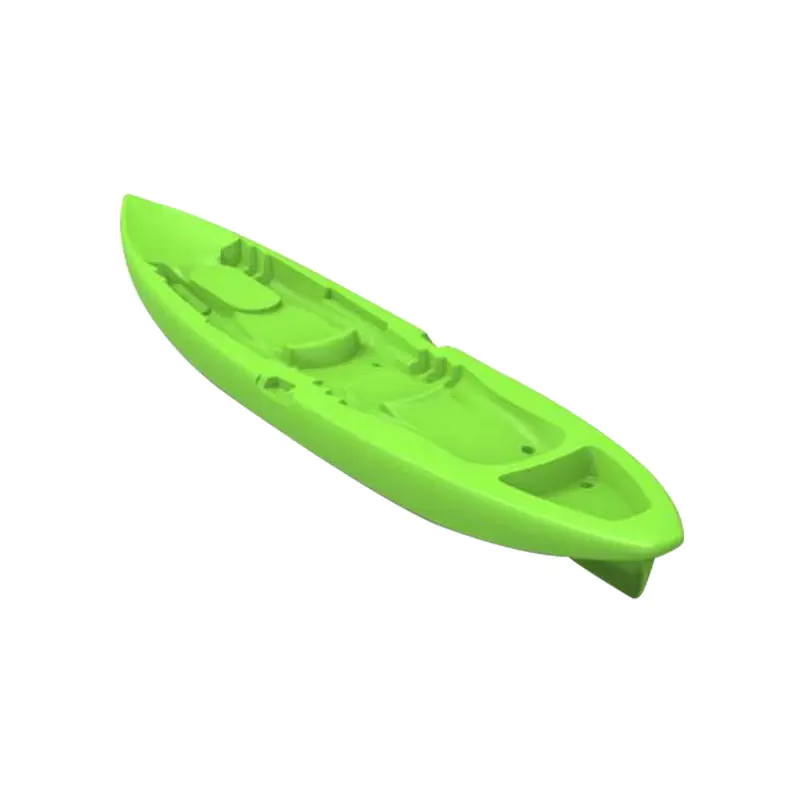
Kayak mold
Why Kayak Mold Quality Matters
The quality of the mold directly influences nearly every important feature of a rotomolded kayak. The mold determines the external hull contour, deck shape, cockpit position, storage recesses, mounting points, handle locations, and other functional details. It also affects how polyethylene powder moves during rotation and how evenly the material builds across the mold surface.
Unlike simple plastic parts, kayaks have large curved surfaces, hollow internal spaces, long hull sections, and areas that may include recessed or integrated features. These characteristics create demanding tooling requirements. A mold must retain its shape during heating and cooling, distribute thermal energy effectively, support reliable clamping, and release the finished shell without damaging edges or functional details.
A poorly designed mold may produce uneven wall thickness, distorted hull lines, incomplete corners, surface defects, difficult demolding, or variations between production batches. These problems can increase material consumption and finishing work while reducing customer confidence in the final kayak. In contrast, an accurately designed mold provides a stable foundation for repeatable production.
Tooling quality is especially important for one-piece rotational molding. The finished kayak is formed as a continuous hollow structure rather than as several separately molded sections joined together. This method reduces the number of weld lines and joining operations. However, because the entire shell is created inside one closed mold, the tooling must be engineered carefully to ensure that the material reaches all required areas during the forming cycle.
For manufacturers, a strong mold can also reduce the total cost of ownership. A tool that maintains dimensional accuracy over many cycles requires fewer repairs and less frequent adjustment. Reliable release reduces the likelihood of damage during demolding. Consistent geometry lowers the risk of rejected parts and makes downstream installation of seats, hatches, fittings, and accessories more efficient.
One-Piece Rotational Molding Technology
Rotational molding is well suited to hollow plastic products such as kayaks. A measured quantity of polyethylene resin is loaded into the mold before the mold enters a temperature-controlled oven. The mold rotates around two axes while heating, allowing the resin to gradually melt and coat the internal surface. As the material becomes evenly distributed, it forms a continuous shell that follows the mold geometry.
After the heating stage, the mold enters a controlled cooling phase. Rotation continues so that the material remains distributed while the shell solidifies. The finished kayak body is then removed from the mold and sent for trimming, fitting, inspection, and other finishing operations.
The one-piece process provides several advantages over construction methods that depend on multiple shell sections. A continuous shell can reduce potential leakage points and eliminate many conventional weld seams. It can also improve production consistency by reducing the number of joining and alignment operations. For outdoor products exposed to impact, water, sunlight, transport, and repeated handling, a seamless structure can contribute to dependable service performance.
Rotationally molded polyethylene also offers useful resistance to impact and practical outdoor wear. It is suitable for recreational products that may be dragged onto shore, transported on roof racks, stored outdoors, or used in rental operations. The finished product can combine a durable exterior with a hollow, lightweight structure that is practical for handling and water use.
The mold must be designed together with the complete process. Wall thickness depends not only on the quantity of resin but also on mold geometry, rotational speed, oven temperature, heating time, cooling conditions, and material behavior. A professional tooling supplier considers these variables during design rather than treating the mold as an isolated component.
Continuous Hull Integrity
A kayak shell with fewer seams has fewer areas that may become vulnerable to leakage or structural separation. One-piece molding is especially useful for watercraft because the hull and deck can be formed as an integrated body, depending on the selected design. This approach supports watertight performance and reduces secondary joining work.
Continuous construction can also improve appearance. A well-made mold reproduces smooth transitions and flowing hull lines without visible weld marks across major surfaces. This is important for manufacturers selling kayaks in competitive consumer markets, where visual quality influences purchasing decisions.
Material Distribution and Wall Consistency
Uniform material distribution is one of the most important performance requirements for rotationally molded kayaks. Thin areas can reduce durability, while excessive material can increase weight and cycle cost. The mold must allow polyethylene powder to move naturally across the hull, deck, corners, and functional recesses during biaxial rotation.
Careful design of transitions, radii, parting areas, and internal features helps improve the distribution process. The mold structure should also support stable heating and cooling so that different sections of the kayak do not experience excessive thermal variation. When tooling and process conditions are properly matched, manufacturers can achieve more consistent weight, wall thickness, and structural behavior.
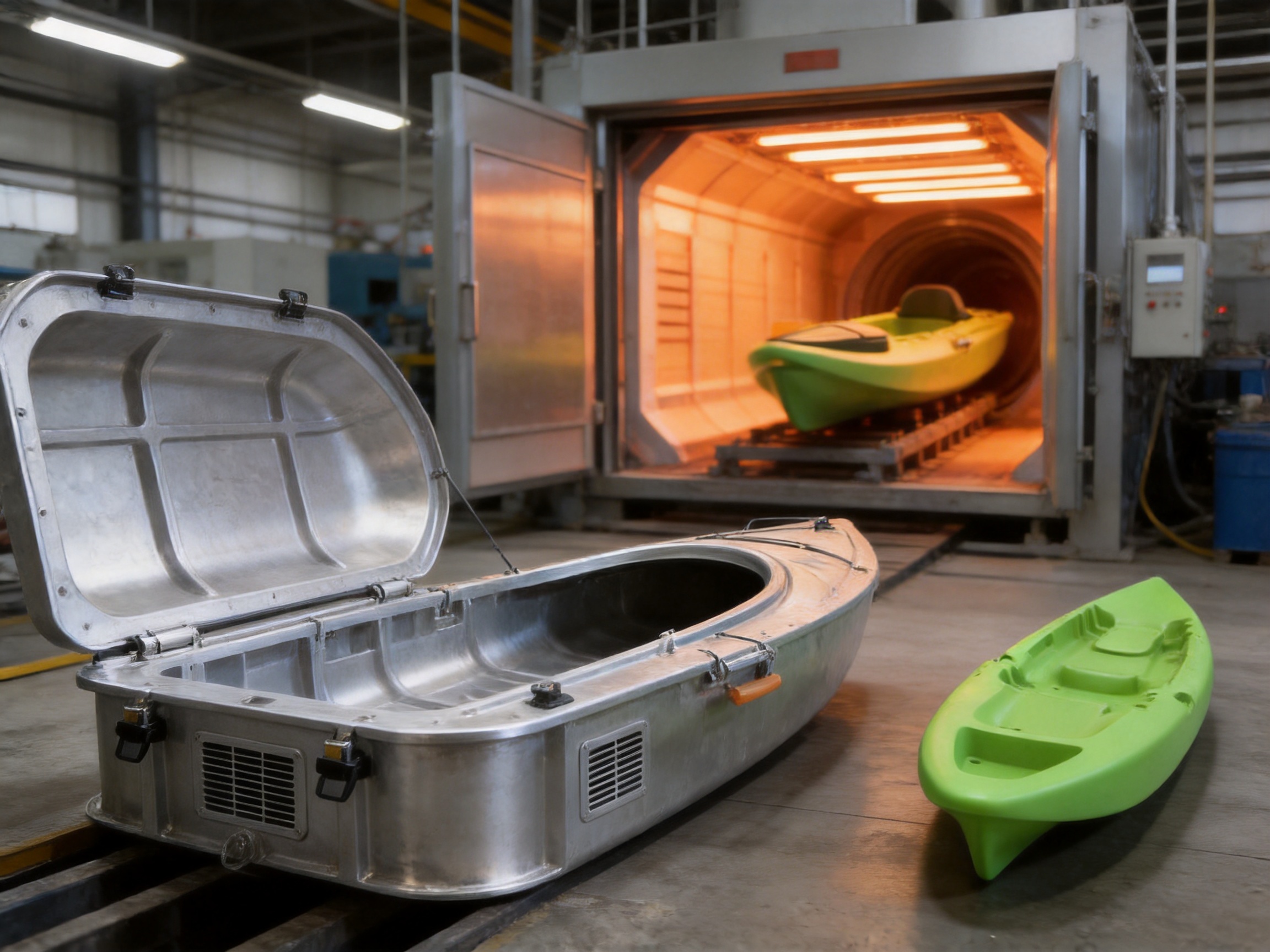
Design Features of a High-Performance Kayak Mold
A high-performance kayak mold combines product engineering with manufacturing practicality. It must accurately reproduce the intended design while remaining suitable for repeated rotational molding cycles. The following features distinguish professional tooling from basic or poorly optimized molds.
Accurate Hull Geometry
The hull shape influences speed, stability, tracking, turning response, load capacity, and general handling. Small dimensional variations can affect the finished kayak's behavior on the water. For this reason, the mold cavity must reproduce the approved three-dimensional product data accurately.
Computer-aided design and three-dimensional engineering allow the tooling team to review hull curvature, cockpit proportions, deck height, storage areas, and accessory positions before mold construction begins. This early review helps identify areas that may be difficult to form, release, trim, or inspect.
Dimensional Stability
During rotational molding, the mold is exposed to repeated heating and cooling. Thermal expansion and contraction can influence its dimensions if the structure is not designed correctly. High-grade mold materials, appropriate reinforcement, carefully planned closures, and stable construction methods help control these changes.
Dimensional stability is especially important for long touring or tandem kayaks. A large mold must maintain its alignment and shape across an extended surface area. Reinforcement and handling structures should provide sufficient support without interfering with heating, rotation, or product removal.
Smooth Surface Reproduction
The internal mold surface becomes the external surface of the kayak. Any imperfection, unwanted mark, rough transition, or machining defect may be transferred to the finished product. Precision machining and appropriate surface treatment help create the smooth appearance expected from a high-quality watercraft.
Smooth mold surfaces also support easier product release. Reduced friction at carefully designed release areas can lower the risk of deformation, scratches, or damage during demolding. This is important for large kayak shells that may require coordinated handling after the mold is opened.
Practical Parting and Closure Design
The parting structure must balance two requirements: it must hold the mold securely during heating and rotation, and it must permit efficient opening after cooling. Poorly planned parting areas can create flash, alignment problems, or difficult access for finishing operations.
Professional tooling design considers how operators will load resin, close the mold, inspect closures, remove the finished kayak, and perform maintenance. Practical access improves production efficiency and reduces the likelihood of operating errors during repeated cycles.
Reliable Venting
Venting allows gases and air to move appropriately during the molding cycle. The venting strategy should be selected according to the kayak's geometry, material, wall requirements, and machine conditions. Proper venting can help reduce unwanted pressure, trapped air, and forming irregularities.
Vents must be designed carefully so that they support the process without creating visible defects or difficult finishing requirements. Their position, size, and maintenance condition should be included in the tooling evaluation.
Efficient Demolding
Kayaks have long, curved bodies that can be difficult to remove if the tooling contains unnecessary undercuts or poorly positioned features. A mold designed for efficient release can reduce cycle time and protect both the product and the tooling.
Product geometry should be reviewed from the beginning to ensure that integrated storage areas, handles, mounting points, and cockpit details remain compatible with the release direction. When a design requires specialized release solutions, these should be addressed during engineering rather than after the mold has been completed.
Custom Tooling for Different Kayak Categories
Different kayak categories require different combinations of geometry, stability, storage, comfort, and structural performance. A standardized mold may not provide the flexibility needed for every application. Custom tooling allows manufacturers to develop products for specific users and operating environments.
Recreational Kayak Mold Tooling
Recreational kayaks are commonly used on lakes, calm rivers, coastal waters, and rental sites. Their design often emphasizes stability, ease of use, comfort, practical storage, and dependable durability. The mold must reproduce a hull that is easy to handle while supporting efficient production at commercial volumes.
Recreational models may range from compact single-person kayaks to larger leisure products. A three-meter class kayak requires tooling that is relatively easy to handle while still maintaining precise hull geometry. The mold should support consistent wall formation around the bow, stern, seat area, and deck features.
One-piece rotational molding is particularly valuable in this segment because recreational kayaks may experience frequent contact with docks, shorelines, transport equipment, and other vessels. A durable polyethylene shell can provide practical resistance to everyday impacts. The mold must therefore support a robust finished product without creating unnecessary weight or excessive material use.
Custom recreational kayak tooling may include provisions for storage compartments, molded footrests, handles, drain features, seat locations, and accessory mounting positions. These details should be designed with smooth transitions and appropriate draft so that the material forms consistently and the product releases efficiently.
Fishing Kayak Mold Tooling
Fishing kayaks require additional attention to functionality. Users may need rod holders, tackle storage, equipment mounting points, elevated seating, paddle storage, and stable standing areas. The mold must integrate these features while preserving the hull's water performance and structural durability.
A fishing kayak often carries more equipment than a basic recreational model. The deck and hull must accommodate additional loads without excessive flexing or local weakness. Rotomolded polyethylene is well suited to this application because it can produce a durable hollow body with integrated functional details.
Recessed areas require careful mold engineering. Deep or sharply defined recesses may influence powder movement, heat transfer, wall thickness, and product release. Smooth radii and manufacturable transitions help the material reach the required surfaces while reducing stress concentration in the finished shell.
The intended environment should guide the mold design. A compact fishing kayak for calm lakes may require different stability and storage characteristics from a river model exposed to rocks, current, and frequent launching. A coastal fishing platform may need a wider hull, larger storage spaces, and additional equipment positions. Custom tooling allows these requirements to be addressed during product development.
Touring Kayak Mold Tooling
Touring kayaks are designed for longer distances and extended water activities. Their tooling may place greater emphasis on tracking, directional stability, internal capacity, deck layout, and efficient movement through the water. Longer hulls create additional demands on mold rigidity, handling, thermal distribution, and dimensional control.
A touring kayak mold must maintain the intended longitudinal shape throughout repeated cycles. Even modest distortion across a long hull can affect the finished vessel's performance. Reinforcement, closure alignment, and support structures should therefore be evaluated carefully during engineering.
Touring kayaks may also include front and rear storage areas, hatches, bulkhead-related features, deck lines, handles, and cockpit details. Each feature must be compatible with the rotational molding process. A well-designed mold balances functional complexity with reliable material distribution and efficient release.
Tandem Kayak Mold Tooling
Tandem kayaks can reach approximately five meters in length and require tooling capable of handling a large product envelope. The mold must remain stable during loading, oven movement, rotation, cooling, opening, and product removal.
Large tooling may require additional structural support and carefully positioned handling points. At the same time, the support system should not create excessive thermal differences across the mold. Uniform heating is important for achieving consistent polyethylene fusion throughout the long hull and deck structure.
Tandem products also require accurate seating positions, balanced cockpit arrangements, practical storage, and sufficient load capacity. Custom engineering ensures that these features are positioned according to the intended user configuration instead of being forced into a generic tooling platform.
| Kayak category | Main product objective | Important tooling considerations | Typical applications |
| Recreational kayak | Stable, comfortable, and easy-to-use watercraft | Reliable geometry, practical release, durable shell formation, and efficient production | Lakes, calm rivers, coastal leisure, and rental operations |
| Fishing kayak | Stable watercraft with integrated fishing functions | Storage recesses, rod holders, mounting points, load support, and smooth transitions | River, lake, and coastal fishing |
| Touring kayak | Efficient long-distance watercraft | Long-form stability, tracking geometry, dimensional control, and storage integration | Extended touring and recreational expeditions |
| Tandem kayak | Multi-user capacity and balanced handling | Large mold support, thermal uniformity, seating alignment, and structural reinforcement | Family recreation, touring, and commercial rental use |
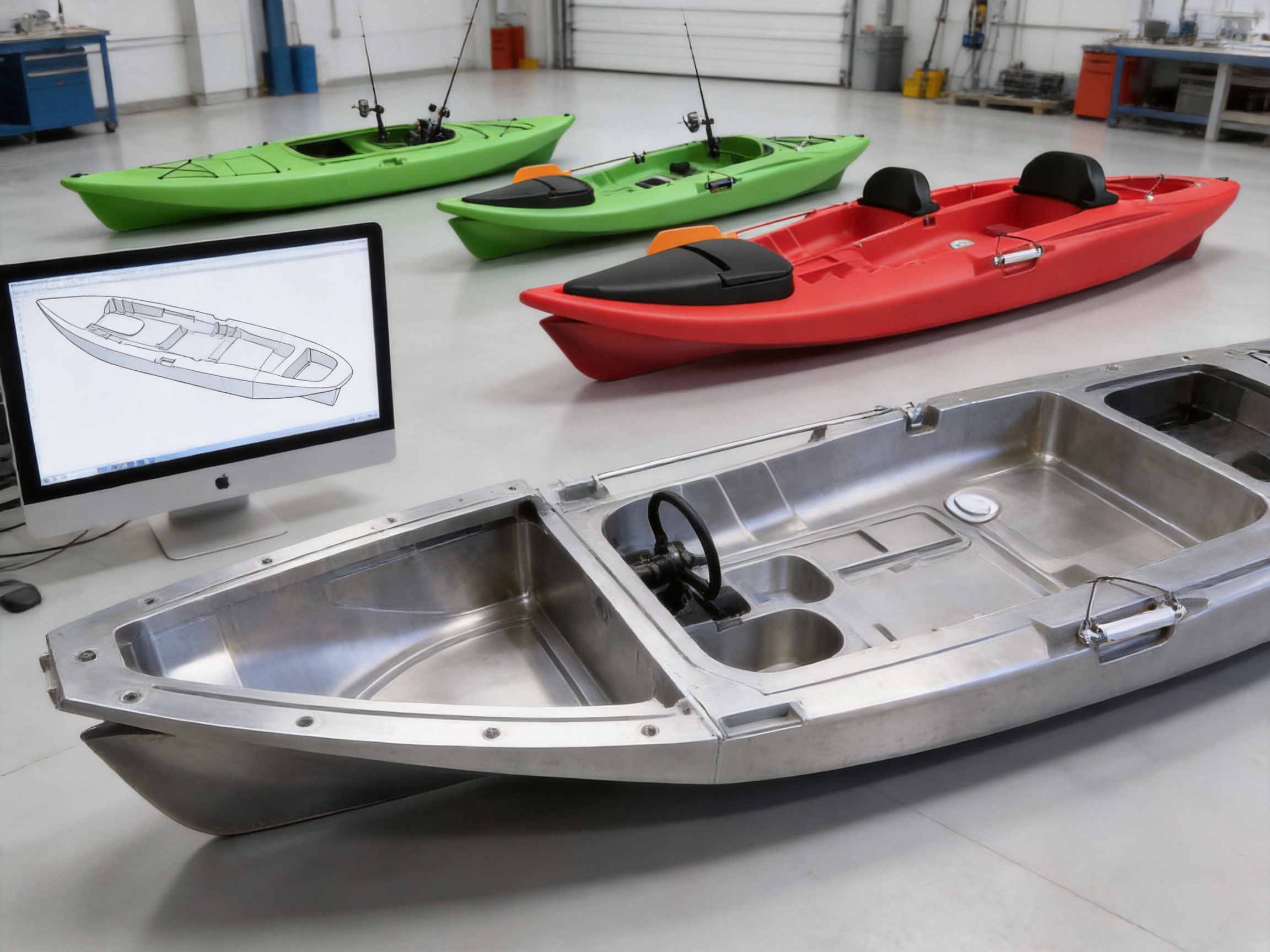
Material and Construction Advantages
The mold material must withstand repeated thermal and mechanical demands. During production, the tooling is exposed to heating, cooling, rotation, clamping forces, handling, and contact with resin. High-grade materials and appropriate construction methods help maintain service performance over many cycles.
Aluminum-based tooling is widely used in rotational molding because it can support efficient heat transfer and practical mold fabrication. Uniform thermal behavior helps the polyethylene resin fuse more consistently across the mold surface. The exact construction method should be selected according to product size, geometry, machine type, expected production volume, and desired surface quality.
For the kayak tooling described here, the manufacturing concept supports aluminum-based mold construction and precision-machined cavities. The provided technical specifications identify a target tolerance of approximately plus or minus 1.5 millimeters for CNC-machined mold geometry. Actual tolerances may depend on the design, measurement method, product size, and agreed project requirements, but precise machining remains essential for consistent hull reproduction.
The mold must also be strong enough to resist deformation during repeated cycles. A large kayak cavity can experience different stresses from heating, cooling, rotation, clamping, and handling. Reinforcing the correct areas improves stability while avoiding unnecessary mass that could slow thermal response or increase machine load.
Thermal Performance
Thermal performance affects the quality of the final kayak. The mold must allow heat to reach the resin effectively and support controlled cooling after fusion. Uneven thermal behavior may contribute to variations in wall thickness, incomplete fusion, distortion, or residual stress.
The mold design should be evaluated together with the oven, heating method, rotation speed, cycle time, resin type, and product geometry. A tooling solution that performs well on one machine may require adjustment when transferred to a different production system. Machine compatibility should therefore be confirmed before manufacturing begins.
Long-Term Service Life
A production mold is an investment that should support stable manufacturing over an extended service period. The service life depends on mold construction, operating conditions, maintenance, handling, cleaning, closure care, and process control.
High-quality tooling can maintain surface quality and dimensional accuracy over thousands of cycles when it is operated correctly. Routine inspection should include closure condition, vent condition, surface wear, reinforcement, hinges, fasteners, and any areas exposed to repeated mechanical stress.
Maintenance advice should be provided as part of the tooling service. Operators should follow suitable cleaning procedures and avoid actions that may damage the mold surface. Early identification of wear or alignment problems can prevent larger defects and reduce unplanned downtime.
Compatibility with Gas-Heated and Electric-Heated Machines
Rotational molding equipment may use conventional gas heating or electric heating. Both systems can support kayak production, but the tooling and process should be matched to the characteristics of the selected machine.
Gas-heated rotational molding remains widely used for large hollow plastic products. It offers established equipment compatibility and flexibility for many production environments. A properly engineered kayak mold can be designed to operate on conventional equipment when the heating profile, rotation pattern, and cooling process are correctly established.
Electric-heated rotational molding provides opportunities for more precise thermal management. Independent heating zones can help address products with complex geometry or different thermal requirements across the mold. The available information indicates that the company's electric-heating technology can achieve temperature control accuracy of approximately one to two degrees Celsius under suitable conditions.
More precise heating may help manufacturers manage long hulls, deep recesses, curved transitions, and integrated features. However, electric heating does not remove the need for sound mold design. The mold material, wall configuration, venting, reinforcement, and thermal behavior must still be evaluated together.
Jiangsu Zhroto Mould Co., Ltd. has invested in electric-heated rotational molding technology since 2023. Its tooling and technical solutions are intended to support both conventional gas-heated systems and newer electric-heating systems. This flexibility can benefit manufacturers who are upgrading equipment or operating different machine configurations within the same production program.
Benefits of Zoned Thermal Control
Zoned heating can help compensate for differences in product geometry. A thicker or deeper area may require different thermal exposure from a broad, shallow surface. Independent control allows the process engineer to refine the heating profile while maintaining the overall production cycle.
For a kayak mold, zoned control may be useful around cockpit structures, storage recesses, tall sidewalls, bow and stern transitions, and long central hull sections. The final process settings must be determined through testing, but the tooling should be capable of supporting the required thermal strategy.
Energy and Process Efficiency
Electric heating may improve energy efficiency by directing heat more precisely and reducing unnecessary thermal loss. It can also support more repeatable process control when the machine is properly configured. Better control may reduce trial-and-error adjustments and improve consistency across production batches.
Energy efficiency should be considered alongside cycle time, product quality, maintenance, equipment investment, and production volume. An integrated tooling supplier can help evaluate these factors before the customer commits to a particular production method.
Advanced Manufacturing Process
The manufacturing process for a custom kayak mold should be organized into clear stages. Each stage affects the accuracy and reliability of the final tooling. Jiangsu Zhroto Mould Co., Ltd. provides an integrated workflow intended to connect product design, mold engineering, production, testing, and technical support.
Stage One: Product and Application Evaluation
The process begins with a review of the kayak's intended use, dimensions, user configuration, functional features, material, machine type, target output, and quality requirements. This stage helps identify possible manufacturing issues while changes are still easy to make.
The evaluation should consider whether the kayak is intended for recreation, fishing, touring, tandem use, rental operations, or another specialized application. Hull width, length, seating, storage, handles, mounting points, and cockpit arrangements should be reviewed together rather than separately.
Stage Two: Product Optimization
A product concept may look attractive in a drawing but still contain features that are difficult to form or release. Product optimization adapts the design to the behavior of rotational molding. This may involve adjusting corner radii, recess depth, wall transitions, draft, parting locations, or accessory positions.
Optimization at this stage can reduce later tooling modifications and improve the balance between appearance, function, durability, and production efficiency. It also helps manufacturers avoid designing a kayak that performs well in theory but creates unnecessary process difficulty.
Stage Three: Three-Dimensional Engineering
Three-dimensional CAD engineering converts the approved product concept into detailed tooling data. Engineers can review the mold cavity, closures, reinforcement, vents, handling structures, parting areas, and machine interface.
Three-dimensional review is valuable for large kayak molds because it allows the team to examine the complete structure before machining begins. Potential interference, insufficient access, unsuitable release direction, and support conflicts can be identified digitally.
Stage Four: Mold Confirmation
Before production, the tooling design should be confirmed with the customer. Important points include product dimensions, material, machine configuration, heating method, expected cycle, accessory locations, surface requirements, and inspection criteria.
Design confirmation helps ensure that the mold reflects the customer's actual production objectives. It also creates a clear technical reference for manufacturing and later sample validation.
Stage Five: Precision Manufacturing
After confirmation, the mold is manufactured using appropriate machining, forming, welding, assembly, surface treatment, and inspection processes. CNC machining supports accurate reproduction of complex hull surfaces and functional details.
Manufacturing quality depends on both equipment and process discipline. The mold must be inspected during construction rather than only at the end. Surface condition, alignment, closure accuracy, dimensions, reinforcement, and venting should be checked at suitable stages.
Stage Six: Trial Production
A mold trial confirms how the tooling performs under actual rotational molding conditions. The trial may examine resin loading, heating, biaxial rotation, cooling, opening, demolding, trimming, and finished product quality.
Trial production can reveal issues that are not visible in the design model. These may include local wall variation, difficult release, unexpected flash, deformation, incomplete fusion, or the need for process adjustments. Refining these points before delivery helps improve production readiness.
Stage Seven: Inspection and Delivery
Inspection verifies that the mold and trial product meet the agreed technical requirements. Depending on the project, inspection may include dimensional checks, surface review, closure verification, sample weight, wall assessment, functional feature confirmation, and visual quality evaluation.
After acceptance, the tooling is prepared for delivery. Production support and maintenance guidance help the customer integrate the mold into regular manufacturing operations.
Stage Eight: Technical Support
Long-term technical support may include process recommendations, mold maintenance advice, troubleshooting, production parameter adjustment, and guidance for future product modifications. This support is particularly valuable for customers developing a new kayak range or adopting electric-heated rotational molding for the first time.
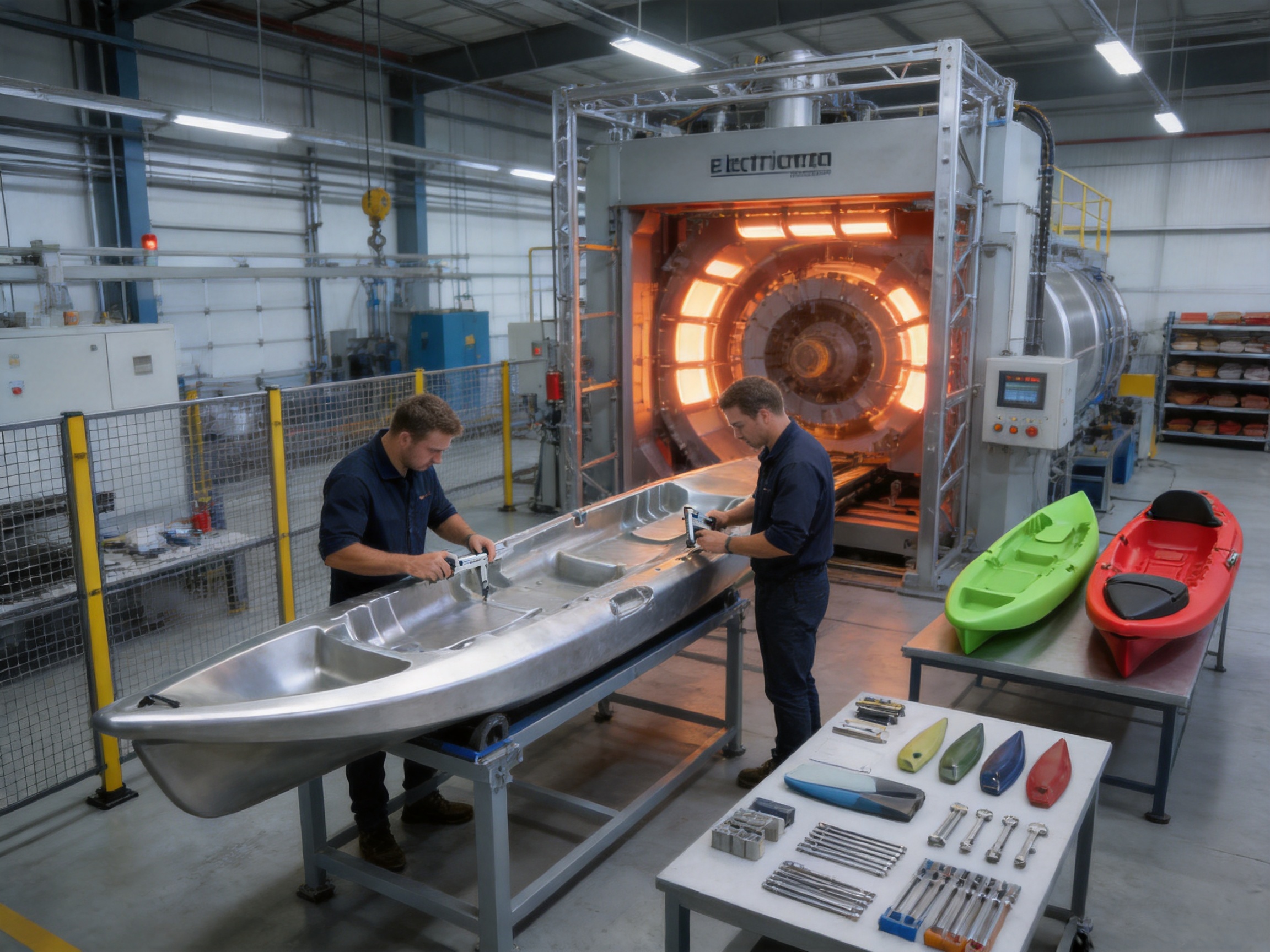
Engineering and Performance Advantages Compared with Basic Tooling
The primary advantage of this custom kayak mold is that it is developed around the final product and the production system. Basic tooling may focus only on creating a cavity, while professional tooling considers geometry, thermal behavior, release, machine compatibility, structural support, and long-term maintenance.
One important advantage is seamless one-piece construction. By supporting a continuous rotationally molded body, the tooling helps reduce weld lines and joining operations that can become potential leakage or failure points. This is particularly relevant for kayaks exposed to water, impact, transport, and outdoor use.
A second advantage is improved dimensional consistency. Precision-machined cavities and stable mold construction help reproduce the approved hull shape from one cycle to the next. Consistency is important for product performance and for the installation of seats, hatches, fittings, and accessories.
A third advantage is design flexibility. The mold can be customized for single-person recreational kayaks, fishing models, touring vessels, tandem products, and specialized watercraft. Manufacturers can adjust hull length, deck shape, storage features, cockpit layout, accessory positions, and ergonomic details according to market requirements.
A fourth advantage is compatibility with different heating technologies. Tooling can be developed for conventional gas-heated machines as well as electric-heated rotational molding systems. This gives manufacturers greater flexibility when selecting equipment, expanding capacity, or modernizing production.
A fifth advantage is integrated project management. Product design optimization, CAD engineering, tooling manufacturing, trial production, inspection, and technical support are coordinated through one service process. This can reduce communication gaps between product designers, mold builders, and production teams.
A sixth advantage is suitability for large and complex products. The capability to manufacture large curved tooling supports kayaks up to approximately five meters in length. Large mold engineering requires careful attention to structure, thermal behavior, handling, and dimensional stability, all of which are addressed during the tooling process.
Company Manufacturing Strengths
Jiangsu Zhroto Mould Co., Ltd. was founded in 2015 and specializes in rotational molding mold design, manufacturing, rotomolded product processing, and integrated technical solutions. The company moved to a modern facility in Jiangyan District, Taizhou City, in 2021.
The facility covers approximately 18,000 square meters, including more than 12,000 square meters of standardized production workshops. This production environment supports organized tooling manufacturing, machining, assembly, inspection, and product processing.
The company's annual mold output exceeds 800 sets. Its plastic product processing capacity exceeds 3,600 tons. These capabilities indicate experience in managing both tooling projects and larger-scale rotomolded product requirements.
The company's products serve multiple industries, including hydrogen energy storage and transportation, automotive components, industrial equipment, agricultural machinery, water treatment, outdoor facilities, and other applications. Experience across these sectors can support broader understanding of structural design, hollow product manufacturing, material behavior, and quality control.
Management systems include ISO 9001:2015 quality management certification, ISO 14001:2015 environmental management certification, and ISO 45001:2018 occupational health and safety certification. These systems provide a framework for managing quality, environmental responsibilities, workplace safety, and production procedures.
For kayak manufacturers, the company's broad rotational molding experience can be valuable because watercraft tooling often requires both product-specific creativity and disciplined production control. The ability to connect design, machining, trial production, and finished product processing helps create a more complete tooling solution.
Quality Control for Kayak Tooling
Quality control should begin during design and continue through the entire mold life cycle. Waiting until the final inspection to identify problems can result in expensive modifications or delayed production. Early review creates more opportunities to correct issues efficiently.
Dimensional inspection confirms that the mold matches approved engineering data. Surface inspection identifies machining marks, unwanted irregularities, and areas that may affect the kayak's appearance. Closure inspection verifies that the mold can be secured consistently during heating and rotation.
Trial production provides important information about actual product quality. The trial kayak should be reviewed for dimensions, weight, surface appearance, wall consistency, structural features, trimming requirements, and release performance. If necessary, the process can be adjusted before production approval.
Quality control should also consider repeatability. One acceptable sample does not automatically prove that a mold will perform consistently over an extended run. Production parameters, resin loading, heating conditions, rotation, cooling, and operator procedures should be documented and controlled.
Maintenance inspections help preserve the mold after delivery. Operators should monitor the condition of closures, hinges, vents, fasteners, reinforcement, surfaces, and handling points. Any damage or abnormal wear should be addressed before it affects finished kayak quality.
Recommended Mold Evaluation Checklist
Manufacturers evaluating a custom kayak mold should first confirm the intended product category and user environment. A fishing kayak, recreational kayak, touring kayak, and tandem kayak may require different tooling features even when they share the same general rotational molding process.
The hull and deck geometry should be reviewed for water performance, comfort, storage, structural requirements, and manufacturing feasibility. Special attention should be given to deep recesses, sharp corners, long unsupported sections, undercuts, and integrated accessory features.
Machine compatibility should be confirmed before tooling construction. The mold dimensions, weight, handling system, closure configuration, heating method, oven capacity, and rotation equipment must work together.
Material behavior should also be considered. The selected polyethylene resin, powder quantity, color, additives, and processing temperature can influence the required cycle and tooling performance.
The project should include a clear plan for trial production and inspection. Acceptance criteria should cover appearance, dimensions, weight, wall consistency, release performance, and functional details.
Finally, the customer should establish a maintenance and technical support plan. A well-built mold can provide long service, but its performance depends on correct operation, cleaning, inspection, and repair.
Applications of Rotomolded Kayak Tooling
Custom kayak molds can support many commercial product strategies. Recreational equipment brands can develop stable entry-level models for beginners and rental operators. Fishing equipment companies can create specialized platforms with storage and mounting features. Touring brands can produce longer vessels for extended trips. Outdoor product manufacturers can add tandem kayaks for families, resorts, and organized activities.
The same tooling development principles can also be applied to specialized watercraft. These may include utility kayaks, training kayaks, expedition-oriented designs, sit-on-top products, and customized vessels for institutional or commercial use.
Because rotational molding permits hollow one-piece construction, manufacturers can develop products that balance durability, practical weight, impact resistance, and cost. The mold remains the central tool for translating these product objectives into repeatable production.
Frequently Asked Questions
Q1: What is a rotational kayak mold?
A rotational kayak mold is a closed forming tool used to produce hollow polyethylene kayaks through controlled heating and biaxial rotation. Resin is loaded into the mold, melted against the internal cavity, cooled into a continuous shell, and then removed for finishing.
Q2: Why is one-piece rotational molding suitable for kayaks?
One-piece rotational molding can create a continuous hollow body with fewer seams and joining operations. This supports watertight construction, practical impact resistance, consistent appearance, and efficient production of recreational, fishing, touring, and tandem kayaks.
Q3: Can the mold produce different kayak sizes?
The tooling concept can be customized for different product dimensions. The described application range includes approximately three-meter single-person recreational kayaks and five-meter tandem touring kayaks. Each product size and geometry requires its own engineering review and mold configuration.
Q4: Can the tooling include fishing features?
Yes. Custom tooling can include integrated or molded features such as rod holders, storage recesses, equipment mounting areas, seat positions, handles, footrests, and other functional details. These features must be designed for material distribution and efficient release.
Q5: What materials are commonly used for this type of mold?
Aluminum-based tooling is commonly used for rotational molding because it can provide practical thermal transfer, suitable machinability, and useful dimensional performance. The final material and construction method should be selected according to mold size, product geometry, machine type, and production volume.
Q6: Can the mold work with electric-heated rotational molding machines?
Yes. The tooling can be engineered for electric-heated systems as well as conventional gas-heated machines. Electric heating may provide more precise temperature control and independent heating zones, but the mold structure and process settings must be matched to the selected equipment.
Q7: What is the benefit of CNC machining for kayak molds?
CNC machining helps reproduce complex hull curves, deck surfaces, cockpit areas, and functional details with consistent accuracy. It supports dimensional repeatability and improves the ability to manufacture multiple kayaks with similar geometry.
Q8: How does custom tooling compare with a standard mold?
Custom tooling is developed around the customer's product, production equipment, resin, functional requirements, and target output. A standard mold may offer faster initial selection, but it may not provide the same level of dimensional control, feature integration, thermal compatibility, or design flexibility.
Q9: What should be checked during mold trials?
Mold trials should evaluate resin loading, heating, rotation, cooling, opening, demolding, trimming, surface appearance, dimensions, weight, wall consistency, functional details, and overall product stability. Trial results can be used to refine production parameters before approval.
Q10: How can mold service life be extended?
Service life can be supported through correct operation, appropriate heating and cooling, careful handling, regular cleaning, closure inspection, vent maintenance, surface protection, and timely repair of damaged or worn components. Operators should follow the supplier's maintenance recommendations.
Q11: What services does Jiangsu Zhroto Mould Co., Ltd. provide?
The company provides project consultation, product design optimization, three-dimensional engineering, mold design confirmation, precision manufacturing, material and process recommendations, trial production, quality inspection, delivery, production support, and maintenance guidance.
Q12: What industries does the company serve?
The company's rotational molding capabilities serve watercraft and outdoor products as well as hydrogen energy storage and transportation, automotive components, industrial equipment, agricultural machinery, water treatment, and other industrial applications.
Conclusion
A high-quality kayak mold is essential for manufacturers seeking dependable one-piece rotationally molded watercraft. The mold influences hull accuracy, wall consistency, surface quality, thermal performance, release efficiency, and long-term production stability. Tooling that is designed only as a basic cavity may not address the complex requirements of large hollow kayaks.
The custom tooling approach described here supports recreational, fishing, touring, and tandem kayak production. It accommodates product lengths from approximately three to five meters and can be developed for both conventional gas-heated and electric-heated rotational molding systems.
Its main advantages include seamless one-piece construction, dimensional stability, smooth surface reproduction, flexible product customization, CNC-machined accuracy, durable mold construction, and compatibility with integrated production services. These features can help manufacturers improve product consistency while reducing joining operations, quality risks, and long-term tooling difficulties.
Jiangsu Zhroto Mould Co., Ltd. combines rotational molding experience, modern workshop facilities, precision manufacturing, trial validation, quality systems, and technical support. By connecting product design with mold engineering and production assistance, the company provides a practical path from kayak concept to repeatable commercial manufacturing.
For manufacturers developing new watercraft, the best results begin with early tooling evaluation. Hull geometry, product function, material, machine type, heating method, production volume, and quality standards should all be considered before mold construction. When these factors are coordinated, a custom rotational kayak mold can become a reliable production asset and a strong foundation for competitive watercraft manufacturing.
References
1. ASTM International. Standard practices and test methods related to rotational molding, plastic materials, and finished polymer products.
2. Association of Rotational Molders. Technical guidance on rotational molding process control, mold design, heating, cooling, and material distribution.
3. ISO 9001:2015. Quality management systems and requirements for consistent product and service provision.
4. ISO 14001:2015. Environmental management systems and related operational controls.
5. ISO 45001:2018. Occupational health and safety management systems.
6. Technical information supplied for custom one-piece rotational kayak mold design and manufacturing.
7. Technical information supplied for Jiangsu Zhroto Mould Co., Ltd. rotational molding equipment, manufacturing capabilities, and integrated services.
Product: Kayak mold


We provide customers with one-stop services ranging from product design, mold manufacturing to finished product production.
-
 +86-18006248936
-
 ricky.t@zhroto.com
-
 No.9 Jiangyuan Road, Luotang Street, Jiangyan District, Taizhou City,Jiangsu Province, China
Copyright © Jiangsu Zhroto Mould Co., Ltd. Rights Reserved.Custom Rotational Plastic Molding Factory
