
 English
 中文简体
中文简体 русский
 Español
Military box mold


 ricky.t@zhroto.com
 +86-18006248936
Hydrogen energy is moving from research facilities into transportation, industrial power, backup energy, and distributed storage systems. As this transition accelerates, manufacturers need production tools that can support consistent, repeatable, and safety-oriented component manufacturing. A hydrogen gas cylinder rotational molding mold is one such specialized tool. It is designed to produce hollow plastic cylinder components, including liners, outer shells, protective casings, and prototype vessels used in hydrogen-related storage systems.
This article focuses on the product characteristics, manufacturing value, structural advantages, production applications, and technical strengths of a hydrogen gas cylinder rotational molding mold. It also explains how advanced mold-making capability, precision machining, engineering design, and experienced production support help manufacturers achieve better consistency than with general-purpose hollow container molds.
Hydrogen Gas Cylinder Rotational Molding Mold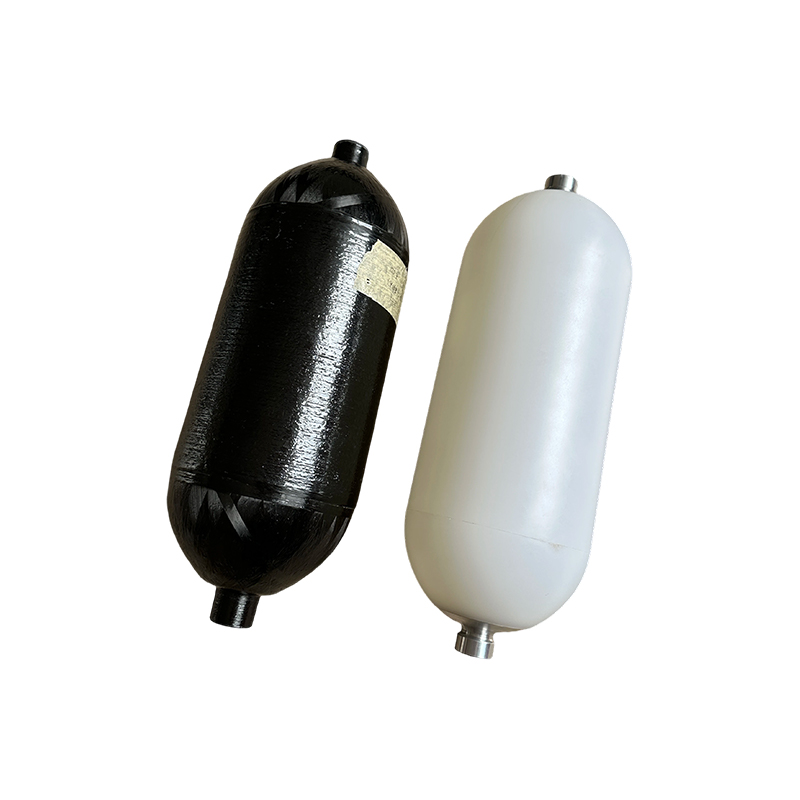
A hydrogen gas cylinder rotational molding mold is a precision-engineered mold used in the rotational molding process to form hollow plastic cylindrical parts. Unlike simple molds for water tanks or general containers, this type of mold is designed around the specific geometry, dimensional stability, wall thickness control, and surface requirements associated with hydrogen storage-related products.
Rotational molding, also known as rotomolding, is a manufacturing process in which polymer powder is placed inside a mold, heated while rotating on multiple axes, melted against the interior mold surface, and then cooled to form a hollow product. The process is especially suitable for producing seamless hollow structures with complex shapes, large sizes, and controlled wall thickness.
In hydrogen gas cylinder applications, the mold is not merely a forming tool. It directly influences the uniformity, reliability, and repeatability of the molded part. Uniform wall thickness is important because uneven material distribution can cause localized stress, deformation, weak areas, or performance inconsistency. A well-designed rotational molding mold helps the polymer flow and fuse evenly, resulting in stable hollow cylinder components.
This product is suitable for medium- to large-scale production environments where consistent output, reliable mold closure, long service life, and efficient operation are critical. It can be customized for different cylinder lengths, diameters, wall thickness requirements, and surface finish needs. It is compatible with common rotomolding-grade polymers such as HDPE and XLPE, depending on project requirements.
Hydrogen-related applications require higher attention to product quality than many ordinary plastic hollow products. Hydrogen is lightweight, highly diffusive, and often stored under demanding conditions in engineered systems. Although the rotationally molded part may serve as a liner, protective shell, casing, or prototype component rather than a complete high-pressure pressure vessel by itself, its dimensional accuracy and material uniformity still matter.
For manufacturers working with hydrogen cylinders, poor mold design can result in inconsistent wall thickness, weak fusion, surface defects, excessive warpage, or difficulty during demolding. These issues may increase rejection rates and reduce production efficiency. A general hollow container mold may be acceptable for basic storage tanks, but hydrogen-related cylindrical components benefit from tighter mold geometry, reinforced construction, accurate closure, and controlled thermal behavior.
A hydrogen gas cylinder rotational molding mold is therefore engineered to support a more demanding production standard. The mold must withstand repeated heating and cooling cycles while maintaining dimensional accuracy. It must allow uniform material distribution along the cylinder body, dome areas, ends, transitions, and any integrated features. The internal surface must be smooth enough to support proper polymer fusion and demolding. The closure system must remain stable during biaxial rotation, and the mold structure must resist deformation under thermal cycling.
In competitive manufacturing, the difference between a general mold and a specialized mold becomes visible through production stability. A mold with optimized design can reduce the need for repeated parameter adjustments, shorten trial time, improve product consistency, and support long production cycles. These benefits directly affect cost, delivery reliability, and customer confidence.
The hydrogen gas cylinder rotational molding mold provides several advantages over standard storage tank molds and general hollow container molds. These advantages are especially important for manufacturers that require stable production of cylindrical hollow components with higher safety expectations.
One of the most important advantages is improved wall thickness control. Rotational molding relies on powder movement, heating time, mold geometry, rotational speed, and material behavior. If the mold is not properly designed, powder may accumulate unevenly, especially around corners, ends, ribs, neck regions, and transition areas.
This mold is designed with cylinder-specific geometry to promote more even material distribution. The result is a molded part with improved wall uniformity, more predictable mechanical behavior, and better dimensional consistency. In hydrogen storage-related applications, uniformity helps reduce localized weak points and supports stable structural performance.
Dimensional accuracy is essential when a molded cylinder component must integrate with valves, composite layers, metal fittings, protective frames, or external assemblies. The mold is manufactured with attention to diameter, length, roundness, closure line accuracy, and overall shape control. Precision machining and inspection help ensure that the molded products remain within the required specification range.
Compared with general-purpose molds, this specialized mold is better suited for applications where consistent cylinder volume, stable geometry, and repeatable component fit are required. This improves downstream assembly efficiency and reduces the risk of rework.
Rotational molding involves repeated exposure to high temperatures followed by controlled cooling. Over time, poorly built molds may experience deformation, closure misalignment, surface degradation, or structural fatigue. The hydrogen gas cylinder rotational molding mold is reinforced to withstand repeated heating and cooling cycles, making it suitable for continuous or high-frequency industrial production.
Robust construction helps maintain mold accuracy over a longer service life. It also reduces maintenance frequency and supports more predictable production scheduling. For manufacturers producing medium or large batches, durability is a significant cost advantage.
A smooth internal mold surface supports uniform polymer fusion and improves the final surface quality of the molded part. For cylinder liners and protective casings, surface consistency can affect assembly, sealing interfaces, cleaning, and inspection. Optional surface treatments may be selected depending on product requirements.
The internal mold surface is engineered for cylindrical hollow products, reducing unnecessary turbulence in material movement and helping avoid surface irregularities. Better surface control can also make demolding easier and reduce part damage during removal.
Hydrogen storage systems vary widely according to application, pressure class, installation method, protective structure, and production scale. Therefore, mold customization is often necessary. This mold can be tailored for cylinder diameter, length, wall thickness design, surface finish, structural reinforcement, opening configuration, and compatibility with automated or semi-automated rotational molding equipment.
Customization allows manufacturers to build a production tool aligned with their exact product development goals rather than adapting a generic mold. This is especially valuable for prototype hydrogen storage vessels, protective casings for composite tanks, and specialized industrial gas storage containers.
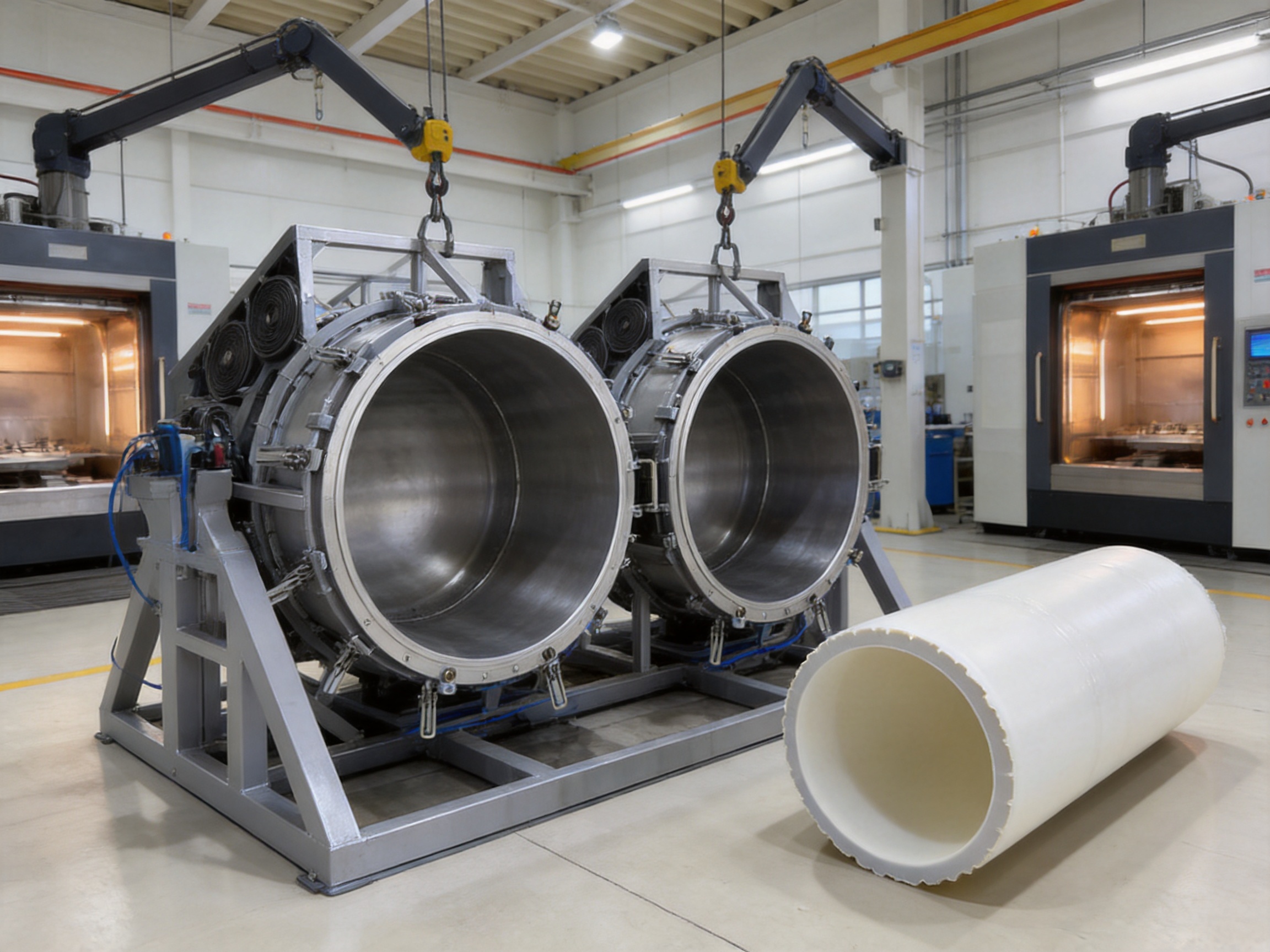
The following comparison highlights how a hydrogen gas cylinder rotational molding mold differs from standard storage tank molds and general hollow container molds.
| Comparison Item | Hydrogen Gas Cylinder Rotational Molding Mold | Standard Storage Tank Rotational Mold | General Hollow Container Mold |
|---|---|---|---|
| Target Product | Hydrogen cylinder liners, outer shells, protective casings, and prototype vessels | Water tanks, chemical tanks, and liquid storage tanks | General hollow plastic products |
| Geometry Focus | Cylinder-specific design with attention to roundness and axial consistency | Tank geometry with basic capacity and shape requirements | Broad shapes with moderate precision needs |
| Wall Thickness Control | Excellent, optimized for uniform distribution along cylinder body and ends | Good, generally suitable for liquid storage applications | Moderate, depending on shape complexity |
| Dimensional Accuracy | High, suitable for integration with hydrogen-related assemblies | Medium to high depending on tank design | Medium for general-use products |
| Safety-Oriented Requirements | Very high, with emphasis on defect reduction and stress consistency | High for storage reliability | Standard commercial requirements |
| Customization Level | High, including size, wall design, surface finish, and production-line compatibility | Medium, usually based on tank capacity and installation needs | Low to medium, depending on product category |
| Production Stability | Excellent for repeated long-cycle industrial production | Good for routine tank production | Good for ordinary hollow components |
| Recommended Use | Hydrogen energy, industrial gas, specialized cylinder components, and prototypes | Liquid storage and standard industrial tanks | General plastic hollow products |
This comparison shows that the hydrogen gas cylinder rotational molding mold is not simply a standard cylindrical mold. It is designed for higher reliability, more accurate production, and more specialized applications. Its value is strongest when a manufacturer needs a stable mold for safety-focused components and repeatable output.
The quality of a rotational molding mold depends not only on its design concept but also on the manufacturing process used to produce it. A well-established mold manufacturer with CNC machining capability, experienced engineers, and quality management systems can deliver molds with better precision, durability, and production readiness.
Jiangsu Zhuohe Mould Co., Ltd. has developed as a one-stop rotational molding mold and product supplier with many years of experience in mold research, design, and production. The company operates a modern factory covering more than 12,000 square meters and is equipped with multiple CNC centers, including a five-axis CNC center, as well as rotational molding machines for testing and production support. This combination of design, machining, mold assembly, trial production, and product manufacturing gives the company strong practical insight into what makes a mold perform reliably in real industrial conditions.
The manufacturing process begins with engineering design. For a hydrogen gas cylinder rotational molding mold, the design stage includes cylinder geometry analysis, wall thickness targets, mold splitting strategy, heating behavior, demolding direction, reinforcement layout, closure structure, and compatibility with rotational molding equipment.
The engineering team considers how polymer powder will move during rotation, where heat will accumulate, where wall thickness could become too thin or too thick, and how cooling may affect shrinkage and dimensional stability. Mold geometry is optimized to reduce defects such as voids, uneven fusion, weak points, and surface irregularities.
Compared with competitors that may rely on simple mold drawings or generic tank designs, a manufacturer with practical rotomolding production experience can improve the mold design based on actual process behavior. This helps reduce trial-and-error during customer production and shortens the time needed to reach stable output.
Precision machining is a major factor in mold quality. CNC centers allow accurate shaping of mold surfaces, flanges, parting lines, closure areas, and integrated features. Five-axis CNC capability is especially valuable for complex geometries and smooth transitions, because it can machine difficult angles and curved surfaces with higher accuracy.
For hydrogen cylinder components, roundness and smooth internal contours are important. CNC machining helps achieve consistent dimensions and surface quality, which directly influence the final molded product. Accurate parting lines and stable closure features reduce the risk of flash, mismatch, and deformation during rotation.
High-quality CNC manufacturing also improves repeatability when multiple molds are required for large production programs. If a customer needs several molds with the same specification, consistent machining ensures that each mold produces comparable parts.
The mold structure must remain stable during repeated heating and cooling. Reinforcement design is used to prevent distortion, especially in long cylindrical molds. Thermal stability is essential because even small mold deformation can lead to inconsistent wall thickness, poor closure, or dimensional drift in the molded product.
Reinforced mold construction gives the product an advantage over lightweight or insufficiently supported molds. A cheaper mold may reduce initial purchase cost, but it may require more frequent repair, produce unstable parts, or fail prematurely under continuous operation. A robust mold offers better long-term value through reduced downtime and improved service life.
After machining and structural fabrication, the mold must be assembled and inspected. Closure alignment, flange fit, internal surface condition, venting arrangement, and demolding features must be checked carefully. For a specialized cylinder mold, inspection helps confirm that the mold will perform as intended during biaxial rotation.
A manufacturer equipped with rotational molding machines can also provide practical trial support. Trial production helps validate heating parameters, material distribution, demolding performance, and final part dimensions. This capability is a significant advantage because mold performance is best confirmed under real process conditions, not only through design drawings.
The hydrogen gas cylinder rotational molding mold is suitable for commonly used rotomolding-grade polymers, including HDPE and XLPE. Material selection depends on the intended application, required strength, chemical resistance, thermal behavior, and customer specifications.
HDPE is widely used in rotational molding because it offers good toughness, processability, impact resistance, and cost efficiency. It is often selected for protective shells, storage components, and industrial hollow products. XLPE, or cross-linked polyethylene, can provide improved thermal resistance, chemical resistance, and mechanical performance in certain applications, though processing requirements may differ from standard polyethylene grades.
For hydrogen storage-related components, material selection must be evaluated carefully according to product function. If the molded part is a protective casing, outer shell, or liner component, the polymer requirements may differ from those of a complete pressure vessel system. The mold supports the production of hollow plastic components, while final product performance should be validated according to applicable standards, testing protocols, and engineering requirements.
Production flexibility is another advantage. The mold can be designed for standard rotational molding machines and can support automated or semi-automated production lines. This allows manufacturers to integrate the mold into existing production systems without unnecessary equipment changes. For companies scaling from prototype to batch production, this flexibility reduces investment risk and improves production planning.
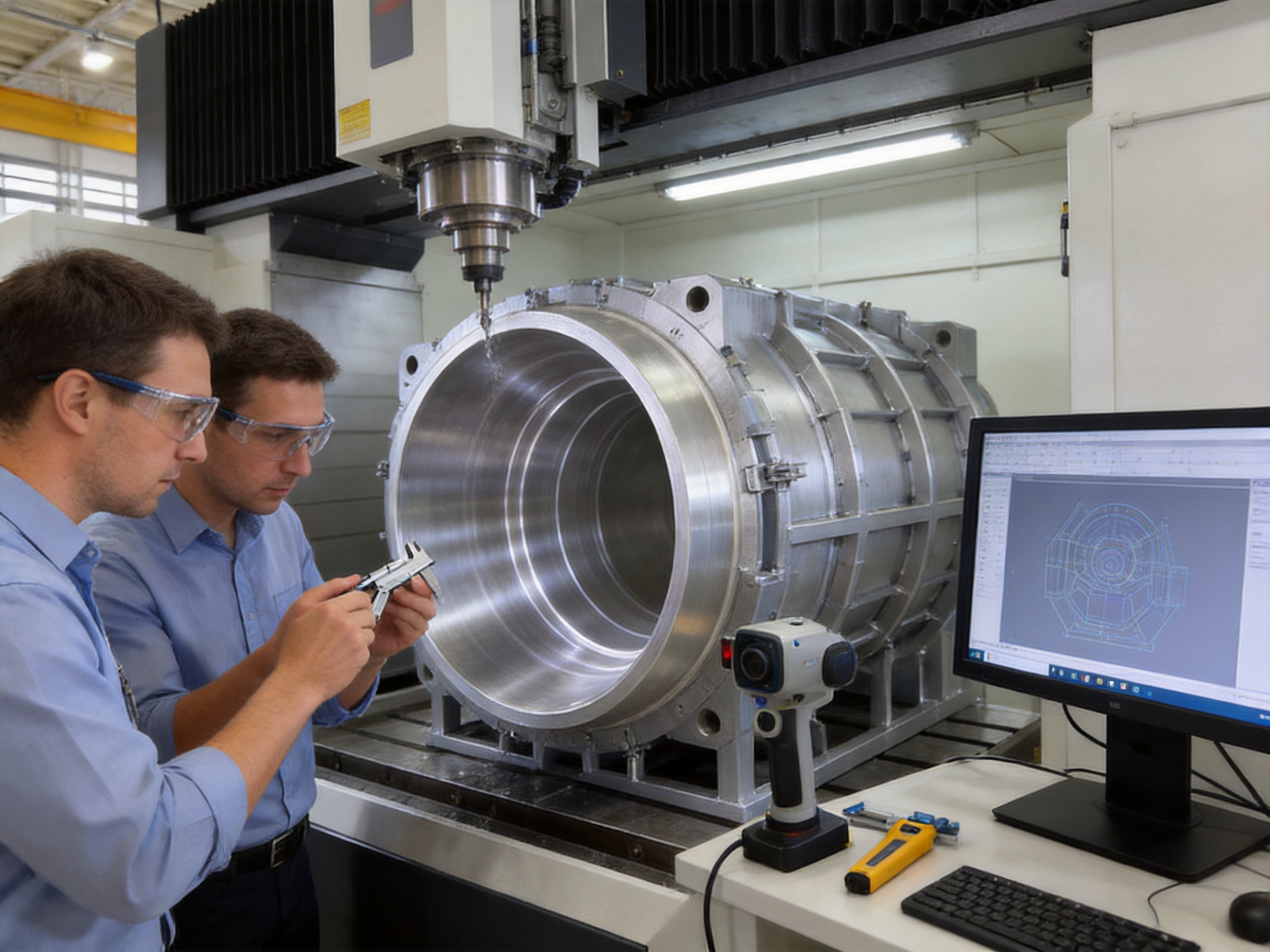
The hydrogen gas cylinder rotational molding mold can be used in several application areas. Its primary role is to produce hollow plastic cylinder components related to hydrogen gas storage and transportation systems.
Outer shells protect internal cylinder structures from physical impact, environmental exposure, abrasion, and handling damage. Rotational molding is well suited for producing seamless protective shells because it can form durable hollow structures with consistent wall thickness and integrated shapes.
A specialized mold ensures that the outer shell maintains proper fit around the cylinder system. Dimensional accuracy is important because the shell may need to align with mounting points, protective frames, valves, or end structures. A stable mold helps produce shells that are repeatable across batches.
Composite hydrogen tanks often require protective casings or covers to reduce exposure to external damage. Rotomolded plastic casings can provide impact resistance, corrosion resistance, and design flexibility. The hydrogen gas cylinder rotational molding mold can be customized to produce casings with required length, diameter, surface finish, and structural features.
Protective casings benefit from smooth internal surfaces and accurate dimensions, especially when they must fit around a composite cylinder without causing interference. A well-designed mold improves part consistency and helps reduce assembly problems.
Industrial gas storage and handling environments may require specialized hollow plastic containers, covers, or protective housings. Although not every application involves high-pressure hydrogen containment, many require reliable cylindrical components with strong durability and stable dimensions.
The mold’s reinforced construction and stable production behavior make it suitable for industrial conditions. Manufacturers can use it for repeated production cycles where consistent quality is required.
Research institutes, hydrogen technology developers, and equipment manufacturers often need prototype components before committing to full production. Rotational molding can be an efficient way to create hollow plastic prototypes, liners, and protective structures. A customizable hydrogen cylinder mold supports product development by allowing engineers to evaluate geometry, wall thickness, assembly fit, and material behavior.
Prototype molds may later be modified or upgraded for production. Working with a mold manufacturer that understands both trial production and industrial scaling can help shorten development cycles.
Safety-oriented design is central to hydrogen-related manufacturing. A rotational molding mold cannot replace system-level engineering validation, pressure testing, certification, or material compatibility evaluation. However, it can contribute significantly to product reliability by helping create molded components with uniform structure and fewer defects.
Uniform material distribution reduces the risk of thin zones and weak areas. Smooth internal surfaces reduce stress concentration points and improve inspection quality. Stable mold closure reduces mismatch and flash that could affect assembly or product function. Reinforced mold construction reduces dimensional drift during repeated cycles.
In hydrogen-related environments, every production variable should be controlled. The mold supports this goal by providing a stable foundation for repeatable manufacturing. When paired with proper material selection, process control, cooling management, inspection, and testing, the mold helps manufacturers produce components that meet demanding application needs.
A quality-focused mold manufacturer also provides value through management systems. Jiangsu Zhuohe Mould Co., Ltd. has passed ISO9001:2015 Quality Management, ISO14001:2015 Environmental Management, and ISO45001:2015 Occupational Health and Safety Management certifications. These certifications reflect attention to quality control, environmental responsibility, and workplace safety, which are important for customers seeking reliable long-term suppliers.
In a competitive mold market, buyers often compare suppliers based on price, lead time, machining capability, design experience, service support, and production stability. A hydrogen gas cylinder rotational molding mold provides advantages when supplied by a manufacturer with strong rotomolding specialization rather than a general metal fabrication workshop.
Rotational molding molds require process-specific knowledge. The mold designer must understand polymer powder movement, heating behavior, venting, cooling shrinkage, demolding, and wall thickness formation. A general mold supplier may machine a shape accurately but may not understand how that shape will perform inside a rotational molding oven.
With years of experience in rotomolding molds and products, the manufacturer can design molds based on real production knowledge. This reduces the risk of defects and improves the customer’s ability to reach stable production quickly.
A supplier that produces both molds and rotomolded products has a practical advantage. Product manufacturing experience reveals common mold problems that may not be obvious during design. For example, a technically correct drawing may still cause difficult demolding, uneven heating, excessive wall buildup, or inconsistent cooling. By combining mold-making and rotomolding production, the manufacturer can identify and solve such issues earlier.
This integrated capability supports better design decisions, more realistic process recommendations, and stronger after-sales technical support.
The company’s factory is equipped with 10 CNC centers, including a five-axis CNC center. This machining capacity supports accurate mold production, stable delivery, and complex custom designs. Advanced CNC capability is especially important for molds requiring precise cylindrical geometry, smooth transitions, reinforced structures, and high-quality parting lines.
Competitors relying on less advanced machining may struggle to maintain dimensional precision or may require more manual finishing, which can increase variation. CNC-based production improves repeatability and reduces uncertainty.
The company has an annual mold-making capacity of about 1,500 sets and produces more than 3,600 tons of rotomolded plastic products annually. This capacity indicates strong production organization and the ability to support both custom projects and larger manufacturing programs.
For customers planning long-term product development, supplier capacity matters. A supplier with limited production ability may become a bottleneck when multiple molds, urgent modifications, or batch production support are needed.
The company’s team has participated in projects related to major public events such as the 2008 Beijing Olympic Games and the 2010 Shanghai World Expo. Such experience reflects the ability to handle demanding project requirements, delivery coordination, and quality expectations.
In hydrogen energy applications, project reliability is important. Buyers need suppliers that can communicate clearly, understand technical requirements, and provide consistent manufacturing support.
Proper maintenance extends mold life and preserves product quality. The hydrogen gas cylinder rotational molding mold is designed for long service life, but routine care is still essential.
Regular cleaning prevents material residue, contamination, or buildup from affecting surface quality. Operators should inspect mold closure areas, bolts, flanges, vents, and lifting points before production. Heating cycles should be controlled to avoid unnecessary thermal stress. Cooling should be managed carefully because uneven cooling can affect both the mold and the molded product. Correct demolding practices help prevent surface scratches, deformation, or accidental damage.
Maintenance should also include periodic dimensional inspection, especially after long production runs. If the mold is used continuously in high-frequency production, operators should track cycle conditions, repair minor wear early, and maintain documentation for quality control.
Because the mold is reinforced and designed for repeated heating and cooling, it has low maintenance requirements compared with less robust molds. However, disciplined operation remains important for preserving accuracy and surface finish over extended use.
Every hydrogen-related product program has different requirements. The mold can be customized to match specific design needs and production plans.
Customization options may include adjustable cylinder diameter and length, wall thickness design support, optional surface finish treatments, reinforced mold structure, customized parting line arrangement, venting configuration, lifting and handling features, and compatibility with specific rotational molding machines.
The customization process usually begins with product requirements. Engineers evaluate the intended component function, material selection, production quantity, required dimensional tolerance, assembly interfaces, and expected operating environment. Based on this information, the mold structure is designed to support efficient production and reliable output.
For customers developing new hydrogen storage components, design support can be especially valuable. Mold engineers can recommend geometry adjustments that improve manufacturability, reduce defects, simplify demolding, and improve long-term production stability.
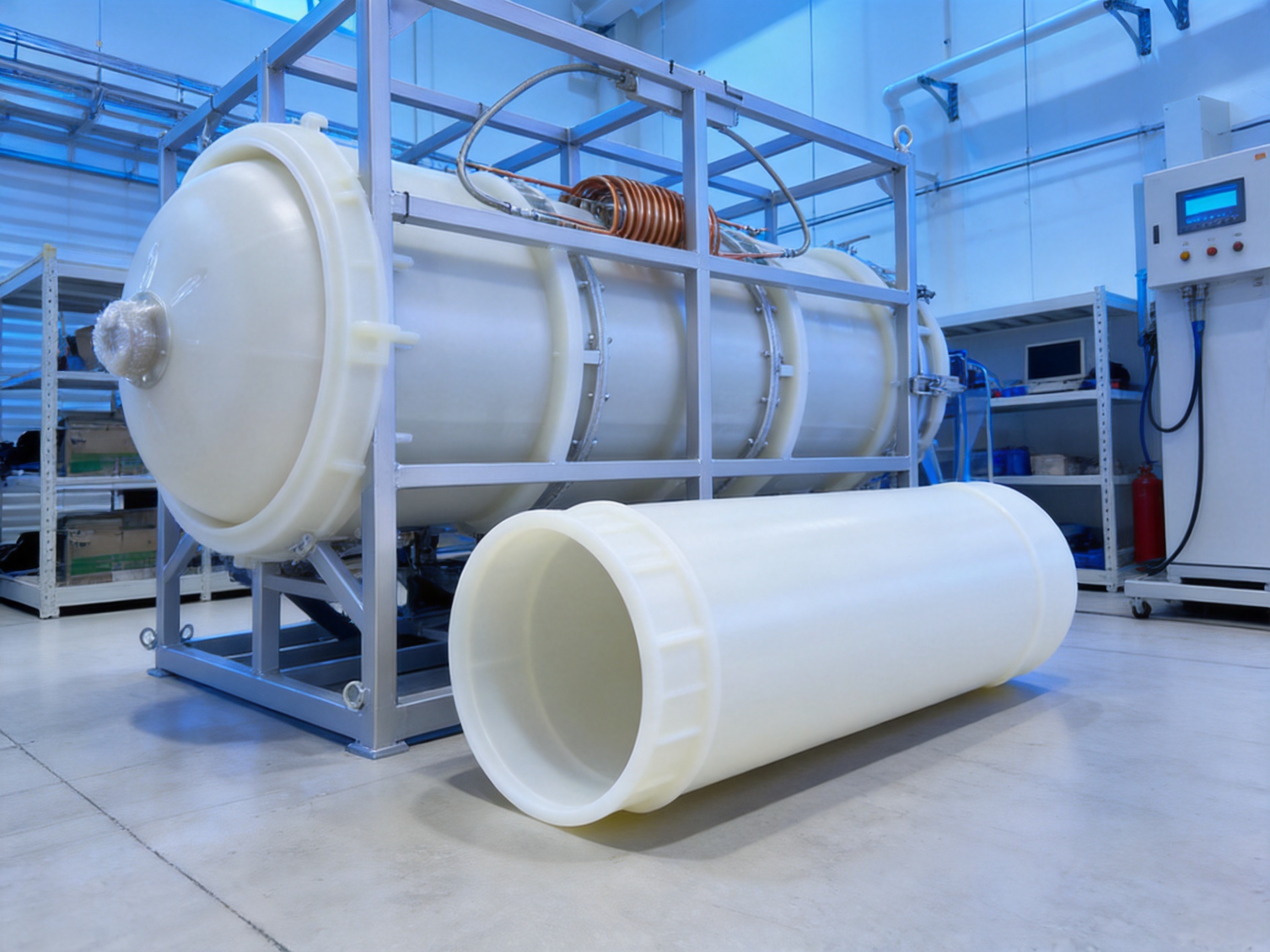
Production efficiency is not only about fast cycle time. It also includes stable yield, reduced scrap, lower maintenance, easy operation, repeatable quality, and smooth integration into existing equipment. A hydrogen gas cylinder rotational molding mold supports efficiency in several ways.
First, optimized geometry helps reduce wall thickness variation, which lowers the risk of rejected parts. Second, stable closure and reinforced construction reduce production interruptions caused by mold misalignment or deformation. Third, compatibility with standard rotational molding machines allows customers to use existing production lines. Fourth, smooth internal surfaces and well-planned demolding features improve operator efficiency and reduce damage during part removal.
In medium- to large-scale production, small improvements in each cycle can create significant long-term savings. A mold that produces consistent parts with fewer adjustments can reduce labor time, material waste, and delivery delays. This makes a precision-engineered mold more cost-effective than a low-cost mold that requires frequent correction.
Before ordering a hydrogen gas cylinder rotational molding mold, buyers should define their technical requirements clearly. The most important factors include cylinder dimensions, intended use, material type, expected wall thickness, annual production volume, required surface finish, integration with other components, and applicable testing standards.
It is also important to clarify whether the molded part is a liner, protective shell, casing, prototype, or other component. Different uses require different design priorities. A protective shell may focus on impact resistance and fit, while a liner may focus more on surface quality, dimensional control, and material compatibility.
Buyers should also discuss machine compatibility. Rotational molding machines vary in arm size, oven capacity, loading method, and rotation control. The mold should be designed to match the customer’s equipment to avoid installation issues.
Finally, buyers should consider trial production and validation. A mold supplier with testing capability can help confirm the initial process window and provide recommendations for heating time, cooling strategy, powder loading, and demolding methods.
The main purpose is to manufacture hollow plastic cylinder components used in hydrogen gas cylinder systems, such as liners, outer shells, protective casings, and prototype vessels. The mold helps ensure consistent wall thickness, dimensional stability, and reliable production performance.
A standard storage tank mold is generally designed for liquid storage tanks with moderate precision requirements. A hydrogen gas cylinder rotational molding mold is designed with cylinder-specific geometry, higher wall thickness control, improved dimensional accuracy, reinforced construction, and stronger attention to safety-oriented production quality.
The mold is suitable for common rotomolding-grade polymers such as HDPE and XLPE. Material selection should be based on the intended application, product function, mechanical requirements, chemical resistance, and validation standards.
Yes. The mold can be customized for diameter, length, wall thickness design, surface finish, parting structure, reinforcement, and machine compatibility. Customization allows the mold to match specific hydrogen cylinder component requirements.
Yes. The mold is designed to withstand repeated heating and cooling cycles and is suitable for continuous or high-frequency rotational molding operations. Reinforced construction and stable closure help maintain long-term production reliability.
The mold contributes to product quality by improving wall uniformity, dimensional consistency, and defect reduction. However, final hydrogen safety depends on the complete product design, material selection, manufacturing process, inspection, pressure testing, and compliance with applicable standards.
CNC machining improves dimensional accuracy, surface consistency, parting line quality, and repeatability. For cylindrical hydrogen-related components, accurate machining helps maintain roundness, fit, and stable wall thickness during production.
Routine maintenance includes cleaning the mold surface, checking closure systems and vents, controlling heating and cooling cycles, inspecting for wear or deformation, and using correct demolding practices. Proper maintenance helps preserve dimensional accuracy and extend service life.
Yes. It is suitable for experimental and prototype hydrogen storage components. Custom mold design allows engineers to test product geometry, wall thickness, material behavior, and assembly fit before scaling to larger production.
An experienced supplier understands both mold manufacturing and rotational molding production. This helps improve mold design, reduce defects, shorten trial time, and provide better technical support. Advanced equipment, quality systems, and production capacity further improve reliability.
A hydrogen gas cylinder rotational molding mold is a specialized production tool designed for demanding hollow cylinder applications in hydrogen energy and industrial gas fields. Its value lies in its ability to support uniform wall thickness, dimensional accuracy, structural stability, smooth surfaces, and repeated industrial production.
Compared with standard storage tank molds and general hollow container molds, this mold provides higher precision, stronger customization, better production stability, and greater suitability for safety-oriented hydrogen-related components. It is especially useful for manufacturing hydrogen gas cylinder outer shells, protective casings for composite tanks, industrial gas storage containers, and prototype hydrogen storage vessels.
The strengths of the manufacturer further enhance the product’s value. Advanced CNC machining, five-axis processing capability, integrated mold and product manufacturing experience, large production capacity, and certified quality management systems help ensure that the mold is not only accurately manufactured but also practical for real rotational molding production.
For manufacturers entering or expanding in the hydrogen energy sector, investing in a precision-engineered rotational molding mold can improve production reliability, reduce defects, and support long-term product development. With proper design, material selection, process control, and maintenance, the hydrogen gas cylinder rotational molding mold becomes a reliable foundation for producing high-quality hollow plastic components in a fast-growing industrial field.
1. Crawford, R. J., and Kearns, M. P. Practical Guide to Rotational Moulding. Smithers Rapra Publishing.
2. Strong, A. B. Plastics: Materials and Processing. Pearson Education.
3. Rosato, D. V., Rosato, D. V., and Rosato, M. G. Plastic Product Material and Process Selection Handbook. Elsevier.
4. International Organization for Standardization. ISO 9001:2015 Quality Management Systems Requirements.
5. International Organization for Standardization. ISO 14001:2015 Environmental Management Systems Requirements.
6. International Organization for Standardization. ISO 45001:2018 Occupational Health and Safety Management Systems Requirements.
7. Beall, G. L. Rotational Molding: Design, Materials, Tooling, and Processing. Hanser Publications.





No. 9 Jiangyuan Road, Luotang Street, Jiangyan District, Taizhou City, Jiangsu Province, China
ricky.t@zhroto.com
+86-18006248936
Copyright © Jiangsu Zhuohe Mould Co., Ltd. Rights Reserved. Custom Rotational Plastic Molding Factory
